Custom Coverall OEM Digital Integration Readiness for United States Buyers
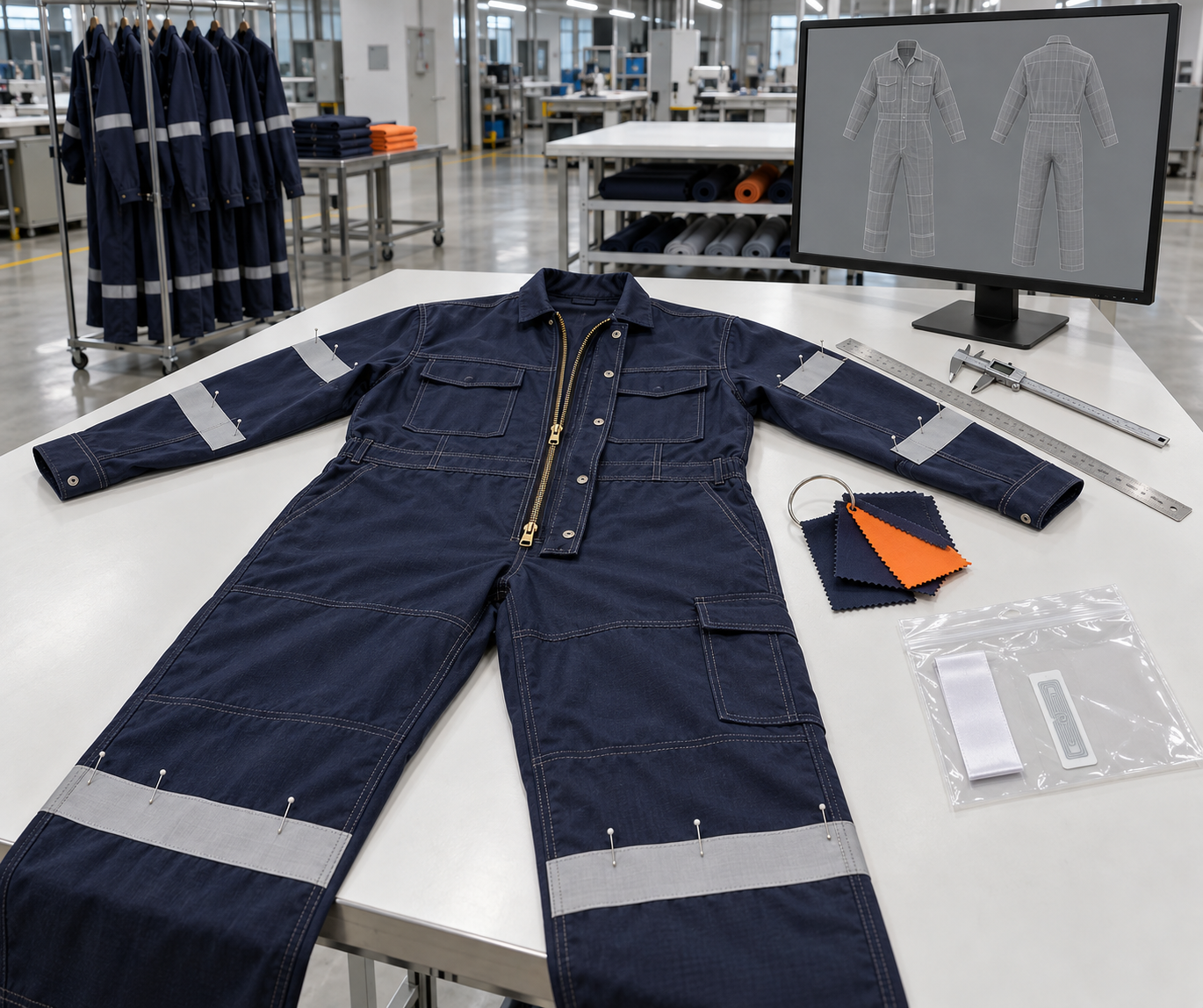
United States buyers evaluating custom coverall OEM digital integration readiness should require proof of a single authoritative specification record before authorizing cutting: the digitized tech pack, the visual mockup used for sign-off, the bill of materials (BOM), and the lot compliance records destined for import receiving. In this manufacturing environment, digital integration readiness means these records transfer between development systems and order-execution platforms without manual re-entry of measurements, trim specifications, or regulatory labeling fields. A supplier portal login is merely an interface, not an integrated data pipeline, and nothing in this analysis indicates that Vanta Workwear or any quoting manufacturer possesses third-party enterprise software credentials.
This analysis is authored for Vanta Workwear by Vincent Xi, Editorial Author (https://www.vantaworkwear.com/authors/vincent-xi/). It relies exclusively on publicly documented industry implementations and published manufacturer workflows to establish procurement verification checkpoints. It does not reflect a proprietary factory audit, private client program, wear trial, or internal facility certification.
United States Order Controls for Custom Coverall Manufacturing Data
For a United States procurement team, custom coverall production data must successfully cross three distinct stages of procurement control: initial technical approval, factory cutting release, and physical warehouse receiving against the purchase order. Landed cost stability and strict delivery windows depend directly on change control. If adjustments to reflective tape width, zipper gauge, chest pocket placement, or mandatory country-of-origin and care labeling are communicated via email rather than committed to a versioned BOM, the buyer cannot prove which revision was authorized when garments arrive at a United States distribution center.
Procurement specifications should prioritize structured data payloads rather than proprietary software brands. An effective custom coverall manufacturing record specifies the base style code, graded size matrix, fabric mill code and finished width, stitch density and seam constructions, reflective tape placement coordinates, hardware specifications, thread types, labeling text, packaging breakdown, and the exact cut-ticket revision number. Industry analysis of workwear digital architectures demonstrates that enterprise resource planning (ERP) and product lifecycle management (PLM) systems require direct API connectivity to establish an immutable record from concept through disposal, leveraging bidirectional synchronization, automated payload validation upon exchange, phased translation middleware for legacy systems, and extended data tracking across the personal protective equipment (PPE) supply chain (PCIAW). This architecture addresses widespread supply-chain fragmentation; it does not constitute a statutory requirement for all United States orders, nor does it describe Vanta Workwear's internal infrastructure. Sourcing teams should identify the data fields their customs brokers, compliance auditors, and warehouse management systems require, then mandate that each field be mapped to a system of record in the OEM quotation.
Data integrity directly governs shipping reliability. An ex-factory date or port arrival schedule is enforceable only if carton labeling, size breakdowns, and garment revision tags match the digital purchase order line items. This document quotes no estimated freight rates, customs tariffs, or base unit costs, as such figures vary by commercial contract and are omitted from the reference sources. Buyers must evaluate transit schedules and landed cost estimates as independent quotation lines requiring empirical verification.
Digital Integration Readiness Checks That Belong in the Manufacturing File
Digital integration readiness is measurable through practical file audits. An OEM offer should be evaluated on whether engineering staff can export the approved production package without manual transcription, whether the receiving ERP validates incoming data before overwriting the cut ticket, and whether post-production test files correlate with that exact revision number.
One published custom coverall manufacturing workflow indicates that customer-submitted tech packs, sketches, or physical reference samples are converted into digitized, production-ready specifications with millimeter tolerances, and that comprehensive 3D visual renderings showing branding, tape, and hardware configurations, accompanied by physical fabric swatches, are delivered within a 48-hour window for customer sign-off (Lantao Work). Sourcing teams must preserve these analytical boundaries: the response time unit is hours (48 hours), representing that specific supplier's published OEM turnaround for digital mockups and swatches without an external audit date; the tolerance unit is the millimeter (mm), reflecting that vendor's digitization threshold. Neither metric represents a baseline standard for Vanta Workwear. Sourcing teams must not treat these metrics as universal industry baselines without contractual commitment from their prospective manufacturer.
In an enterprise case study, Workwear Outfitters implemented a unified PLM platform across eleven brands and twelve production sites to establish a single operational source of truth, systematically replacing fragmented legacy tools so design specifications cascade directly into production, with planned integration into 3D environments such as Browzwear to visualize garments using actual production materials stored within the PLM database (The Interline, 20 February 2026). The scope of this implementation is eleven brands and twelve production facilities as reported on 20 February 2026, which illustrates an enterprise configuration rather than a universal standard for all coverall factories. The practical takeaway for buyers is structural: a single authoritative data source, verified production materials, and digital visualization directly linked to those material records.
Example calculation (illustrative planning assumption, not an empirical lead time): if an OEM quote promises a 48-hour rendering turnaround for technical review, an uncorrected discrepancy in reflective tape placement or pocket hardware triggers an additional 48-hour correction cycle, resulting in an estimated 96 hours of pre-production digital review before manufacturing authorization. Sourcing teams must verify actual lead times and change-order fees directly in the supplier's quotation before setting production schedules.
From Submitted Tech Pack to a Reviewable Digital Spec
Evaluating an OEM's digitization process requires auditing the digital artifacts generated between initial tech-pack submission and final pattern grading. The cited sources outline an orderly progression of technical documents, not a universal factory standard.
The procurement-controlled baseline is the initial tech pack, physical reference garment, or CAD sketch submitted by the buyer. Sourcing vulnerabilities emerge when a 3D digital mockup introduces branding placements, trim selections, or tape dimensions that have not been assigned unique part numbers in the formal tech pack. The referenced manufacturer workflow states that 3D digital renderings prepared within 48 hours explicitly visualize branding, reflective tape, and closure hardware alongside physical swatches. Sourcing teams should require the manufacturer's visualization output to reference the specific tech-pack revision code in its metadata, rejecting mockups that exist as detached image files.
Millimeter-level dimensional tolerances are critical for high-movement coverall stress points: sleeve outseams, torso trunk length, inseam drop, heavy-duty zipper length, retroreflective tape margins from seam lines, and collar reinforcement heights. Broad commercial references to millimeter precision do not establish acceptable variance thresholds. Sourcing teams must define specific numeric tolerances in millimeters (for example, illustrative tolerance assumptions such as ±3 mm or ±5 mm, which must be verified against supplier quotation capabilities) across all critical grading dimensions directly within the RFQ schedule.
Physical textile swatches bridge digital models with production reality. The documented OEM process pairs digital rendering reviews with physical fabric swatches. Sourcing personnel must confirm that the physical swatch's lab-dip code and mill lot number match the material ID embedded in the digital pattern file. When sourcing programs intend to utilize 3D visualization systems that read production fabric properties, as documented in the Workwear Outfitters deployment, buyers should verify whether the digital file utilizes true fabric mechanical properties (drape, weight, tensile behavior) or a generic visual texture. Because that reference describes the 3D link as a planned technical integration, buyers must verify its deployment status with prospective suppliers.
PLM-to-ERP Exchange, Lot Documents, and Item-Level Marks
Technical literature underscores that automated API integration between PLM and ERP systems ensures a single data payload persists from design through garment distribution, providing the technical basis for Digital Product Passports. Key structural requirements include bidirectional data synchronization, schema validation at the point of exchange, temporary middleware layers for legacy infrastructure, and traceability extensions across PPE supply chains (PCIAW). In custom coverall manufacturing, these mechanisms prevent divergence between the technical design package and the warehouse receiving manifest.
Bidirectional exchange ensures that changes to size-ratio allocations made in an order-entry system feed back to fabric-consumption markers in the tech pack, while material substitutions in the factory BOM immediately update the commercial purchase order. Schema validation ensures that the production database automatically rejects incomplete files—such as an export omitting flame-resistant thread specs—rather than generating cut tickets from incomplete data. Sourcing teams should treat supplier claims of full system integration as unverified until demonstrated in pre-production data exchange tests.
Traceability data for protective workwear must be tied to specific production lots. Published custom coverall capabilities state that production can be validated with lot-specific ISO 17025 laboratory test certificates and compliance documentation (Lantao Work). ISO/IEC 17025 evaluates testing and calibration laboratory competence; a laboratory report does not represent factory certification, nor does a website claim guarantee a valid accreditation scope. United States buyers purchasing flame-resistant, arc-rated, or high-visibility coveralls must require the specific test report number, testing standard, fabric roll identifier, and verification that the issuing laboratory maintains active ISO/IEC 17025 accreditation for that specific test method. Laboratory credentials must be audited separately from sewing factory qualifications.
Item-level electronic tracking, such as embedded RFID transponders, represents an advanced data gate. None of the referenced sources indicates standard RFID integration into custom coverall production lines. If an enterprise buyer requires RFID or 2D data-matrix tagging for uniform management, the procurement team must specify the inlay model, thermal and laundering survival thresholds, encoding format, attachment method, and corresponding ERP receiving field. Sourcing teams should treat automated tracking capabilities as non-standard unless verified through scanned prototype samples.
Digital Product Passport attributes represent structured data fields tied to specific custodial controls. While industry frameworks position passport architectures as a method for maintaining garment lineage through end of life, specific mandatory fields depend on governing legal jurisdictions and commercial client mandates. This guidance focuses strictly on United States corporate and municipal procurement; it does not interpret foreign passport mandates. If an RFQ does not contractually require passport data, buyers should omit these data layers to prevent unnecessary engineering costs and production delays.
Buyer Decision Table
This decision table provides a structured framework for evaluating custom coverall OEM digital integration readiness. The evidence column references published operational workflows and industry case studies; it does not represent an internal capability rating for Vanta Workwear.
| Procurement Decision | Specify in the RFQ | Baseline Industry Comparison | Verification Prior to PO Release |
|---|---|---|---|
| Specification Authority | Authoritative system of record (PLM, ERP, or CAD), revision ID, and cut-authorization rules | Manual specification re-entry vs. automated API transmission | Sample digital export matched precisely against the approved revision number |
| Tech-Pack Digitization | Graded size scale and dimensional tolerance limits in millimeters (mm) | Published millimeter-tolerance conversion workflows (Lantao Work) | Factory grading sheet matches buyer-specified points of measure with explicit ±mm tolerances |
| Visual Sign-Off | Renderings displaying branding, retroreflective tape layouts, and closure hardware | Published 48-hour OEM turnaround for 3D renderings and fabric swatches | Digital rendering files state approved revision ID; swatch batch codes recorded in the BOM |
| Material Simulation | Mill roll identification, dye lot, and physical textile properties | Planned integration of production mill materials into 3D visualization (The Interline) | Digital pattern metadata references the exact mill material code, not a placeholder texture |
| PLM-to-ERP Handshake | Mandatory data schema, BOM fields, and bidirectional synchronization protocols | Industry framework: direct APIs, automated schema validation, phased middleware (PCIAW) | Test exchange demonstrating automated rejection of files omitting required compliance fields |
| Lot Certification | Relevant test method, fabric roll/lot identifier, and accredited laboratory ID | Supplier workflow offering lot-specific ISO 17025 test documentation | Active laboratory accreditation scope verified; report numbers match delivered production lots |
| Electronic Tracking (RFID) | Chip frequency, placement, laundering durability limits, and encoding schema | No baseline implementation documented in industry workwear references | Laboratory or prototype scan test verified in buyer warehouse management software |
| Engineering Change Control | Designated personnel authorized to approve BOM revisions and cut tickets | Automated downstream change cascading vs. informal email instructions | Written contract clause prohibiting factory cutting from unconfirmed revision files |
| United States Inbound Receiving | Carton marking keys, size breakdowns, and revision numbers matching purchase orders | Commercial receiving data matching upstream manufacturing records | Verification that carton packing slips scan directly into ERP without spreadsheet cross-referencing |
| Production Schedule Modeling | Factory-specific CAD processing, sample approval, and production lead times | Illustrative calculation: 48h initial review + 48h revision loop = assumed 96h digital review | Firm production timeline and revision penalties established in formal quotation |
RFQ Checklist
- Ask the supplier to identify its primary digital system of record for custom coverall tech packs and confirm in writing that cut tickets are generated solely from the signed revision.
- Require the manufacturer to provide a digitized specification sheet detailing all buyer-defined points of measure alongside explicit plus-or-minus tolerances in millimeters.
- Specify that visual submission packages include high-resolution renderings detailing branding, tape placement, and hardware closures, paired with physical fabric swatches carrying identical material codes.
- Ask the supplier to quote its standard turnaround time in hours for digital mockup revisions and state whether published 48-hour turnarounds apply to the proposed garment complexity.
- Require the manufacturer to confirm whether 3D garment visualization files utilize true production fabric codes or visual approximations, documenting the material reference in the approval record.
- Specify the exact digital fields that must transfer between PLM and ERP databases without manual re-keying, including style number, revision index, size breakdown, fabric code, trim specs, and care labeling text.
- Ask the supplier to demonstrate system-level data validation by transmitting a test file missing mandatory technical fields to verify automated schema rejection.
- Require the manufacturer to disclose whether legacy system middleware is utilized in its data pipeline, identifying the legacy software involved and the timeline for native API implementation.
- Specify mandatory lot documentation criteria for receiving: standard test method, accredited laboratory report number, production lot or roll ID, and evidence of current ISO/IEC 17025 laboratory accreditation for that method.
- Ask the supplier to separate sewing facility compliance claims from testing laboratory accreditations, submitting only third-party test reports traceable to the production lot.
- Require the manufacturer to provide written confirmation if RFID inlay insertion or barcode encoding is excluded from scope or, if included, provide detailed specifications on placement, laundering durability, and sample scan validation.
- Specify United States destination terms, size-by-carton packing criteria, and carton labeling data keys that must match the purchase order revision before shipment authorization.
- Ask the supplier to separate base garment production costs from digital passport or advanced data tracking fees, quoting optional data tracking layers as separate line items.
- Require the manufacturer to define the formal approval protocol for technical changes following initial sign-off, confirming that email requests cannot authorize cut-ticket modifications.
Methodology, Source Context, and Limits
Methodology note: this technical analysis was prepared through a structured synthesis of three publicly available industry references and contains no search-volume, keyword-demand, difficulty, or ranking metrics. The first source context is PCIAW's technical analysis of digital workwear supply chains, used to evaluate PLM-ERP interoperability: bidirectional API synchronization, automated schema validation, phased translation middleware, PPE tracking extensions, and passport-style data continuity. The second source context is Lantao Work's published custom coverall manufacturing process, cited exclusively for its documented workflow involving tech-pack conversion to millimeter-tolerance specifications, 48-hour digital rendering and swatch turnarounds, and lot-specific ISO 17025 laboratory documentation. The third source context is The Interline's report (published 20 February 2026) regarding Workwear Outfitters' enterprise PLM rollout across eleven commercial brands and twelve manufacturing facilities, demonstrating single-source-of-truth architectures and planned 3D fabric integration. The author of this synthesis is Vincent Xi, Editorial Author (https://www.vantaworkwear.com/authors/vincent-xi/). These sources do not document direct factory audits or proprietary product trials; consequently, no first-person operational claims are made.
Scope limitations and verification criteria: the cited sources do not audit Vanta Workwear facilities and provide no authorization for claims that Vanta Workwear operates proprietary PLM interfaces, automated ERP APIs, 3D simulation tools, RFID encoding operations, or accredited testing laboratories. The 48-hour turnaround and millimeter tolerance specifications represent published manufacturer claims and have not been independently tested. The eleven-brand and twelve-facility statistics describe a single corporate group as reported on 20 February 2026 and do not constitute an industry median for workwear manufacturing. ISO/IEC 17025 designates laboratory competence; promotional references on manufacturer websites do not constitute current accreditation certificates. Discussion of Digital Product Passports reflects system architecture analysis rather than statutory requirements for United States commercial procurement. The 96-hour timeline represents an illustrative compounding calculation (48 hours initial review plus 48 hours revision cycle) for procurement risk modeling, not a measured lead-time guarantee. Sourcing professionals must verify specific interface protocols, digital exports, physical swatch batches, tolerance matrices, laboratory accreditation scopes, and landed commercial terms directly within their prospective supplier's binding quotation.
Discuss Your Requirements
Review our manufacturing capabilities, then share your specifications for a supplier-fit review.