Custom Coverall Sourcing Sustainability Sourcing Criteria for United States Buyers
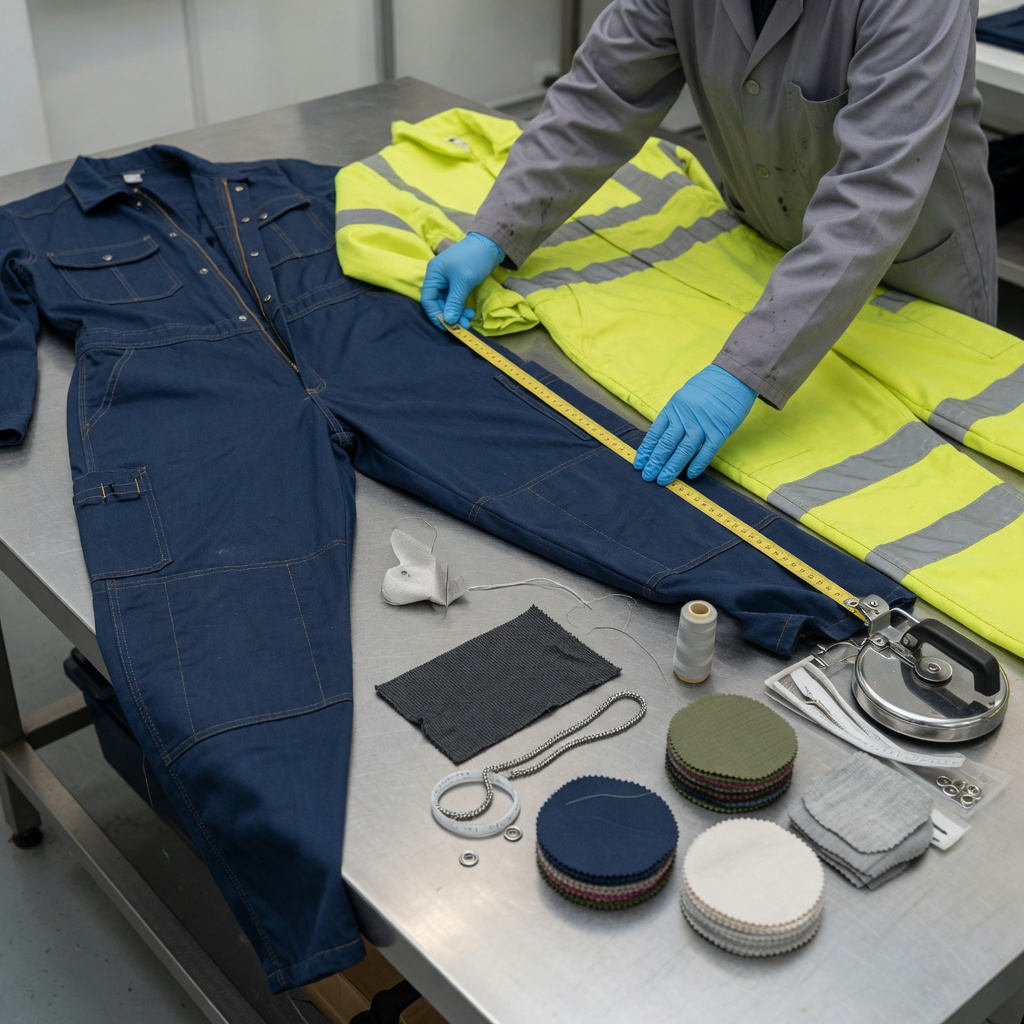
What United States buyers should freeze before a custom coverall RFQ
By Vincent Xi, Editorial Author Author profile
United States B2B buyers should freeze the proof behind a recycled-content, organic-fiber, restricted-substance, or mixed claim before they request a custom coverall sample. In custom coverall procurement, mill price is not the first decision. The purchase order has to substantiate the claim at lot level, and United States fiber-labeling and environmental-marketing rules still have to be true on the hangtag.
Put that proof in the contract: claim type and bill-of-materials (BOM) scope; current scope certificates plus transaction certificates (TCs); chemical coverage of every component; retained audit files; and the U.S. label pack. A mill that can sew a coverall is not automatically qualified to support a recycled, organic, or “eco” claim. Uncertified “recycled-look” polyester cannot back a truthful environmental claim in United States marketing or in a customer sustainability questionnaire.
GRS recycled polyester and GOTS organic cotton support a claim only when TCs match the fabric lots actually shipped. Stretch and summer-weight styles add a product-appendix check: elastane and some constructions may sit outside a given organic or recycled scope. Split the BOM (certified shell, conventional stretch panels) or specify a documented recycled stretch blend and reduce organic-cotton share—only after the mill confirms in writing which BOM lines sit on the current scope certificate and product appendix.
The sections below turn those choices into RFQ lines, a specify–compare–verify table, a weighted scorecard, United States landed-cost and delivery controls, and a mandatory attachment list.
Sustainability sourcing criteria for custom coverall sourcing
For custom coverall sourcing, sustainability sourcing criteria belong in the tech pack and the purchase contract, not in a brand paragraph.
- Claim type and scope. State whether the claim is recycled content, organic fiber, restricted-substance chemistry, or a mix. State whether it applies to the shell only, to lining, or to the full garment, including thread, labels, pocketing, zippers, buttons, elastic, and reflective tape.
- Standard versus practice. Name a standard only when the mill must hold a current scope certificate. Distinguish the standard’s rules (what GRS or GOTS requires for a recycled or organic claim) from a factory’s own practice (an internal restricted-substance list). Do not treat a website badge as certification.
- Lot-level chain of custody. Require TCs for GRS and GOTS lots, not only an annual facility certificate.
- Chemical coverage of all components. If OEKO-TEX STANDARD 100 or an equivalent restricted-substance program is specified, require coverage of trims, not only the shell fabric. A workwear sustainability briefing treats GOTS, GRS, and OEKO-TEX as contract requirements in tenders and states that buyers should verify certificates with issuing bodies and ensure all components, including trims, meet the stated eco criteria (Sustainability in Workwear: Why Buyers Can’t Ignore Eco Standards Anymore).
- Due-diligence file. For United States companies that also operate in Europe, retain supplier due-diligence documents that legal counsel maps to the EU Corporate Sustainability Due Diligence Directive (CSDDD). A Bangladesh workwear sourcing guide asserts that CSDDD-related files include RMG Sustainability Council (RSC) monitoring reports, GRS or GOTS fabric certificates, OEKO-TEX STANDARD 100 covering all components, and ISO 9001 (Sustainable Workwear Bangladesh: B2B Sourcing Guide 2025). Treat that list as one manufacturing-origin interpretation, not as a sales-market invitation. RSC reports are Bangladesh sector-monitoring products, not a universal CSDDD form, and ISO 9001 is a quality-management system—not a sustainability claim.
If a factory cannot produce the matching certificate number, validity window, product appendix, and TC for the shipped lot, the sustainability line item is not met—regardless of fabric hand-feel.
Buyer decision table: specify, compare, verify
Use this table in mill comparison. Every row is an RFQ or approval action for custom coverall procurement.
| Decision | Specify in the RFQ | Compare across mills | Verify before production approval | Order / shipment control |
|---|---|---|---|---|
| Recycled polyester claim | GRS (or a stated alternative) recycled content % by mass, per BOM line | Scope-certificate entity, product appendix, % offered, TC fee and lead time | Certificate database check; greige vs finished quality | TC number on invoice and packing list; mismatch = hold shipment |
| Organic cotton claim | GOTS fiber % by mass; whether a GOTS product label is allowed | Organic share vs blend; chemical inputs; label rules | Scope + TC; confirm label language against the standard’s rules | No GOTS mark on carton if the product is not GOTS-labeled |
| Restricted substances | OEKO-TEX STANDARD 100 (or named equivalent) covering all components including trims | Class, components listed, report date vs colorway | Certificate covers zipper, thread, tape, labels | Retest on color or trim change |
| Stretch / summer-weight | Elastane %; finished GSM; mechanical tests | Whether stretch panels are inside or excluded from the claim | Lab dips + GSM-cutter results on bulk | Fail lot if GSM or elastane % is outside tolerance |
| Social / due diligence | Named audit type, date limit, subcontractor disclosure | Report completeness; open findings; RSC or other sector reports if used | Full report under NDA; legal mapping if CSDDD-relevant | No unauthorized subcontracting |
| QC | AQL, measurement chart, critical defects (needle, seam, HV tape) | In-line vs final only; retained-sample policy | Pre-production sample sign-off; in-line plan | Final inspection before ship |
| U.S. label pack | Fiber %, RN/WPL if used, care, origin, any certified-content sentence | Artwork accuracy vs BOM | Compliance review of hangtag claims | Carton and garment labels match signed artwork |
| Logistics to the United States | Incoterms, port, carton cube, document set including TCs | Transit time vs TC issuance time | Booking only after the document checklist is complete | Collect documents at cargo handover |
Chain-of-custody documents versus greenwashing claims
Greenwashing risk on a custom coverall is a lot-file problem, not a presentation problem. Write these typical failure modes as hold-or-fail rules in the purchase contract:
- A facility GRS or GOTS certificate exists, but the coverall fabric is not on the product appendix.
- Recycled-content percentage is stated on a quote sheet but no TC follows the roll or the cut.
- Shell fabric is certified; sewing thread, pocketing, or fluorescent tape is not.
- “Organic cotton blend” is used when the organic share is not quantified by fiber mass.
- Test reports are outdated, on a different colorway, or on greige fabric rather than the finished, dyed, and printed quality.
- The legal entity on the certificate does not match the commercial invoice.
- Hangtag language exceeds the fiber label or the TC percentage.
A United States procurement team can run these checks without visiting a mill:
- Collect the scope certificate PDF and check the legal entity name against the commercial invoice.
- Confirm the standard version and expiry date printed on the certificate; do not assume a calendar year still equals a valid document. Re-check on the purchase-order date and again before shipment.
- Match fiber, GSM, and color references on the TC to the packing list.
- Require the mill to identify the certification body and allow the buyer to confirm certificate status through that body’s public database.
- Keep a copy of each TC in the shipment file for U.S. customer audits and for any environmental marketing review under the FTC Green Guides.
The same Bangladesh manufacturing-origin guide states that GRS recycled polyester and GOTS organic cotton apply to coveralls and that transaction certificates are mandatory for verification against EU and GCC tender specs (Sustainable Workwear Bangladesh: B2B Sourcing Guide 2025). United States private-sector buyers are not automatically bound by those tender templates, but TCs remain the practical way to prove a fiber claim. If the U.S. buyer has European operations, counsel should map which documents belong in a CSDDD due-diligence file. That mapping is a legal-retention control—not an invitation to source or sell outside the United States program.
Do not accept mill marketing PDFs or “equivalent to GRS” language as substitutes for TCs.
Fabric, stretch, and summer-weight specs to freeze
Sustainability claims collapse when the fabric block is vague. Freeze construction before price.
Shell. Specify fiber percentages by mass, weave or knit, finished GSM, usable width, color standard, and shrinkage. An example summer-weight shell of 200 g/m² (grams per square meter; scope: finished fabric; as-of: quote assumption to verify in the mill test report and supplier quote) is not a regulatory minimum and not a house specification.
Recycled polyester (GRS). State recycled content as a percentage by fabric mass for each BOM line. An example assumption of 50% GRS recycled polyester by weight for the shell only (unit: percent by mass; scope: shell fabric line, not automatically thread or trims; as-of: quote assumption to confirm on the TC and mill invoice), with other fibers making up the balance, must be confirmed on the TC and the mill invoice. If the coverall uses recycled filament sewing thread, that is a separate GRS line.
Organic cotton (GOTS). State organic cotton as a percentage by mass and whether the product is intended to carry a GOTS product label (additional chemical, social, and labeling rules) or only to use GOTS-certified fiber in a blend that will not carry that label. Those two outcomes are not interchangeable.
Stretch coveralls. Elastane can sit outside GOTS product labeling and can complicate recycled-content accounting. Specify elastane percentage by mass (an example assumption of 2% elastane by weight in a stretch panel is to be verified in the quote; unit: percent by mass; scope: named stretch panel unless the RFQ says full garment), name whether stretch is in the full garment or in articulated panels, and state whether stretch panels are excluded from the certified-content claim.
Summer-weight coveralls. Lower GSM can improve heat comfort and can increase tear and seam-slippage risk. Require a named tensile, tear, and seam-slippage method (ASTM or ISO) and a minimum result stated in the RFQ. Those mechanical minima are quality gates, not sustainability certificates.
A China custom-workwear sourcing guide states that buyers must prepare a tech pack defining fabric blend, GSM, colors, size charts, and compliance such as ANSI/ISEA 107 or EN ISO 20471 (How to Sourcing Custom Workwear From China? Reliable Makers). If the custom coverall is high-visibility for United States road or utility work, ANSI/ISEA 107 is a performance standard; it does not replace GRS, GOTS, or OEKO-TEX. EN ISO 20471, named on that cited page, is a different performance standard and does not replace U.S. ANSI/ISEA 107 or a fiber certificate. Do not imply that a visibility class is a recycled-content claim.
Weighted supplier scorecard for certificates, QC, and audits
Use a numeric scorecard so a “sustainable factory” label cannot hide weak QC or opaque subcontracting. The China sourcing guide lists seven factory-ranking dimensions: Compliance Fit, Workwear Specialization, MOQ Fit, Sampling Speed, Audit Transparency, QC Maturity, and Logistics Readiness, and it calls for fiber traceability and BSCI audits (How to Sourcing Custom Workwear From China? Reliable Makers). Those seven dimensions (unit: dimensions; scope: the cited guide’s ranking model; as-of: as listed on that page) are a useful skeleton. They are not a certification.
Example weight set (example calculation to align with the buyer’s risk policy, not a universal rule; unit: percent of 100; scope: internal mill-comparison model; as-of: replace with the buyer’s procurement policy). Fiber traceability is added as a scored line because the same cited guide calls for it; MOQ Fit and Sampling Speed from that seven-dimension list are combined in this example:
| Dimension | Example weight (% of 100) | Evidence that scores well |
|---|---|---|
| Compliance and certificate fit | 25 | Current GRS/GOTS/OEKO-TEX scopes match the BOM; TCs available per lot |
| Audit transparency | 20 | Named audit (for example BSCI) with date, full report under NDA, subcontractor list |
| QC maturity | 15 | AQL plan, in-line and final inspection, retained samples, needle/metal control |
| Workwear specialization | 10 | Coverall construction library: bartacks, double-needle, knee, radio, tool loops |
| Fiber traceability | 10 | Roll-to-cut mapping; TC numbers on the commercial invoice |
| MOQ and sampling speed | 10 | Stated MOQ by color and size run; sample calendar in calendar days |
| Logistics readiness | 10 | Carton specs; packing-list fields for certificate numbers; U.S. port document experience |
Scoring rule (example): score each dimension 0–5 (unit: points; scope: each scorecard dimension; as-of: example scoring rule to replace with the buyer’s procurement policy), multiply by the weight, and set a go/no-go floor—for example, any 0 on certificates or audit access fails the mill even if the total is high. Verify that floor in internal procurement policy. BSCI is a social-audit scheme; it does not prove recycled content. ISO 9001 does not prove GOTS. Keep the instruments on separate scorecard lines.
United States labeling, landed cost, and delivery controls
United States custom coverall programs fail sustainability reviews when the garment is certified at origin and mislabeled on arrival.
Fiber and care labeling. The Textile Fiber Products Identification Act and FTC care rules require accurate fiber percentages and care instructions on goods sold in the United States. Recycled and organic words on a hangtag are marketing claims; they must match the fiber label and the substantiation (TCs, test reports). Do not print “100% recycled” if only the shell meets an example 50% GRS line (unit: percent by mass; scope: shell only unless the TC says otherwise; as-of: quote assumption to verify). Confirm current FTC labeling text with counsel; this page does not replace that review.
Environmental marketing. U.S. environmental claims are expected to be specific and substantiated under the FTC Green Guides. “Sustainable coverall” without a defined criterion is a risk. Prefer a sentence limited to what the TC will support, and only after the TC exists.
PPE and visibility (only if specified). If the coverall is PPE, OSHA rules and the chosen performance standard apply in addition to sustainability documents. ANSI/ISEA 107 remains a performance standard; it does not certify recycled content.
Landed cost. Sustainability upgrades change more than FOB fabric cost: TC administration, possible lower mill capacity, possible air freight on first lots, and duty that still follows HTS fiber and construction. Woven coveralls are typically reviewed under Harmonized Tariff Schedule of the United States (HTS) Chapter 62 (woven apparel) as a broker starting point (unit: HTS chapter; scope: woven apparel classification family, not a binding ruling for a finished BOM; as-of: confirm with a licensed U.S. customs broker on the PO date). The exact heading, ad valorem duty, merchandise processing fee, and harbor maintenance fee depend on fiber, construction, gender category, and country of origin. Do not use a catalog average. Obtain a licensed U.S. customs broker opinion (or a binding ruling) for the finished BOM.
Example landed-cost skeleton (example calculation to complete with the broker and forwarder, not a quote; unit: USD per piece unless noted; scope: one finished custom coverall lot into a United States port; as-of: replace with broker and forwarder figures on the PO date):
- Unit FOB (USD per piece) from the supplier
- International freight (USD per piece, based on carton cubic meters and mode)
- Insurance (USD per piece)
- U.S. duty (percent of dutiable value, from the broker for that HTS)
- MPF and HMF (USD, as applicable)
- Domestic drayage and warehousing (USD per piece)
Delivery. Put certificate-pack lead time on the same calendar as sewing lead time. A coverall that ships without TCs is late for a sustainability-controlled PO even if cartons arrive on the requested date. Require TCs, packing list, commercial invoice, mill test reports, and inspection report as one shipping-document set, issued before cargo handover. A GRS or GOTS certificate does not replace U.S. origin marking.
Document-gate risk controls. Do not book ocean or air freight until the document checklist is complete. Hold the shipment if any of the following occur: certificate entity mismatch; product appendix does not list the shipped quality; TC numbers absent from the invoice or packing list; OEKO-TEX (or named equivalent) omits a trim; hangtag claim exceeds the fiber label or TC; unauthorized subcontracting; GSM or elastane outside the signed tolerance; inspection not completed before ship.
Practical RFQ checklist for custom coverall procurement
Issue the following as mandatory attachments. Each item is something a buyer specifies, compares, verifies, approves, or orders.
- Tech pack: style, size set, measurement tolerances, construction notes, and a BOM with fiber % by mass for shell, lining, pocketing, thread, and trims.
- Finished GSM target and tolerance in g/m²; if using the 200 g/m² summer-weight example, mark it as a quote assumption until the mill confirms.
- Recycled-content line: standard (GRS unless another is justified), % by mass, BOM lines included and excluded.
- Organic-content line: GOTS fiber %; yes/no on GOTS product labeling.
- Elastane % and location (full garment vs panels); state whether stretch panels are outside the certified claim.
- Color standards and whether each colorway needs its own chemical certificate.
- Certificate pack: current facility scope certificates; product appendices; last two TCs on comparable fabric, redacted, as a capability sample (example count; unit: certificates; scope: comparable fabric capability sample; as-of: replace with the buyer’s document policy).
- Authorization for the buyer to validate certificate numbers with the issuing body.
- OEKO-TEX STANDARD 100 or named equivalent covering all components, including trims, with certificate numbers.
- Restricted-substance and California Proposition 65 position as they apply to finished goods and U.S. distribution—do not paste an EU-only clause without review.
- Social-audit report (for example BSCI) dated within the buyer’s stated window, plus a subcontractor list for embroidery, washing, or reflective-tape application.
- If counsel wants Bangladesh sector monitoring for a manufacturing-origin mill in that market, request RSC monitoring reports as extra evidence—not as a substitute for GRS/GOTS TCs (Sustainable Workwear Bangladesh: B2B Sourcing Guide 2025).
- QC plan: AQL, in-line frequency, needle detection, measurement audit, and photo protocol.
- Pre-production sample calendar in calendar days from deposit, and bulk lead time in calendar days from sample approval and TC-ready fabric.
- MOQ by color and by size run; surcharge table for below-MOQ (figures must come from the mill quote).
- U.S. label pack: fiber, care, origin, and any certified-content sentence limited to what TCs will support.
- If high-visibility is in scope: ANSI/ISEA 107 class and color, written on a separate line from sustainability claims (How to Sourcing Custom Workwear From China? Reliable Makers).
- Incoterms, preferred U.S. port or airport, carton specs, and a document set that lists TC numbers.
- Right to inspect, right to reject lots that fail certificate match, and a stated corrective-action window in calendar days.
- Landed-cost worksheet fields for FOB, freight, insurance, duty, MPF/HMF, and inland—values to be completed with a U.S. broker, not estimated here.
- Record retention: mill must keep lot files for a stated period (example assumption: 24 months from ship date—unit: months; scope: lot files tied to TCs, inspection reports, and label artwork; verify in the contract) so U.S. customer audits can be answered.
How this briefing was compiled and what to verify
Author note. Visible byline: Vincent Xi, Editorial Author, https://www.vantaworkwear.com/authors/vincent-xi/. No factory visit, wear trial, laboratory test, client name, award, or first-person production story is attached to this page.
Methodology. This briefing is editorial research for United States custom coverall procurement. It draws on three published B2B pages: a Bangladesh sustainable-workwear sourcing guide discussing CSDDD-related document lists, GRS/GOTS, OEKO-TEX, ISO 9001, and transaction certificates; a China custom-workwear sourcing article describing tech packs, a seven-dimension factory scorecard, fiber traceability, and BSCI; and a sustainability-in-workwear article describing GOTS, GRS, and OEKO-TEX as contract requirements, certificate verification with issuing bodies, and component-level coverage. Named public instruments (GRS, GOTS, OEKO-TEX STANDARD 100, ISO 9001, BSCI, ANSI/ISEA 107, EN ISO 20471, FTC labeling and Green Guides, OSHA PPE rules, U.S. HTS Chapter 62, CSDDD, California Proposition 65) are identified as standards or laws. Their requirements are distinguished from any one factory’s practice. No mill was tested for this page, no prices were collected, and no certification status is claimed for any manufacturer.
Limitations / what to verify. Certificate databases, standard versions, CSDDD applicability thresholds and timelines, U.S. duty rates, and audit-scheme protocols change. Confirm every certificate number and expiry with the issuing body on the PO date and again at shipment. Confirm CSDDD document expectations with qualified counsel if the U.S. buyer has European operations. Confirm HTS, duty, and fees with a licensed U.S. customs broker for the actual BOM. Confirm ANSI/ISEA 107 only if the garment is specified as high-visibility. Example GSM, elastane %, recycled-content %, scorecard weights, score points, TC sample count, and record-retention months in this briefing are assumptions to replace with the supplier quote and the buyer’s policy. This page does not certify products, does not replace legal advice, and does not document a factory visit, laboratory test, award, or customer outcome.
Discuss Your Requirements
Review our manufacturing capabilities, then share your specifications for a supplier-fit review.