FR Clothing OEM Communication Workflow Review for United States Buyers
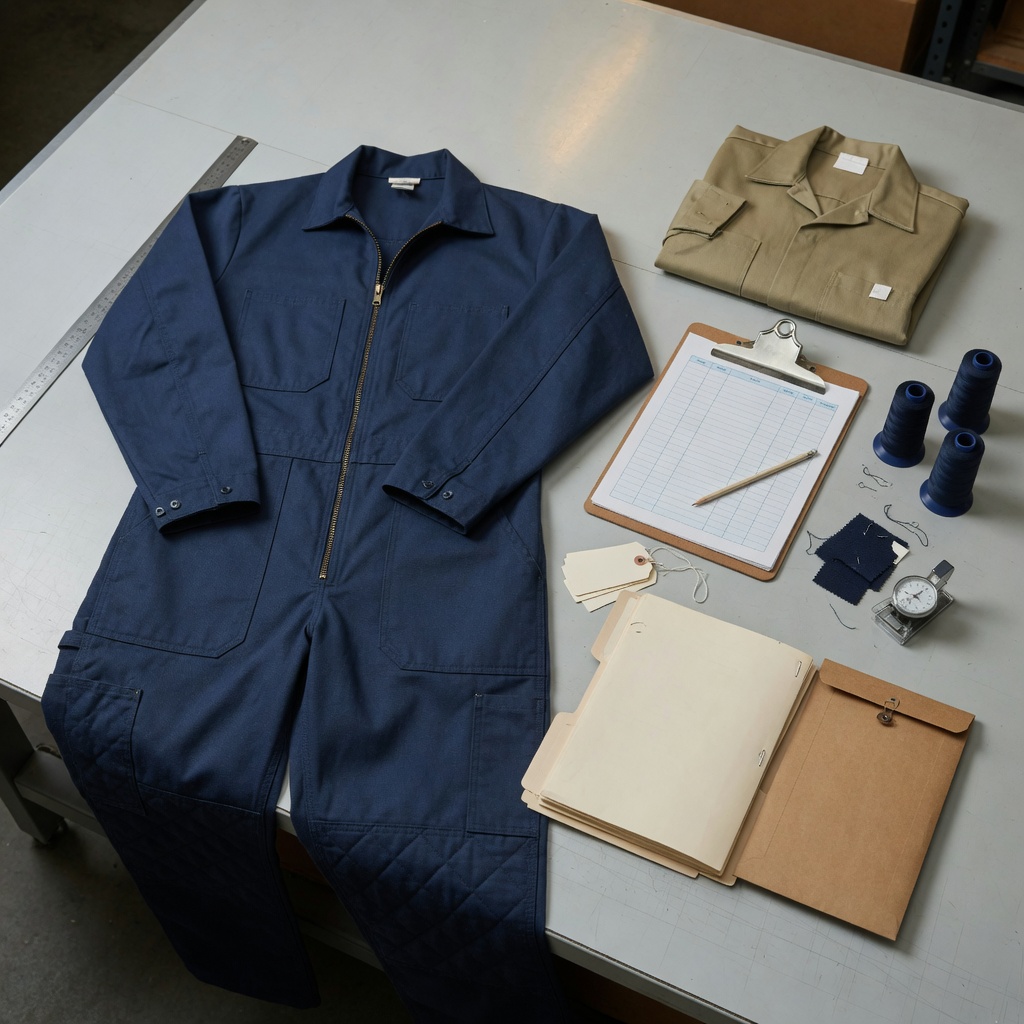
A United States B2B buyer should treat an FR clothing OEM communication workflow review as a manufacturing gate, not a post-award courtesy. Do not release bulk fabric, findings, or cut tickets until a written protocol names a technical owner and backup, defines the contractual channel and response clocks, version-controls the tech pack, records every sample revision with measurements and photos, transmits lot-level traceability and certification files with each shipment, and uses a paid pilot to score garment quality and supplier responsiveness under production load.
Approve a paid pilot only after the OEM returns that written workflow. Approve bulk cut only after the pilot passes product inspection and a communication scorecard covering time-to-acknowledge, time-to-close, lot-file completeness, and undocumented substitutions. Reject the OEM if technical questions route only through sales, if the tech pack is not versioned, or if lot certificates cannot be mapped to the garments on the packing list. Hold the bulk-cut ticket until the carton-1 document rehearsal also passes.
United States receiving docks, EHS programs, and site stores depend on matching labels, lot codes, and certificates. A delayed certification packet, a missed care-label change, or an unexplained substitution creates downtime and compliance exposure even when the cloth was tested. This page is an RFQ control for FR clothing manufacturing, not a product encyclopedia and not a country guide.
Editorial author: Vincent Xi, Editorial Author (https://www.vantaworkwear.com/authors/vincent-xi/). This page does not claim factory visits, laboratory tests, client outcomes, awards, or first-person production experience.
What a communication workflow review must lock before manufacturing starts
The review is the buyer's written map of how information, decisions, and evidence move from specification through sampling, bulk cutting, packing, and United States document handoff. It is not a marketing promise of dedicated support.
Lock these items in writing before fabric is committed:
- Who owns technical questions (pattern, fabric, findings, labels, test reports) and the backup person.
- Contractual channel (named inbox, shared folder, or portal) versus informal chat.
- Clock-start and complete-answer rules: a complete question includes RFQ/PO ID, style ID, tech-pack revision ID, the decision requested, and a photo or measurement; a complete answer includes the decision, spec change or no-change, effective lot or date, residual risk, and the next evidence file.
- Escalation among the buyer technical lead, OEM production, and any third-party lab, plus record retention so a later lot can be reconstructed after a site incident.
- Freeze rules: no bulk fabric commit, no cut ticket, and no ship while a critical communication defect is open.
Public OEM and factory-direct pages can supply comparison templates. They are not a substitute for the contract and they are not Vanta Workwear capabilities.
- Source context 1: one FR certification guide walks a manufacturer workflow from hazard assessment and fabric selection through prototype testing, factory QA, and labeling. How to Certify FR Clothing
- Source context 2: a factory-direct procurement guide organizes certified FR garment sourcing into five phases, from hazard definition and manufacturer identification through sampling, contract lock, and FR-focused pre-shipment inspection. Unit: count of editorial phases (five). Scope: that guide's published sourcing sequence, not a regulation. As-of: as stated on the cited public page; reconfirm the live URL at RFQ because commercial posts change. Factory-direct FR procurement guide
- Source context 3: a custom workwear sourcing SOP, including FR, emphasizes a detailed tech pack, a supplier scorecard, structured audits, third-party lab validation of pre-production samples, and a pilot run with AQL inspection before bulk production. Custom workwear sourcing SOP
Those sequences only work if communication artifacts exist at each gate. A five-phase process without versioned files is a slide, not a manufacturing workflow.
Tech packs, sample loops, and evidence artifacts
Put the workflow inside the tech pack and the sample loop. United States buyers should issue a single current tech-pack ID and refuse verbal make-it-like-last-time instructions.
Specify, do not assume:
- Garment type, fit block, size run, grading, construction targets (stitch types, SPI, bartacks, pocket measurements with cm or in and buyer-written tolerances), and packaging (fold, carton marks, carton-1 documents).
- Fabric fiber content, FR technology type (inherently FR versus treated), color, and the test methods the buyer's United States program actually uses.
- Findings: FR-compatible thread, zipper, snap, and reflective tape if specified, plus a written substitution rule (any unapproved substitution is a critical nonconformance).
- Label package and change control: content, language, care, size, lot/trace placement, and any standard-required statements the buyer's program names; sewing tickets must print the current tech-pack revision ID.
Run the sample loop as evidence. The five stages below are a buyer RFQ structure for this manufacturing review; they are not a sourced legal standard:
- Development sample for fit and construction, with a written exception list.
- Pre-production sample (PPS) in bulk-intent fabric and findings, with a measurement chart versus spec (units and tolerances as written in the tech pack).
- Size-set when the United States size run is wide enough that grading risk is material.
- Sealed gold sample after PPS approval, photographed and retained by both parties.
- Each revision: redline of the tech pack, dated photos of the changed area, and a close/open log.
Sourced figures used only as RFQ probes (not Vanta measurements). On the cited FR certification page, that publisher states as its own commercial practice for custom FR garment projects: sampling in 5–10 days; 100% fabric batch testing; material traceability over 3 years; and a dedicated team responding within 12 hours. Units: days for sampling (working versus calendar not fully defined); percent of mill batches for fabric tests (batch not fully defined); years for retention; hours for response (time zone and clock-start not fully defined). Scope: that publisher's house practice on that page, not an industry average, not a Vanta Workwear capability, and not an NFPA 2112 retrieval rule. As-of: as published on the cited URL; reconfirm the live page and quote. How to Certify FR Clothing
If a supplier quotes 5–10 days, require the clock-start event and whether days are working or calendar, and list exclusions. Any internal calendar that copies 5–10 days is an assumption to verify in the supplier quote. If a supplier quotes 100% fabric batch testing, require the batch definition and a redacted report whose lot codes match garments.
The custom-workwear SOP recommends validating PPS garments with third-party lab tests for FR metrics and using a pilot run with AQL inspection. Custom workwear sourcing SOP Add a communication test to that pilot: count unanswered questions, revision lag, and whether lot documents arrived with the goods. AQL numerical levels are not specified in the supplied source excerpts; write the AQL level and FR-critical defect list into the RFQ and PO.
United States labeling, certification packets, landed cost, and document handoff
United States program owners must receive documents their EHS and receiving teams can file. Name the standard and edition year the buyer's sites require. Distinguish a standard's requirement from any OEM's house practice. Never treat a brochure PDF as current certification.
Ask the OEM to document, and then independently verify:
- The exact standard and edition year on the label and on the certificate.
- Whether certification is garment design plus fabric, and whether findings changes void it.
- The certifier's listing identifier, to be verified on the certifier's current public listing.
- Non-US marks, including EN ISO 11612, only if the buyer's own specification requires them; they are not a substitute for the United States program the sites actually run.
The FR certification guide notes labeling as an end step and discusses NFPA 2112 and EN ISO 11612. How to Certify FR Clothing The factory-direct guide lists those standards and stresses segregation evidence, destructive sampling tests, and contract liability language. Factory-direct FR procurement guide This article does not interpret those standards or imply that Vanta Workwear or any cited publisher holds a current certification listing. Confirm edition years in the buyer's written United States EHS program and on the certifier's current listing.
Specify this document handoff for United States delivery:
- Commercial invoice, packing list, and carton-level contents that match the PO line (style, color, size, quantity).
- Mill certificates and fabric FR test reports for the lots actually cut, not a historical typical report.
- Garment certification or letter of continuing conformity if the program uses a certified design.
- Traceability map: fabric lot to cut bundle to carton to individual label code.
- Care and FR warning labels in the language and placement the tech pack requires.
- Photo of the packed carton-1 document pouch before ship.
- Advance written notice of any substitution; unapproved substitution is a bulk-release kill criterion.
- Named production-complete date, cargo-ready date, and Incoterms handoff point. Treat any estimated United States arrival date as a planning figure to verify with the carrier.
Landed-cost communication is part of the same manufacturing workflow. A unit price on EXW or FOB terms is not United States landed cost. Require Incoterms, proposed HTS classification as the supplier's suggestion only, piece weight (kg or lb as specified), carton dimensions (L × W × H in cm or in), gross and net carton weight, and the file set they will give the buyer's broker. Any duty or freight percentage in an internal worksheet is an example assumption to verify with the customs broker and carrier.
Contacts, channels, and response clocks you can audit
Dedicated contacts fail when the named person is a salesperson who cannot release a pattern change. Specify four roles as a buyer RFQ control (not a sourced industry rule): commercial owner (capacity, PO, ship date); technical owner (tech pack, samples, deviations); documentation owner (certificates, lot files, label approvals); and a backup for each, with coverage during OEM local holidays and United States holidays.
Use one contractual inbox or portal folder per PO. Chat tools may schedule calls but do not count as notice unless the contract says they do.
If a publisher states a dedicated team responding within 12 hours for custom FR garment projects, rewrite that figure into auditable language. How to Certify FR Clothing Example terms to verify in the quote (not a Vanta Workwear standard): completeness check in stated business hours; technical answer or dated plan-to-answer within one business day when no lab test is required; lab-dependent answers that pause the clock only with written lab name, method, and expected report date; production-stop defects reported the same calendar day with photos and quantity. Name one time zone. Twelve hours without a time zone is not a specification.
Material traceability over 3 years, as stated on that same OEM page, should be converted into a contract clause: who stores what, in what format, and how a United States buyer retrieves a lot file after an incident. How to Certify FR Clothing Confirm whether 3 years starts at fabric dye lot, garment ship date, or invoice date. That number is a stated house practice, not an NFPA 2112 retrieval rule.
Pilot orders as a joint test of consistency, lead time, and communication
Use a trial or pilot order before full OEM commitment when the style, mill, label program, or certified design is new to the OEM. The custom-workwear SOP positions a pilot run with AQL inspection as the step that confirms compliance, quality, and communication before bulk production. Custom workwear sourcing SOP The factory-direct FR guide places destructive testing at pre-production sampling and FR-focused inspection before shipment. Factory-direct FR procurement guide
Specify the pilot so it tests communication:
- Quantity large enough to exercise size run, packing marks, and carton-1 documents (state the quantity in the RFQ).
- Bulk-intent mill lot, not leftover proto cloth.
- Named AQL level and FR-critical defect definitions (missing label, non-FR thread if prohibited, open seam, lot-code mismatch). The numerical AQL is a buyer/PO value to verify; it is not stated in the supplied source excerpts.
- Communication scorecard fields (buyer-defined pass/fail): time-to-acknowledge in hours; time-to-close in business hours; percent of required lot-file documents present; count of undocumented substitutions.
- Lead-time scorecard: promised versus actual days from PO to the named Incoterms point (working or calendar days as defined in the quote).
- Kill criteria: missing certification file, unlabeled cartons, or a substitution without written approval stops bulk release.
A pilot that only checks whether garments look acceptable wastes the manufacturing decision. Score the emails and the PDFs with the same seriousness as stitch quality.
Decision table: communication controls for FR clothing OEM manufacturing
Rows below are buyer manufacturing controls. Where a cell mentions 12 hours, 3 years, 100% fabric batch testing, or 5–10 days, those figures come only from the named publisher page and must be re-quoted. They are not Vanta Workwear measurements.
| Buyer task | Control to specify | Evidence to compare | Verify / approve gate | Order implication if weak |
|---|---|---|---|---|
| Identify technical owner | Named technical contact plus backup and time zone | Pattern/QA owner, not only sales | Live call on a sample defect | Do not award if sales-only |
| Set response clocks | Clock-start, hours, time zone, lab-pause | Written SLA and sample threads | Timed pre-award question | United States start dates at risk |
| Version the tech pack | Single revision ID; no verbal changes | Rev A versus Rev B redline | Confirm PPS used latest rev | Freeze PO until tickets match |
| Run sample loop | Proto, PPS, gold sample, photos, chart | Dated chart versus spec | Re-measure PPS | No gold sample, no bulk cut |
| Fabric lot communication | Define batch if 100% testing is offered | Lot codes matching PPS reports | Cross-check fabric, ticket, label | Reject unmatched lots |
| Traceability | Retention and retrieval SLA; define 3-year clock if offered | Example trace map | Retrieve a file during pilot | Weak United States incident response |
| Certification packet | Standard, edition, certifier ID, voiding changes | Current listing plus label art | Buyer checks certifier site | Do not ship mismatched labels |
| Pilot as message test | AQL, communication scorecard, carton-1 files | Inspection report and email log | Sign product and communication scores | No bulk PO if communication fails |
| United States landed-cost files | Incoterms, weights, carton specs, broker files | Redacted prior US-bound set | Broker review | Hold commercial approval |
| Calendar and delivery risk | Shutdown dates, cargo-ready date, notice days | Written production calendar | Align to United States in-service date | Do not assume 5–10 day sampling in shutdowns |
Each row helps a buyer specify, compare, verify, approve, or order.
RFQ checklist for an FR clothing OEM communication workflow review
Issue these items in the RFQ. Each item is a specify, compare, verify, approve, or order control.
- Named technical, documentation, and commercial owners plus backups, time zones, and United States and OEM holiday coverage.
- Single contractual channel that constitutes official notice; unlogged chat does not count unless accepted in writing.
- Clock-start rules: complete questions include RFQ/PO ID, style ID, tech-pack revision ID, the decision requested, and a photo or measurement; state response hours and lab-pause rules.
- Manufacture only to the buyer's current tech-pack revision; print that ID on sewing tickets.
- Numbered deviation log with buyer approval before cutting or sewing the change; unapproved substitution is a critical NCR and a bulk-cut freeze.
- Quoted proto, PPS, and gold-sample lead times in working or calendar days, with clock-start defined. If 5–10 days is offered, list exclusions and verify in the quote. How to Certify FR Clothing
- Measurement chart and photo protocol for every sample revision, with units (cm or in) and buyer-written tolerances.
- PPS laboratory plan: FR metrics, methods, lab name, report format (for example PDF), and how the report is transmitted.
- Fabric batch-testing rule: every mill lot versus sampled rolls. One OEM guide states 100% fabric batch testing as house practice; require the batch definition and a sample report format. How to Certify FR Clothing
- Traceability fields, retention in years (one guide states material traceability over 3 years—confirm clock-start), file format, and United States retrieval time.
- Label artwork for sewn-in and carton marks; name who checks wording against the buyer's current program.
- Certification communication: standard, edition year, certifier, and process if mill or findings change. Buyer verifies the current listing. No certification is implied.
- Segregation method for FR rolls, cut work, and thread, plus same-calendar-day mix-up notice.
- Pilot quantity, AQL, FR-critical defect list, production days, and a communication scorecard. AQL numbers are PO values to verify, not figures copied from this page.
- Pre-shipment FR-focused inspection owner, NCR channel, and no-ship rule for open critical defects, including incomplete carton-1 files.
- United States file set with the goods and the pre-departure email set: mill lots actually cut, packing list, invoice, trace map, and label photos.
- Incoterms, carton dimensions, gross/net weights, cargo-ready date, and a redacted prior US-bound document set. Any duty rate is an assumption to verify.
- Nonconforming-lot notice method and proposed remedy timelines (repair, replace, sort), with clock units in hours or days as defined in the quote.
- Bulk-cut freeze until written PPS/gold approval and complete pilot communication close-out.
- Dated folder structure (PO / style / rev / lot) that a United States EHS administrator can archive.
A completed checklist is a manufacturing communication specification. It is not a certification.
Evidence basis, methodology, and what to verify
Source contexts. This briefing uses three public manufacturer or factory-direct pages as comparison material only:
- An FR clothing certification explainer that describes a manufacturer workflow and stated sampling, testing, traceability, and response practices. How to Certify FR Clothing
- A factory-direct FR procurement guide that distinguishes flame-resistant from fireproof claims and sets a five-phase sourcing process. Factory-direct FR procurement guide
- A custom workwear (including FR) sourcing SOP that stresses tech packs, audits, third-party PPS tests, and a pilot with AQL. Custom workwear sourcing SOP
Claim-to-source ledger (exact numbers). All of the following are publisher-stated commercial or editorial figures, not Vanta Workwear measurements and not legal requirements:
- 5–10 days sampling for custom FR garment projects; unit: days; scope: that certification-page practice; as-of: cited public URL, reconfirm live; source: visonsafety.com/certify-fr-clothing/.
- 12-hour dedicated-team response; unit: hours; scope: that certification-page practice; as-of: cited public URL, reconfirm live; source: visonsafety.com/certify-fr-clothing/.
- 100% fabric batch testing; unit: percent of mill batches; scope: that certification-page house practice; as-of: cited public URL, reconfirm live; source: visonsafety.com/certify-fr-clothing/.
- Material traceability over 3 years; unit: years; scope: that certification-page house practice; as-of: cited public URL, reconfirm live; source: visonsafety.com/certify-fr-clothing/.
- Five sourcing phases; unit: count of phases; scope: that factory-direct guide's editorial sequence; as-of: cited public URL, reconfirm live; source: haiyuanworkclothes.com/blog/is-fr-clothing-fireproof/.
Methodology. Those numbers and phases were taken from the cited pages' stated commercial or editorial process descriptions and converted into RFQ questions. They were not measured in a Vanta Workwear audit, not averaged across the market, and not treated as legal requirements of NFPA 2112 or any other standard. Process phases were mapped only to buyer tasks: specify, compare, verify, approve, order. Sample-loop stages, role names, scorecard fields, and freeze gates in this briefing are buyer-control language for this FR clothing manufacturing RFQ, not additional sourced statistics.
Limitations / what to verify. Blog and OEM service pages can lag staffing, lab queues, and certification listings. Edition years must come from the buyer's written United States program and the certifier's current listing. Sampling days may be working or calendar; clocks and time zones are not fully defined. 100% fabric batch testing is a house practice in one guide, not a universal mandate. Traceability over 3 years may not match the buyer's incident policy. AQL numerical levels were not specified in the supplied excerpts and must be written into the PO. Landed cost, HTS classification, and duty remain United States importer responsibilities. This article does not certify any factory, award any standard mark, or report first-hand production experience. Re-quote every SLA and have EHS, quality, and the customs broker approve the document set before bulk cut.
Vincent Xi is the named Editorial Author for this page. Role: Editorial Author. Profile: https://www.vantaworkwear.com/authors/vincent-xi/. No additional credentials, years of experience, factory tours, or customer results are claimed.
Discuss Your Requirements
Review our manufacturing capabilities, then share your specifications for a supplier-fit review.