FR Clothing OEM Compliance Requirements for New Zealand Buyers
By Vincent Xi | Editorial Author
Author basis: Vincent Xi's profile identifies him as Editorial Author. No wear trial, laboratory test, factory audit, certification decision, or buyer outcome is claimed.
For New Zealand procurement teams, fr clothing OEM compliance requirements belong in the RFQ before supplier prices are compared. The purchasing decision is whether each bidder can connect the buyer's intended use and selected performance basis to one controlled garment specification, matching evidence, measurable production checks, and a defined shipment scope.
A generic FR statement, certificate image, logo, or manufacturing-origin claim does not answer that question. The bidder should identify the exact style, revision, materials, components, evidence scope, production controls, permitted changes, and documents covered by its quotation. Any mismatch should remain an open deviation until the buyer's authorised safety or compliance owner resolves it.
Unless a statement is expressly attributed to a cited source, the controls below are recommended RFQ and release practices. They are not presented as New Zealand law, requirements of a named standard, or proof that a particular OEM can manufacture a compliant garment.
New Zealand FR clothing OEM compliance requirements for supplier comparison
Send every bidder the same controlled schedule. Compare commercial terms only after the technical and evidence fields have been completed.
| RFQ decision area | Buyer-controlled input | Required supplier return | Hold signal |
|---|---|---|---|
| Intended use | Work task, identified hazard, environment, body coverage, layering arrangement, and interaction with other PPE | Written acknowledgement of the intended use, assumptions, exclusions, and unresolved inputs | Generic product wording replaces the buyer's hazard basis |
| Performance basis | Standard or test method selected by the buyer, applicable edition, conditioning, required result, and decision owner | Line-by-line response with evidence references, scope notes, and declared deviations | The response omits the edition, conditioning, result, or evidence scope |
| Product identity | Style code, revision, drawing, measurement schedule, tolerances, bill of materials, colour, and size range | Matching identifiers across the quote, sample plan, material schedule, evidence index, labels, and packing data | Provisional or inconsistent identifiers prevent document matching |
| Compliance evidence | Required document type, acceptable issuer, product scope, language, and verification method | Index linking each claim to the issuer, document, tested sample, result, and supporting page or section | Evidence cannot be mapped to the quoted fabric, component, garment, or production condition |
| Manufacturing control | Sample stages, inspection points, traceability fields, defect rules, and change-approval process | QC plan, lot definition, records, corrective-action process, and substitution workflow | A safety-relevant change can enter production without written review |
| Quotation scope | Quantity basis, currency, required cost lines, validity, and allocation of evidence and inspection costs | Itemised product, development, testing, inspection, packing, rework, and change costs | Required work remains inside an undefined allowance or exclusion |
| New Zealand delivery | Dispatch point, destination, requested delivery window, and responsibility allocation | Packing data, delivery term, route assumptions, staged timing, exclusions, and third-party dependencies | Freight responsibilities or shipment-release documents remain undefined |
An alternative proposal should be recorded as a deviation, not silently marked as conforming. Ask the bidder to explain how the alternative changes product identity, evidence coverage, price, manufacturing timing, and shipment release.
Turn compliance requirements into measurable manufacturing fields
Descriptions such as suitable fabric, standard stitching, or compliant garment are not adequate acceptance criteria. Use fields that can be measured, traced, reviewed, or rejected. Where the buyer has not selected a target, mark the field as pending buyer input instead of inserting an unsupported value.
| Controlled parameter | Supplier return field | Verification record |
|---|---|---|
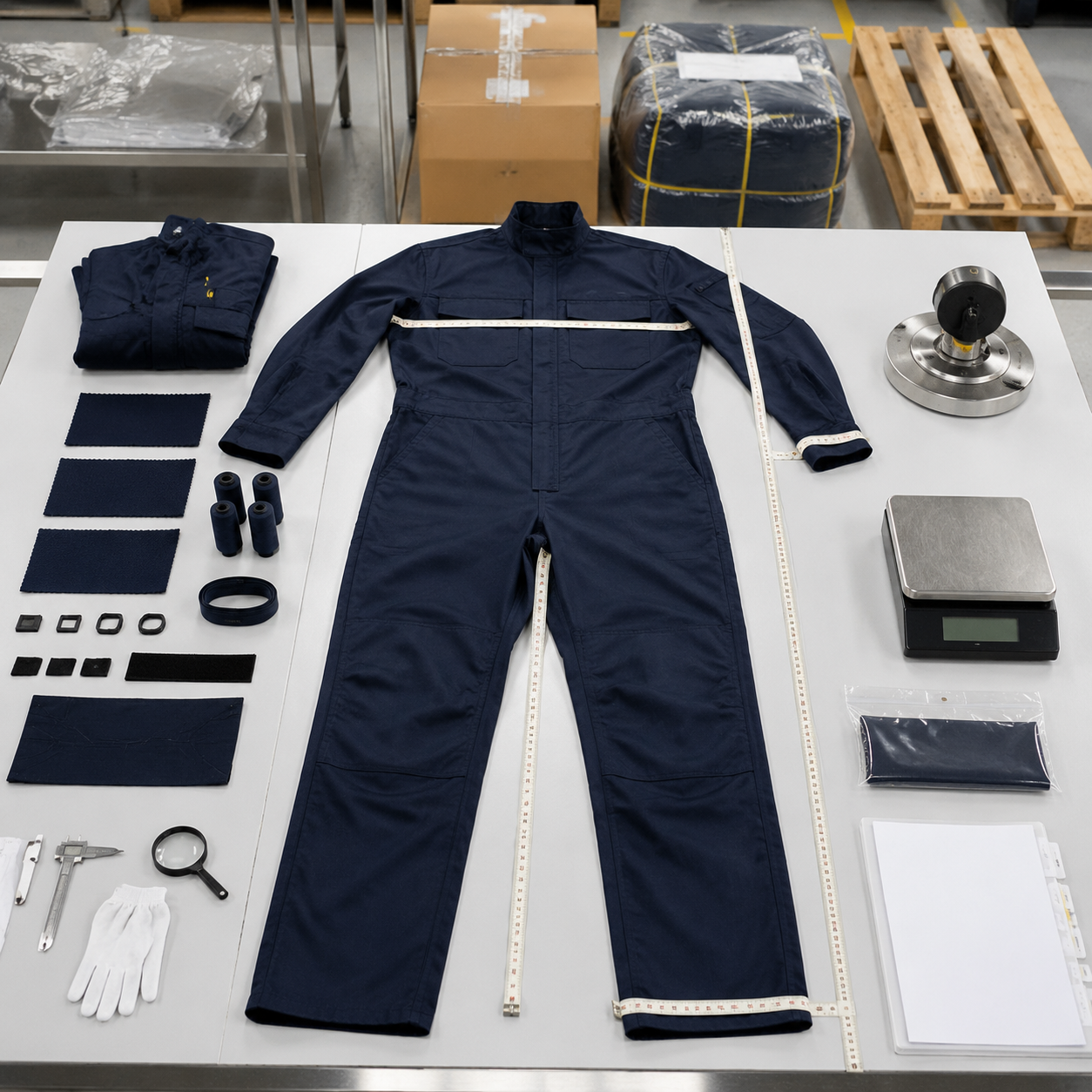
| Style control | Garment code, revision, pattern status, drawing reference, and bill-of-materials reference | Matching identity on the quote, samples, inspection records, labels, packing list, and retained sample |
| Fabric identity | Material code, fibre description, FR technology where documented, construction, colour, finish, treatment, and source | Link between the quoted swatch, source declaration, report sample, incoming lot, and production batch |
| Finished fabric mass | Target and tolerance in grams per square metre | Method, conditioned-sample status, tested lot, result, date, and record identifier |
| Garment measurements | Measurement point, size, target, tolerance, unit, and sample result | Measuring method or tool, sample identifier, measurement date, and approval status |
| Dimensional change | Length-direction and width-direction results in percent after the buyer-selected conditioning sequence | Conditioning procedure, tested item, initial and final measurements, result, report locator, and scope limitation |
| Seam construction | Seam type, stitch type, thread code, reinforcement, critical location, and stitch density per declared measurement length | Comparison with the approved construction drawing and production-intent sample |
| Closures and trims | Component code, material specification, dimensions with units, placement, source, and substitution status | Bill-of-materials entry, incoming-lot record, change log, and inspection result |
| Performance evidence | Standard and edition, method, conditioning, result or classification, applicable unit, report identifier, and supporting page | Match between the tested sample identity, quoted product, claimed scope, and proposed care marking |
| Samples and production inspection | Sample stage, material status, approval owner, lot definition, inspection characteristic, defect class, and buyer-selected acceptance rule | Approved sample record, inspected quantity, findings, disposition, corrective action, reinspection, and responsible role |
| Traceability and packing | Material lot, cut batch, sewing batch, garment or bundle reference, carton reference, package count, dimensions, and net and gross mass | Reconciliation from approved materials and production records to delivered cartons and shipment documents |
Require each supplier response line to use a controlled status such as conforming, deviating, pending buyer input, or not applicable. A blank field should remain unresolved.
Every exact value returned by a supplier should include its unit where applicable, product or lot scope, measurement or status date, method, and source record. A value based only on quotation assumptions should be labelled as an assumption to verify in the supplier quote and approval record.
Map each garment claim to product-specific evidence
The evidence index should preserve the chain from the buyer's requirement to the item proposed for production. Useful fields include:
- Requirement identifier and exact claim wording.
- Applicable style, revision, material code, component code, colour, and production condition.
- Standard, edition, method, conditioning, and buyer-required result.
- Evidence type, issuer, document identifier, issue date, and status stated by the issuer.
- Tested sample identity, source lot where recorded, result with unit, and exact supporting page or section.
- Certificate scope and expiry when a certification scheme applies and the document states those details.
- Difference between the tested sample and the quoted production item.
- Verification action, owner, completion date, and release status.
The VisonSafety FR manufacturing overview discusses technical files, third-party reports, labels, fabric batch testing, and traceability. These topics are useful prompts for an RFQ, but that page is not product-specific evidence for a bidder, material, or garment.
Accept a report only for the sample, method, conditions, and scope identified in the document. Do not automatically extend a fabric result to a finished-garment claim, or extend evidence for one material, construction, colour, treatment, or conditioning state to another. Record the difference and obtain the scope assessment or additional evidence required by the buyer's authorised decision owner.
Keep reports, certificates, supplier declarations, mill data sheets, and internal QC records distinct. They answer different questions. A logo, catalogue statement, expired document, or test report that does not state certification status should not be presented as proof of current certification.
Separate standards from buyer and OEM practices
The cited VisonSafety source names EN ISO 11612 and NFPA 2112 as thermal-protection references. The cited LAPCO FR overview discusses NFPA 70E in an electrical workplace-safety context. Mention on those commercial pages does not establish that any of these standards applies to a particular New Zealand workplace, hazard, or quoted garment.
Before placing a standard in the RFQ, the buyer's competent safety adviser should verify the official title, applicable edition, relevant clauses, conditioning, required results, and workplace relevance. Label each compliance line as one of the following:
- A requirement verified against the applicable official standard.
- An additional performance, evidence, or commercial control selected by the buyer.
- An OEM manufacturing or inspection practice.
- Evidence supplied by a laboratory, certification body, material source, or component provider.
Maintaining a technical file, using a specified thread, or conducting an inline inspection may be a buyer control or an OEM practice. Do not describe it as a standard's requirement unless the applicable official text supports that attribution. Do not describe a garment or supplier as certified without a current, verifiable document whose scope covers the relevant product and claim.
Use published price data only to expose missing quote lines
The following figures are transcribed from MWG Apparel's article published April 1, 2024. Each figure uses USD as the currency unit, applies only to the source's stated product category, and carries the source publication date as its context.
| Source and publication context | Product-category scope | Published data point |
|---|---|---|
| MWG Apparel, published April 1, 2024 | FR base layers | USD 40 to USD 120 |
| MWG Apparel, published April 1, 2024 | FR shirts | USD 60 to USD 160 |
| MWG Apparel, published April 1, 2024 | FR pants | USD 80 to USD 340 |
| MWG Apparel, published April 1, 2024 | FR outerwear | USD 120 to USD 880 |
These category figures are not New Zealand dollar conversions, OEM unit-price benchmarks, landed-cost forecasts, or current supplier offers. Do not average, convert, or extrapolate them for approval. Their limited RFQ use is to prompt a check that every cost-bearing requirement is visible in the supplier's own quotation.
Ask each bidder to identify:
- Garment price by controlled style, colour, size band, quantity basis, and quote currency.
- Minimum-order constraints by style, colour, material, and component where applicable.
- Pattern, development, fit-sample, pre-production-sample, and retained-sample charges.
- Testing, report, certification-scheme, document, and issuer-verification charges where applicable.
- Inspection, corrective-action, reinspection, traceability, packing, and storage charges.
- Responsibility for rework, replacement, or additional evidence after a supplier-initiated change.
- Freight, insurance, border-service, duty, tax, and local-delivery assumptions, each marked included, excluded, or pending qualified verification.
- Quote validity date, payment stages, buyer-supplied inputs, exclusions, and change-pricing method.
Lead time should also be separated by evidence review, material booking, sample production, sample approval, bulk manufacture, inspection, corrective action, document release, international transport, border processing, and local delivery. The bidder should state durations in calendar days and identify dependencies. Route and clearance timing should remain assumptions until verified for the actual shipment.
New Zealand freight and compliance document controls
The cited commercial sources do not provide a New Zealand statutory document list, shipment-specific tariff decision, duty or tax outcome, biosecurity determination, preferential-origin decision, or live freight quotation. Obtain those conclusions from appropriately qualified parties using the actual product, packing, route, transaction, and shipment date.
Use the manufacturing RFQ to collect the supplier inputs needed for that verification:
| Freight or document field | Supplier return | Buyer verification gate |
|---|---|---|
| Manufacturing and dispatch | Manufacturing location, dispatch point, proposed handover point, and any relevant origin support | Confirm consistency with the quote, transport plan, and separately verified origin treatment where applicable |
| Delivery allocation | Delivery term, named place, referenced rules or version, and responsibility by transport stage | Confirm cost, risk, insurance, border-entry, and local-delivery responsibilities before contract release |
| Route and timing | Mode, proposed route, carrier dependencies, dispatch window, duration assumptions, and quote validity | Obtain route-specific confirmation for the actual cargo and shipment window |
| Packing | Package count, carton dimensions with units, net and gross mass with units, pallet details, and packing materials | Submit final packing information to the qualified import or freight adviser |
| Classification and origin | Supplier-proposed classification and origin statement with supporting basis | Treat both as supplier inputs pending importer-side verification |
| Shipment documents | Document name, issuer, planned issue stage, language, and third-party dependency | Compare the proposed pack with verified contractual and transaction requirements |
| Release status | Final evidence index, inspection result, deviation closure, traceability record, and document status | Hold shipment until all contractually required gates are accepted |
The contract may require a pre-shipment pack containing a final commercial invoice, packing list, applicable transport document, approved compliance matrix, specified reports or certificates, final bill of materials, sample approval, inspection release, nonconformity closure records, and lot-to-carton traceability. Origin or packing-material evidence should be added only when qualified review determines that it applies. This is a recommended contract-control list, not a claim that every item is legally required for every New Zealand shipment.
At receipt, reconcile the garment, production lot, carton, and packing-list identifiers. Hold any delivery whose identity, condition, labels, or contractually required documents do not match the approved record.
Make the quotation decision at defined release gates
Advance a supplier response only when:
- The intended use and hazard basis are controlled by the buyer and acknowledged by the bidder.
- The applicable performance basis, edition, method, conditioning, and result have an authorised decision owner.
- The quote, sample, bill of materials, evidence, labels, inspection records, and packing data use matching product identifiers.
- Every compliance claim maps to a document, tested sample, result, and supporting page or section.
- Differences between tested and quoted materials, components, constructions, colours, treatments, or conditions are resolved.
- Measurement targets, units, tolerances, methods, and approval records are defined.
- Production lots, inspection points, defect treatment, corrective action, and reinspection are documented.
- Safety-relevant substitutions require written approval and an evidence-scope review.
- Testing, inspection, packing, freight, and New Zealand delivery assumptions are separately visible.
- Shipment release depends on accepted evidence, closed deviations, approved inspection status, and the required document pack.
Hold or reject the response when a generic FR claim replaces the specified performance basis, evidence cannot be matched to the quoted product, certification lacks a current product-relevant document, provisional materials are represented as production-approved, or exact values lack units, scope, dates, methods, source records, or assumption labels. Freight estimates should also remain unresolved when presented as confirmed border or delivery outcomes without shipment-specific verification.
Methodology and limitations
The source contexts were kept separate. VisonSafety supplies a manufacturing-oriented discussion of technical files, reports, labels, batch testing, traceability, and named standards. MWG Apparel supplies buyer-oriented purchasing context and the dated USD category ranges reproduced above. LAPCO FR supplies workplace-safety and procurement context involving hazard assessment, clothing selection, and compliance review.
The method was to retain source-attributed statements within their original context, transcribe the published price ranges without conversion or extrapolation, and separate those statements from recommended RFQ controls. Specification, evidence, QC, change-control, commercial, and freight fields were organised as buyer inputs, supplier returns, and release gates. They were not attributed to a standard or New Zealand authority without supporting official evidence.
The cited pages are commercial secondary sources. They are not presented here as New Zealand legislation, official standards, accredited laboratory reports, certification registers, customs rulings, biosecurity determinations, product-specific technical files, or live freight quotations. No garment-specific hazard assessment, supplier quote, bill of materials, test report, certificate, production record, packing specification, route, or shipment date was available for evaluation.
Before placing an order, verify the workplace protection basis, official standard and edition, test method, conditioning, laboratory scope, document authenticity, certificate status, material and garment coverage, production controls, quote assumptions, tariff and tax treatment, packing controls, border requirements, and shipment documents with the appropriately qualified parties. Nothing in this article attributes certification, manufacturing capability, product performance, or customer outcomes to Vanta Workwear or an OEM.
Discuss Your Requirements
Review our manufacturing capabilities, then share your specifications for a supplier-fit review.