FR Clothing OEM Customization Options for Europe: RFQ Decisions
By Vincent Xi, Editorial Author
Author basis: The first-party profile supports Vincent Xi's name and Editorial Author role only. It does not document first-hand manufacturing, factory-visit, garment-testing, certification, or customer-outcome experience, so this article makes none of those claims (author profile).
For Europe-bound B2B procurement, the useful question is not whether an OEM offers customization. It is whether each option can be quoted against a fixed garment configuration, destination, evidence boundary, MOQ trigger, sample route, and release condition.
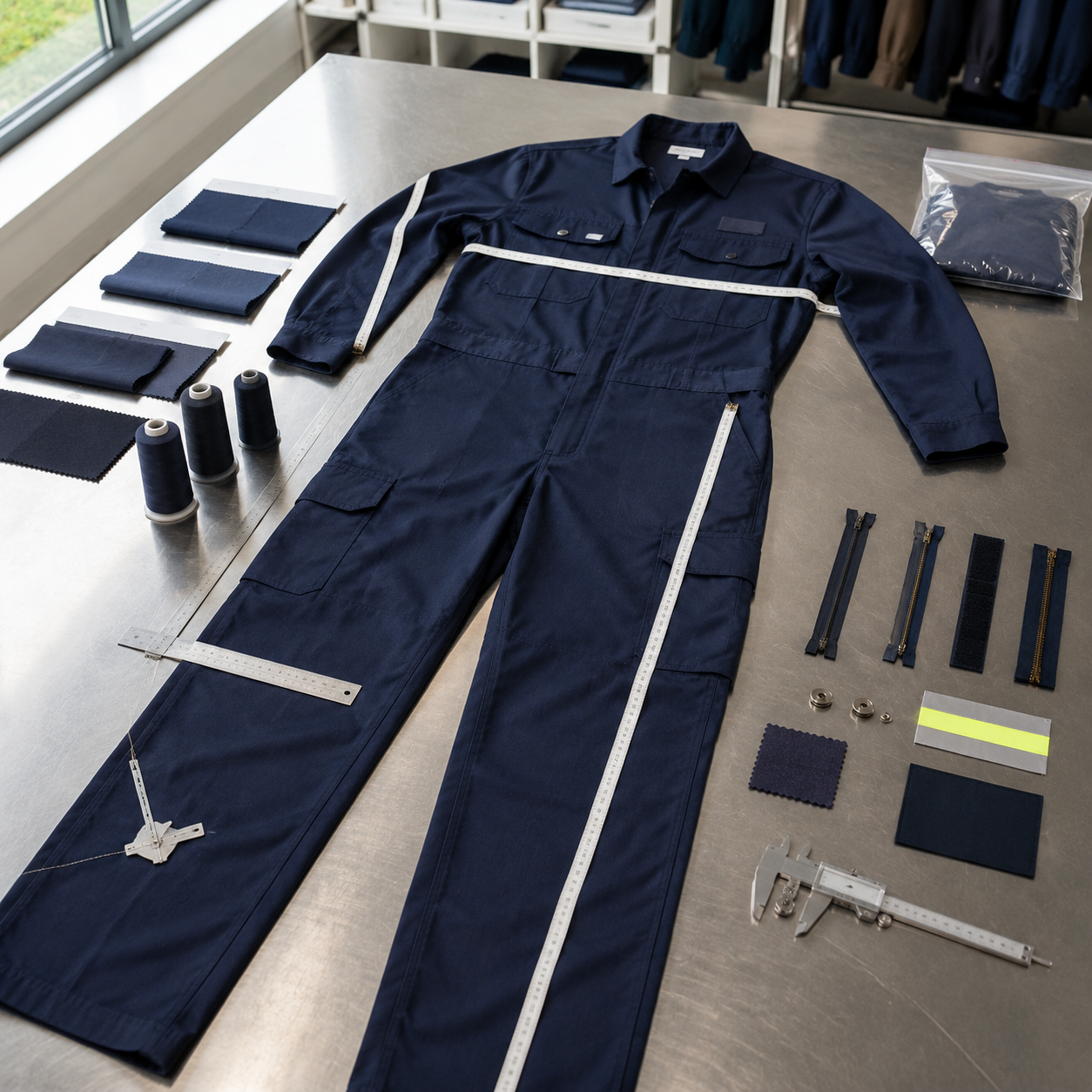
An FR clothing manufacturing RFQ should therefore separate fabric, colour, fit, pockets, closures, visibility components, branding, labels, and packing. Before requesting design changes, record the intended use, assessed workplace hazards, destination country, requested performance or classification, and required evidence route.
Do not use Europe-compliant as a specification. Keep EU member-state destinations, EEA destinations outside the EU, the UK, and other country-specific European destinations in separate RFQ rows. Applicable legal, conformity, marking, language, and economic-operator questions require current destination-specific verification; the commercial sources cited here do not establish those requirements.
FR Clothing OEM Customization Options for Europe-Bound RFQs
The following decision order is an editorial procurement control, not a claim about any supplier's current process or capability. Protective configuration and evidence review remain upstream of styling and branding.
| Decision gate | Customization options to quote | Buyer-controlled input | Required OEM return | Release condition |
|---|---|---|---|---|
| Destination and protection boundary | Destination-specific configuration and evidence package | Destination country, intended use, hazard assessment, requested specifications, classifications, and PPE ensemble | Applicability assumptions, available documents, evidence gaps, proposed verification, and deviations | Hold design approval until destination and evidence gaps are recorded |
| Fabric platform | Identified inherent-FR candidate, treated-FR candidate, stock construction, or custom construction | Composition range, area mass, colour, finish, care conditions, comfort criteria, and requested performance | Exact fabric code, declared composition, construction, source identity, availability, evidence references, MOQ, price, and timing | Approve a traceable fabric platform before garment sampling |
| Colour and finish | Stock shade, custom dye, contrast panel, or additional finish | Physical colour reference, comparison method, tolerance, finish requirement, and destination constraints | Swatch route, dye-lot control, finish code, surcharge, MOQ effect, timing effect, and evidence review | Retain an approved physical reference linked to the fabric code |
| Garment architecture | Coverall, jacket, trouser, shirt, bib garment, or another specified form | Coverage, layering assumptions, technical drawing, opening design, work posture, and PPE compatibility | Pattern proposal, construction drawing, bill of materials, feasibility comments, deviations, and evidence effect | Approve coverage and construction before optional details |
| Fit and size range | Base pattern, grading, inseam choices, ergonomic shaping, and adjustment features | Point-of-measure chart, units, method, nominal measurements, tolerances, wearer profile, and order ratio | Base-size measurements, grading table, size-set plan, measured results, and deviations | Approve representative sizes rather than only a base sample |
| Functional details | Pocket layouts, cuffs, flaps, zips, snaps, buttons, hook-and-loop components, and reinforcements | Finished dimensions, fixed placement references, access needs, work posture, snag constraints, and closure direction | Exact trim and thread identities, attachment method, construction detail, option price, and scope review | Hold any option lacking dimensions, component identity, or assessment |
| Visibility components | Contrast panels or retroreflective components requested through the buyer's risk process | Component requirement, placement, garment coverage, care conditions, and evidence criteria | Component code, placement drawing, finished-area calculation where required, attachment method, reports, and evidence effect | Treat a required component as part of the assessed configuration, not as decoration |
| Branding | Embroidery, transfer, badge, woven label, or removable identity panel | Artwork, finished dimensions, colour, location, backing, and attachment method | Application specification, sample route, price, MOQ, timing, and review of the changed configuration | Approve the actual branded sample and any required evidence review |
| Labels and packing | Destination-language labels, traceability fields, barcode data, individual packing, bulk packing, and carton allocation | Destination matrix, approved legal text, care content, traceability data, packing rules, and order split | Label artwork, material, attachment, packing sample, carton plan, price, and timing effect | Complete destination-specific review before bulk printing |
Separate EU, EEA, UK, and Country-Specific Evidence
Use the destination matrix to frame quote-time questions. It is not a legal conclusion and does not imply that one document, mark, declaration, or language rule applies across Europe.
| Destination entry | RFQ treatment | Verification request |
|---|---|---|
| EU member-state destination | Name each destination country rather than entering only Europe or EU | Verify the current EU legal and conformity route, technical documentation, declarations, marking, required languages, economic-operator responsibilities, and applicable national provisions |
| EEA destination outside the EU | Keep it separate from the EU destination list | Verify current EEA incorporation, national implementation, documentation and marking route, language requirements, and importer or responsible-party duties |
| UK destination | Use a separate UK row and evidence package | Verify the current UK conformity route, marking, declaration, documentation, language, and responsible-party requirements |
| Other European destination | Create a country-specific route | Verify applicable national law, standards, marking, importer duties, language, documentation, and market-surveillance requirements |
| Worksite or tender overlay | Attach it to the relevant destination and garment configuration | Record employer, tender, laundering, site-access, traceability, and PPE-ensemble conditions that narrow the acceptable customization |
The commercial FR sourcing article discusses standards families and procurement documents in a European sourcing context. It is not an official legal source and does not establish which standard, edition, classification, or conformity route applies to a particular destination or garment.
When a standard is relevant, require its exact title, part, edition, classification, and document scope to be verified through current authoritative sources. Distinguish among a legal requirement, a standard's requirement, a tender condition, a buyer specification, and an OEM's own quality-control practice. A supplier's inspection frequency, stitch-density choice, sample-retention process, or batch-release rule is not automatically a standard requirement.
Do not describe a garment as certified without a current document whose holder, product identity, materials, construction scope, manufacturing coverage, standard edition, date, status, and intended destination match the quoted configuration.
Specify Fabric, Colour, and Finish Customization Options
The cited material article describes inherent FR materials as deriving their FR behaviour from fibre structure and treated materials as relying on treatment applied to the textile. It also raises care conditions for treated fabrics (FR material category discussion). Use that distinction to structure questions, not to infer the performance of a quoted textile or garment.
| RFQ field | Required entry | Decision control |
|---|---|---|
| Material identity | Supplier fabric code, source identity, declared fibre composition by mass, construction, area mass in grams per square metre, usable width, finish, and colour route | Reject generic descriptions that cannot be matched to a sample, lot, or report |
| Commercial status | Stock or custom status, reserved quantity, material MOQ, colour dependency, quote validity, allocation, unused-material treatment, and substitution policy | Do not infer bulk availability from a sample swatch |
| Physical reference | Approved swatch identity, fabric code, colour reference, comparison conditions, measurement method, and tolerance | Retain the approved reference and define the response to an out-of-tolerance bulk lot |
| Evidence identity | Report reference, holder, laboratory, method, sample description, conditioning, laundering protocol where relevant, issue date, status, and tested property | Match each document to the offered material rather than a generic material family |
| Acceptance data | Required shrinkage, dimensional stability, colourfastness, tensile, tear, seam compatibility, care, and comfort fields, each with method, unit, acceptance limit, and evidence source | Mark absent data as not supplied rather than treating silence as acceptance |
| Configuration effect | Written scope review for custom dye, finish, contrast panels, reinforcements, layered pockets, trims, reflective components, embroidery, transfers, or other changes | Hold the option when existing evidence does not clearly cover the changed configuration |
Keep material-only evidence separate from finished-garment evidence. Approval of a fabric report does not by itself establish a customized garment's performance, classification, certification, or destination-specific legal status.
Convert Garment Customization Into Measurable Inputs
The performance-apparel sourcing article maps pattern making, grading, material sourcing, testing, prototype sampling, cutting, sewing, labelling, and packing as connected development and manufacturing stages. Because its subject is activewear, it is used here only for generic process mapping, not as evidence of FR performance or European conformity.
| Garment field | Measurable RFQ input | Required OEM return |
|---|---|---|
| Coverage and pattern | Technical drawing, garment form, layering assumption, work posture, base size, pattern reference, and required coverage points | Pattern revision, sample size, deviations, and unresolved compatibility issues |
| Point of measure | Named measurement point, fixed landmarks, method, unit, nominal value, tolerance, and grading rule | Measured result by submitted size with pass, fail, or deviation status |
| Seam and stitch | Seam location, seam type, stitch formation, thread code, reinforcement location, edge treatment, and workmanship criterion | Construction detail, actual component identity, feasibility comments, and evidence effect |
| Pocket or feature | Finished width and depth, opening direction, placement from fixed landmarks, closure type, buyer-defined access requirement, and work posture | Pattern placement, attachment detail, sample check, and deviation record |
| Closure and adjustment | Exact component code, material, finished length, direction, shielding or flap design where specified, attachment, and adjustment range | Component data, drawing, sample operation check, and substitution restriction |
| Visibility component | Component code, placement, dimensions, finished area by garment size where required, seam crossings, attachment, and care conditions | Placement drawing, calculation method, evidence reference, and configuration review |
| Branding | Method, artwork revision, finished dimensions, colours, location, backing, attachment, and appearance criteria | Branded sample, component identity, option price, MOQ trigger, and evidence assessment |
| Label and traceability | Destination, approved content, language, label material, placement, attachment, style code, lot fields, and care information | Artwork proof, traceability example, destination mapping, and approval hold point |
| Packing | Fold method, garment protection, pack quantity, barcode data, carton allocation, carton limits, and destination split | Packing sample, carton plan, price effect, timing effect, and deviations |
Assign a unique option code to the base configuration and every alternative. State which combinations are permitted; do not combine mutually exclusive alternatives in one bill of materials.
Practical RFQ Checklist for FR Clothing Customization Options in Europe
Use this checklist before releasing an RFQ and repeat it before issuing a purchase order. A checked item confirms that the requested input or supplier return is present; it does not establish legal compliance, certification, or protective performance.
- [ ] Name every destination country and separate EU member-state, non-EU EEA, UK, and other European routes in the destination matrix.
- [ ] Record intended use, assessed hazards, PPE-ensemble assumptions, requested performance, and the party responsible for confirming applicable requirements.
- [ ] Assign a style code, option code, and revision to the base garment and every permitted customization combination.
- [ ] Attach technical drawings showing coverage, seam paths, opening direction, pocket dimensions, cuffs, reinforcements, visibility-component placement, branding positions, and label locations.
- [ ] Attach a bill of materials with exact codes for fabric, lining, thread, closures, reinforcements, visibility components, labels, and packaging.
- [ ] Include a point-of-measure chart with units, fixed landmarks, measurement methods, nominal values, tolerances, grading rules, and required sample sizes.
- [ ] State the fabric construction, composition by mass, area mass, colour route, finish, care conditions, physical reference, and evidence requested for each option.
- [ ] Keep the base configuration and every fabric, colour, trim, pocket, branding, label, and packing alternative on separate RFQ rows.
- [ ] Link each requested property to the relevant material or finished configuration, document reference, holder, sample description, method, issue date, and current status.
- [ ] Request an itemized price showing the base unit price, each option adjustment, currency, delivery term, sampling, tooling, verification, labels, packing, and relevant tax treatment.
- [ ] Identify the actual MOQ trigger for each option, including fabric, dye lot, trim purchase, artwork process, label printing, style, colour, size split, packing type, or production run.
- [ ] Require separate dates and dependencies for material reservation, colour approval, development, sampling, verification, buyer approval, bulk manufacture, inspection, document release, and transport.
- [ ] Define prototype, size-set, customization, pre-production, and bulk-release gates using representative materials and components.
- [ ] Request the proposed production site, subcontracted processes, quality-control responsibility, lot-traceability method, sample-retention plan, and change-notification process.
- [ ] Prohibit unapproved substitutions of materials, trims, patterns, processes, production sites, or subcontractors when a change could affect fit, durability, traceability, evidence scope, or requested protective performance.
- [ ] Require a marked-up feasibility return listing unavailable components, technical conflicts, evidence gaps, assumptions, substitutions, commercial dependencies, and deviations.
- [ ] Resolve blank fields, conflicting terms, unsupported
testedorcertifiedstatements, and unidentified option combinations before commercial or sample approval. - [ ] Freeze approved destination-specific label, care, traceability, declaration, barcode, packing, and carton-allocation content before bulk printing.
Quote MOQ and Timing at Option Level
The following figures are reported by the broad apparel fabric-sourcing article. Each row retains the source's stated unit, broad apparel scope, and source-declared quote period. The figures are not FR-specific commitments, Europe-specific delivery forecasts, supplier quotations, or order guarantees.
| Source-reported data point | Unit and scope | Date and source context | Permitted RFQ use |
|---|---|---|---|
| More than 180 mill quote records | Quote records in the source's broad apparel fabric-sourcing dataset | Source-declared calendar-year quote period from 2024 through 2026; fabric-sourcing source | Dataset context only; not evidence of FR capability |
| 100 to 300 metres per colour | Stock-fabric MOQ range across the source's broad apparel quote scope | Source-declared calendar-year quote period from 2024 through 2026; fabric-sourcing source | Prompt the OEM to confirm the actual stock-fabric commitment in writing |
| 500 to 2,000 metres per colour | Specialty-fabric MOQ range across the source's broad apparel quote scope | Source-declared calendar-year quote period from 2024 through 2026; fabric-sourcing source | Ask whether a custom or specialty option creates a separate material commitment |
| 7 to 12 weeks before sea freight | Stock-construction fabric lead-time range in the source's broad apparel dataset | Source-declared calendar-year quote period from 2024 through 2026; fabric-sourcing source | Require material timing to be separated from sampling, garment production, inspection, document release, and transport |
| 11 to 21 weeks before sea freight | Custom-fabric lead-time range in the source's broad apparel dataset | Source-declared calendar-year quote period from 2024 through 2026; fabric-sourcing source | Require a dated development and approval schedule for a custom-fabric option |
For each option, identify whether the MOQ is triggered by fabric, dye lot, trim purchase, label printing, artwork method, style, colour, size split, packing type, or production run. Do not convert a fabric MOQ into a garment quantity without a supplier-verified basis covering usable fabric width, marker consumption, size ratio, process loss, and design-specific consumption.
The schedule should separate material reservation, colour approval, development, sampling, verification, buyer approval, bulk manufacture, inspection, document release, and transport. Every milestone needs a dependency, responsible party, and approval condition.
Require an Option-by-Option RFQ Return
| Return field | Required content | Hold condition |
|---|---|---|
| Configuration identity | Style code, revision, destination, intended use, base configuration, option code, and permitted combinations | The quote mixes alternatives into an unidentified configuration |
| Technical identity | Exact material and trim codes, construction, placement, dimensions, colour, finish, attachment, and deviations | The quote cannot be matched to the controlled tech pack and bill of materials |
| Evidence effect | Existing document references, configuration match, gaps, review needed, proposed verification, responsible party, cost, and timing | The option is supported only by an unscoped tested or certified statement |
| Price | Base unit price, option addition or reduction, currency, delivery term, sample charge, tooling charge, testing charge, label charge, packing charge, and relevant tax treatment | Customization costs are bundled or omitted |
| MOQ | Triggering material or process, quantity unit, colour dependency, style dependency, size-split condition, and unused-material treatment | The commercial commitment cannot be traced to its trigger |
| Schedule | Material reservation, development, colour approval, sample, verification, buyer approval, bulk manufacture, inspection, document release, and transport milestones | Dependencies or approval owners are missing |
| Sampling | Sample type, material status, size, branding status, quantity, charge, remake responsibility, and approval dependency | The proposed sample is not representative of the quoted bulk configuration |
| Manufacturing scope | Proposed production site, subcontracted processes, quality-control responsibility, lot-traceability method, and substitution controls | Production scope or change-notification responsibility is unclear |
| Quote governance | Quote validity, assumptions, exclusions, payment milestones, change process, document handover, acceptance criteria, and remedy for nonconforming goods | Blank fields or conflicting terms remain unresolved |
Set Sample and Bulk-Release Gates
| Gate | Configuration to review | Release decision |
|---|---|---|
| Material evidence | Offered fabric and trims matched to supplier codes, composition declarations, colour references, lot information, care conditions, and report sample descriptions | Record scope gaps before garment sampling |
| Prototype | Coverage, mobility, closure operation, seam placement, pocket access, reinforcement, work posture, and intended PPE compatibility | Record every deviation from the controlled tech pack |
| Size set | Submitted sizes measured using the agreed landmarks, method, units, tolerances, and grading rules | Resolve grading or measurement deviations before pre-production approval |
| Customization sample | Actual visibility components, branding, labels, trims, pockets, and finishes intended for production | Confirm whether the changed configuration remains within the required evidence scope |
| Pre-production sample | Intended bulk materials, trims, patterns, artwork, labels, workmanship criteria, and packaging | Seal the approved reference and freeze authorized deviations |
| Bulk release | Incoming-material identities, lot traceability, construction, measurements, finished appearance, packaging, and required documents | Apply the purchase agreement's correction, verification, concession, rejection, or other agreed remedy rules |
The RFQ is decision-ready only when every customization option has a technical identity, separate commercial effect, evidence assessment, representative sample route, deviation record, and approval condition.
Methodology and Data Boundaries
Source-supported statements were limited to the scope of each cited page. The Vincent Xi profile supports the byline and Editorial Author role only. The commercial FR sourcing article is used for standards and procurement-document context. The FR material article is used for its high-level inherent-versus-treated distinction and care context. The broad apparel fabric-sourcing article supplies the source-reported quote-count, MOQ, and lead-time figures within its stated scope. The performance-apparel article supports generic manufacturing-stage mapping only.
The numerical figures were transcribed without changing their units, broad apparel scope, or source-declared calendar-year quote period. They were not converted into an FR supplier capability, Europe-specific forecast, garment-order quantity, certification claim, or guaranteed result.
The decision matrix, measurable input fields, practical RFQ checklist, option-return schedule, and approval gates were derived by mapping each customization option to its technical identity, measurement method, evidence boundary, commercial effect, change control, and release condition. They are editorial procurement controls, not legal requirements or claims about a named manufacturer's practices.
Limitations and What to Verify
The cited sourcing pages are commercial or industry-editorial sources. They are not official EU, EEA, UK, or country-specific regulations, standards texts, accreditation records, declarations, test reports, or product certificates. They can frame RFQ questions but cannot establish destination-specific legal compliance or protective performance.
Before ordering, verify the current legal and conformity route for every destination country; applicable standard title, part, edition, and classification; laboratory competence and scope; report or certificate status; document holder; exact material, garment, factory, and process coverage; conditioning and laundering method; label and language requirements; MOQ; price; lead time; material allocation; production site; subcontracting; inspection method; traceability; and change controls.
The broad apparel benchmark source does not establish an FR-specific sample, geographic distribution, quote comparability, current supplier availability, or applicability to the requested garment. Obtain a written quotation tied to the exact fabric, colour, garment design, option combination, destination, quantity, delivery term, and approval schedule.
No Vanta Workwear factory capability, product specification, certification, test result, MOQ, price, lead time, production site, customer outcome, or protective-performance claim is asserted. Those details require current documents and a supplier quotation matched to the exact style, materials, customization options, destination, and order configuration.
Discuss Your Requirements
Review our manufacturing capabilities, then share your specifications for a supplier-fit review.