FR Clothing OEM Packing Requirements for Europe: Manufacturing RFQ
By Vincent Xi, Editorial Author
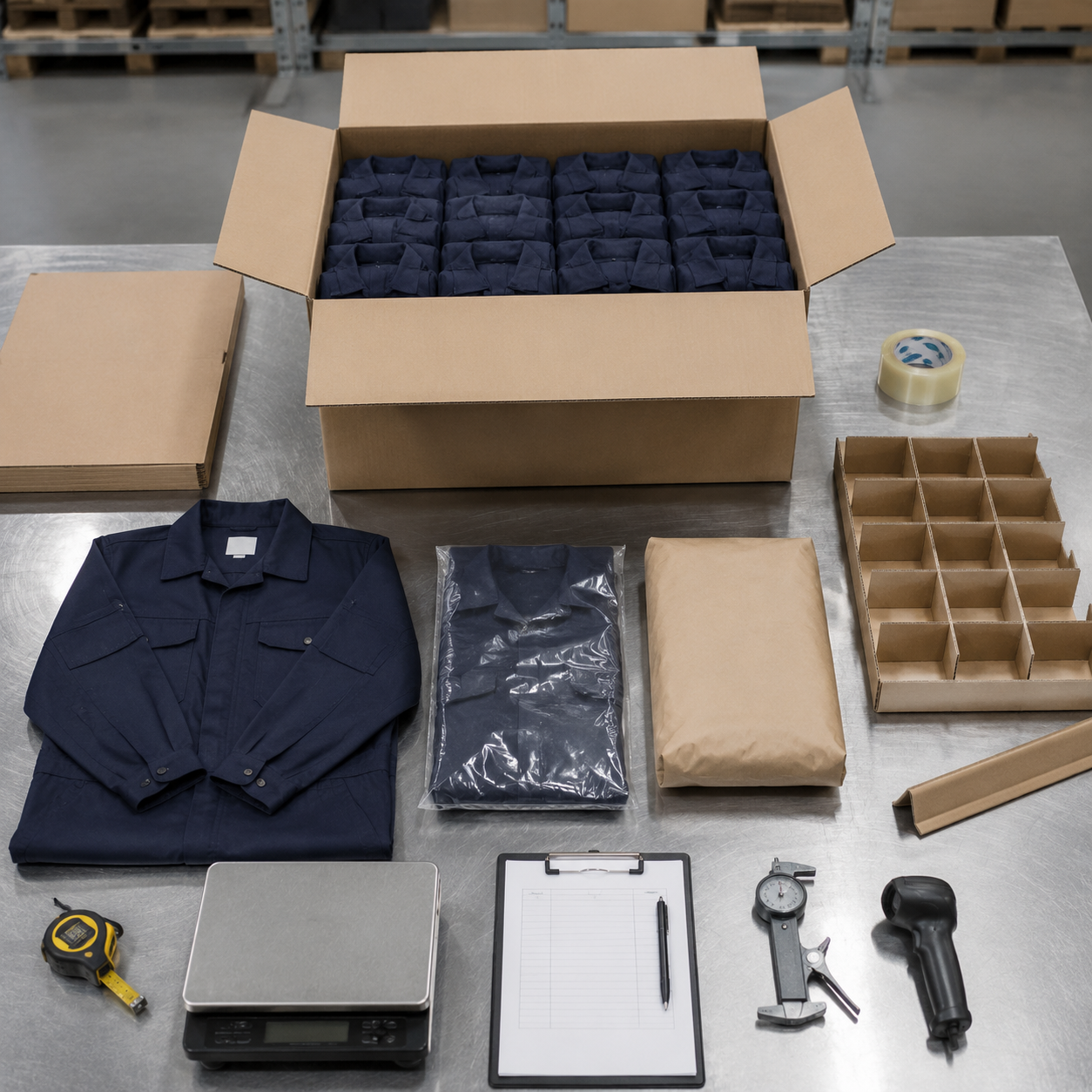
For European B2B procurement teams buying a defined style-colour-size SKU, FR clothing OEM packing requirements should be issued as a controlled schedule with the manufacturing RFQ and purchase order. The schedule should name the destination country and define the garment fold, unit containment, carton construction, physical limits, label data, traceability, route assumptions, approval evidence, and change process.
Require each OEM to return proposed materials, pack quantities, dimensions, masses, supporting documents, deviations, commercial effects, and trial results against the same fields. Standard export packing is not a measurable response. Keep supplier selection conditional on a completed return schedule, and hold bulk packing until the production-intent packing sample and packed-carton trial are approved.
Author basis: The approved Vincent Xi author profile identifies Vincent Xi as an Editorial Author. It provides no basis for a first-hand factory, testing, certification, or customer-outcome statement, so none is made here.
FR Clothing Packing Requirements for Europe: Supplier Return Fields
Issue the schedule at the level at which packing can change: SKU, assortment, carton configuration, and destination. Mark each field as Buyer fixed, OEM proposed, Conditional, or Not applicable. Require the response Comply, Deviation, or Alternative, followed by an evidence reference and price or schedule effect.
| Packing field | Buyer-controlled RFQ input | Required OEM return | RFQ decision rule |
|---|---|---|---|
| Document control | RFQ identifier, revision, issue date, purchase-order link, and approval owner. | Revision used for the quote and a list of clarifications or assumptions. | Quote, sample, trial, and inspection records must resolve to the same approved revision. |
| Order scope | Style, colour, size, SKU, quantity, approved garment reference, and permitted assortment. | Garments per carton for each SKU or approved assortment. | Carton contents must reconcile directly with the order matrix. |
| European destination | Destination country, delivery point, sales channel, warehouse constraints, and compliance owner. | Destination and route assumptions used to select packaging, labels, pallets, and protection. | Reject an undefined European destination; the named country must match the quote and approval record. |
| Garment preparation and fold | Required garment condition, fastener position, accessory placement, and controlled fold drawing or sample. | Preparation sequence, fold diagram, packed-garment dimensions, and production-intent sample. | The physical sample must match the approved reference without an unapproved fold or compression method. |
| Unit containment | Permitted bag, sleeve, paper wrap, reusable containment, or unpacked method. | Material description, dimensions, thickness or basis mass, closure, ventilation, component mass, and supplier data sheet. | The quoted and sampled component must match; a substitution requires written approval. |
| Carton construction | Required board construction, joint, closure, divider, liner, edge protection, and reinforcement fields, or controlled fields for an OEM proposal. | Packaging bill of materials, packaging-supplier specification, and production-intent carton sample. | Construction and closure must match the approved schedule and sample. |
| Physical limits | External dimension limits and tolerances, net-mass limit, gross-mass limit, and buyer-confirmed handling constraints. | Quote calculations and physical packed-trial measurements. | Measured values must remain within the buyer's stated limits. |
| Identification and traceability | Required human-readable fields, encoded data, placement, artwork owner, purchase order, SKU, assigned production lot, carton identifier, quantity, and packing revision. | Label proof, source-data mapping, verification method, and carton-to-packing-list reconciliation. | Label data, physical contents, packing list, and assigned lot records must agree. |
| Route protection and handoff | Shipment mode, transfer and storage assumptions, receiving constraints, pallet type, orientation, restraint, stack limit, and label visibility. | Proposed controls, component specifications, validation method, pallet layout, limitations, and price effect. | Each added control must have a stated route need and buyer-approved acceptance criterion. |
| Commercial and change control | Required treatment of packaging, labour, printing, tooling, trials, inspection, pallets, rework, and alternatives. | Itemised inclusions, exclusions, minimum-order effects, alternative prices, and the component-change notification process. | Compare only complete configurations; no material, dimension, artwork, closure, or pallet change may enter production without approval. |
The Portugal Clothing Factory manufacturer-selection page discusses defining requirements in a technical pack and reviewing a sample before bulk commitment. Those points are applied here only to the controlled packing schedule and production-intent packing sample. The page is commercial guidance, not independent evidence about Vanta Workwear or an OEM being evaluated.
Practical RFQ Checklist for FR Clothing Packing Requirements
Use this checklist as the buyer's working control sheet. Attach it to the RFQ, assign an owner to each item, and retain the completed supplier return with the approved packing revision.
Before Issuing the RFQ
- [ ] Identify every applicable style, colour, size, SKU, order quantity, and permitted carton assortment.
- [ ] Name the European destination country, delivery point, sales channel, warehouse constraints, and shipment-route assumptions.
- [ ] Classify the destination correctly as EU, EEA outside the EU, UK, or another European country without treating those classifications as interchangeable.
- [ ] Assign a compliance owner to verify current destination-specific packaging, declaration, artwork, and importer requirements using authoritative sources.
- [ ] Attach the controlled garment-preparation and fold reference, including fastener position, accessory placement, and permitted unit-containment method.
- [ ] Define which carton-construction fields are fixed by the buyer and which fields the OEM must propose.
- [ ] State the required fields for pack quantity, external carton dimensions, measurement tolerances, net mass, gross mass, closure, and handling limits.
- [ ] Provide the required carton-label data, placement, source system, purchase-order link, SKU fields, assigned production-lot fields, and packing revision.
- [ ] State which packaging, labour, printing, tooling, trials, pallets, inspection, and rework charges must be itemised.
When Evaluating the Supplier Return
- [ ] Confirm that the OEM returned
Comply,Deviation, orAlternativeagainst every required field rather than relying onstandard export packing. - [ ] Check that the proposed packaging bill of materials identifies each component, material description, dimensions, mass or basis mass where applicable, closure, and supplier data sheet.
- [ ] Reconcile proposed garments per carton with the SKU order matrix and any permitted assortment.
- [ ] Check that quoted carton dimensions, net mass, gross mass, and pallet assumptions are tied to the same proposed garment and packing configuration.
- [ ] Require evidence references, price effects, schedule effects, minimum-order effects, and limitations for every deviation or alternative.
- [ ] Compare suppliers on complete packing configurations and exclude unresolved assumptions from commercial comparison.
Before Bulk Packing and Shipment Release
- [ ] Approve a production-intent packing sample covering the garment fold, unit containment, carton construction, closure, and label proof.
- [ ] Require a packed-carton trial that records physical contents, external dimensions, net mass, gross mass, carton condition, closure result, and traceability fields.
- [ ] Verify that the approved sample, trial record, quote, purchase order, and inspection plan all reference the same controlled packing revision.
- [ ] Define bulk inspection methods, defect descriptions, acceptance criteria, sampled-carton identification, and deviation disposition before release.
- [ ] Reconcile carton contents and identifiers with the packing list and assigned shipment lot before shipment approval.
- [ ] Hold any material, dimension, artwork, closure, pack-quantity, or pallet change until the buyer approves the change and any required repeat trial.
A completed checklist is a procurement record, not evidence that a garment or package is certified, legally compliant, or suitable for every European destination. Those conclusions require current documents and approval for the named country, product, route, and commercial arrangement.
Packing Requirements: Manufacturing Quote and Release Gates
| Gate | Evidence required from the OEM | Pass or hold decision |
|---|---|---|
| Quote admissibility | Completed return schedule, packaging bill of materials, proposed measurements, evidence references, deviations, exclusions, alternatives, and itemised charges. | Hold a quote when a mandatory field is blank, an assumption is undisclosed, or an undefined packing term replaces a measurable value. |
| Packing-sample approval | Intended garment reference, physical fold, unit-containment component, carton construction, closure, and label proof. | Approve, reject, or request correction against the controlled packing revision. |
| Packed-carton trial | Content list, external dimensions, net mass, gross mass, closure result, carton condition, label data, and traceability fields. | Hold bulk packing when a result exceeds a buyer-set limit, contents and labels disagree, or the evidence cannot be tied to the proposed configuration. |
| Bulk-packing release | Approved sample and trial records, production component references, buyer-defined inspection method, defect definitions, and acceptance criteria. | Release only the approved configuration; document the disposition of every deviation. |
| Shipment release | Shipment-lot identity, sampled-carton identifiers, content reconciliation, measurements, defects, images, and packing-list reconciliation. | Hold shipment when sampled packs differ from the approved reference or records cannot be resolved to the shipment lot. |
| Change approval | Change request, affected fields, reason, replacement evidence, commercial effect, revalidation decision, and written approval. | Do not use a changed component or configuration before approval and any required repeat trial. |
Photographs can support these records, but they do not replace required quantity, dimension, mass, component, label, or traceability data. The buyer should define the inspection method and acceptance criteria for the actual garment, destination, route, warehouse, and receiving process.
Worked Carton Calculation for Supplier Verification
The following values are buyer-created illustrative assumptions, not Vanta Workwear specifications, OEM capabilities, tested limits, or product-performance claims. Their scope is an illustrative coverall-style SKU and trial-carton configuration. Their as-of context is the controlled RFQ issue date entered by the buyer. Their source is the buyer's example assumptions and arithmetic. Every value must be verified in the OEM's written quote and a production-intent packed-carton trial.
| Data point | Illustrative value | Scope, as-of context, source, and required verification |
|---|---|---|
| Pack quantity | 12 garments/carton | Scope: illustrative coverall-style SKU and trial carton. As of: buyer-entered controlled RFQ issue date. Source: buyer-created assumption. Verify in the OEM quote and physical packed trial. |
| Packed garment mass | 1.10 kg/garment | Scope: production-intent garment for the illustrative SKU. As of: buyer-entered controlled RFQ issue date. Source: buyer-created assumption. The OEM must measure the applicable garment and report the method. |
| Carton tare | 0.80 kg/carton | Scope: proposed empty carton with the intended closure components. As of: buyer-entered controlled RFQ issue date. Source: buyer-created assumption. Verify by measuring the actual empty configuration. |
| Net mass | 13.20 kg/carton | Scope: illustrative SKU at the stated pack quantity. As of: buyer-entered controlled RFQ issue date. Source: buyer example calculation, 12 garments/carton x 1.10 kg/garment = 13.20 kg/carton. Verify by physical measurement. |
| Gross mass | 14.00 kg/carton | Scope: illustrative SKU, carton, and closure configuration. As of: buyer-entered controlled RFQ issue date. Source: buyer example calculation, 13.20 kg/carton + 0.80 kg/carton = 14.00 kg/carton. Verify by physical measurement. |
| External dimensions | 600 mm length x 400 mm width x 300 mm height per closed carton | Scope: closed production-intent trial carton. As of: buyer-entered controlled RFQ issue date. Source: buyer-created assumption. The OEM must measure at buyer-defined measurement points and state any tolerance. |
| External volume | 0.072 m^3/carton | Scope: the illustrative external carton dimensions. As of: buyer-entered controlled RFQ issue date. Source: buyer example calculation, 0.600 m x 0.400 m x 0.300 m = 0.072 m^3/carton. Verify the measured dimensions before using the result in quote comparison. |
Do not convert these example values into order limits. Any change to the garment, pack quantity, fold, containment, carton, closure, or dimensions requires revised arithmetic and a physical trial for the affected configuration.
EU, EEA, UK, and Country-Specific Packing Approvals in Europe
Europe compliant is not an adequate RFQ statement. The supplied citations are not current official sources of packaging law, so they do not establish legal requirements for any destination. Use the following destination controls to assign verification without implying that a single rule applies throughout Europe.
| Destination record | RFQ control | Approval required before artwork or bulk packing |
|---|---|---|
| EU destination | Name the destination member country and keep country-specific fields alongside the EU classification. | The buyer's compliance owner should record the current authoritative EU and country-specific sources considered applicable, their scope, document dates, and approval owner. |
| EEA destination outside the EU | Maintain a separate destination record rather than copying an EU approval file automatically. | Obtain current confirmation for the named country and record the source, scope, responsible owner, and approval date. |
| UK destination | Maintain a UK-specific approval record and do not infer requirements from an EU destination file. | Confirm requirements for the named delivery jurisdiction before approving packaging materials, declarations, or artwork. |
| Other European destination | Name the country, responsible commercial entity, channel, and delivery point. | Obtain country-specific confirmation and retain the approval with the purchase-order records. |
These are procurement controls, not declarations that a particular legal rule applies. The OEM can return packaging composition, component mass, technical data, and proposed wording. The buyer's designated compliance owner remains responsible for determining applicability and approving destination-specific declarations or artwork.
Packing Traceability and Claims
Treat packing records as evidence of configuration, garment identity, and order reconciliation. They are not proof of flame-resistant performance, conformity, certification, or the scope of a garment test report.
The VisonSafety FR sourcing page discusses batch evidence, supplier documents, traceability, and region-dependent references. That commercial context supports asking how the garment, assigned production lot, carton, and shipment records are linked. The page is not treated as legislation, an independent laboratory report, or proof that Vanta Workwear or a proposed OEM holds a certification.
Require each carton record to resolve to the purchase order, style, colour, size, assigned production lot, quantity, packing revision, and shipment record. The RFQ should identify who creates each field, its controlled source, and how the OEM reconciles it with the physical contents and packing list.
Do not permit a standard name, certification mark, performance class, environmental statement, or regulated wording on a bag or carton unless the buyer's compliance owner approves the exact use against a current document whose product, facility, edition, validity, destination, and scope match the order. No technical standard is named here because the supplied sources do not establish one as applicable to the proposed packing configuration.
A buyer-selected fold, carton, label placement, component specification, dimension, or mass limit is a company purchase requirement. It must not be presented as a standard or legal requirement unless a current authoritative source establishes that status for the named destination and scope.
Evidence Method, Source Boundaries, and Limitations
Author source context: The Vincent Xi author profile supports the visible author identity and Editorial Author role. It is not used as evidence of factory work, testing, certification, or customer outcomes.
Manufacturing source context: The Portugal Clothing Factory page is treated as commercial manufacturer-selection guidance. Only its technical-pack and pre-bulk sample context informs the packing schedule and sample-approval gate. Its service, supplier, cost, timing, and outcome claims are not used as evidence about Vanta Workwear or a bidder.
FR sourcing source context: The VisonSafety page is treated as commercial sourcing guidance. Only its discussion of batch evidence, supplier documents, traceability, and region-dependent references informs the packing-record questions. It is not used as law, independent test evidence, or certification evidence.
Method: The source-supported concepts were converted into an RFQ framework of buyer inputs, OEM return fields, evidence requirements, and pass-or-hold decisions. Prescriptive items are identified as buyer procurement controls rather than external legal or standard requirements. The worked values are identified as buyer-created assumptions or calculations and include units, scope, as-of context, source, arithmetic, and required supplier verification.
Limitations and what to verify: No supplier quote, production garment, fabric specification, carton data sheet, packaging-component declaration, packed trial, shipment route, warehouse policy, carrier limit, destination-country legal assessment, packaging-test result, or current conformity document was supplied. Publication and retrieval dates for the commercial guidance pages were also not supplied. Before order placement, replace the illustrative assumptions with measured production-intent values and confirm them in the OEM's written quote and packed-carton trial. Logistics, receiving, safety, importer, and destination-country compliance owners should verify requirements within their respective scopes. Obtain current documents from their issuers and check the applicable product, facility, edition, validity, destination, and claimed scope before approving marks or statements.
Discuss Your Requirements
Review our manufacturing capabilities, then share your specifications for a supplier-fit review.