FR Coverall OEM Packing Requirements for Europe RFQs
By Vincent Xi, Editorial Author
Author scope: The cited profile supports Vincent Xi's name, Editorial Author role, and profile URL. It does not support a first-hand factory, testing, procurement, or product-use claim; none is made here.
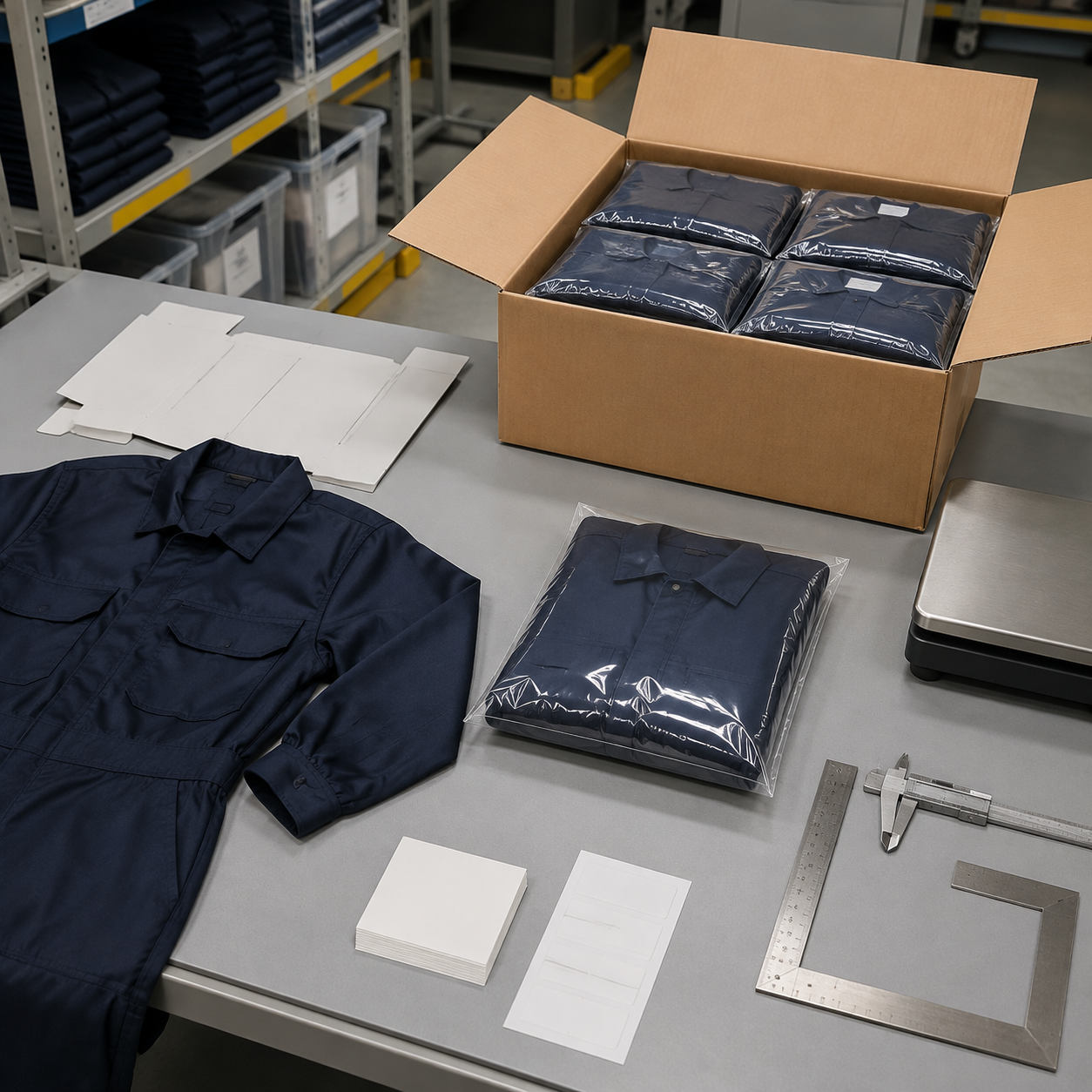
RFQ answer: For a Europe-bound FR coverall OEM order, make packaging a measurable manufacturing release item. The RFQ should define the destination record, unit-pack construction, folded dimensions and tolerances, SKU assortment, carton configuration, controlled marking data, approval evidence, and change procedure. Require the supplier to return proposed values, measurement methods, deviations, costs, and lead-time effects against the same fields.
Treat standard export packing as an incomplete response. It does not identify the fold, enclosure, carton quantity, dimensional basis, gross-mass basis, artwork revision, inspection method, or acceptance evidence. Keep packaging approval separate from garment conformity review: a packed sample or carton inspection can support a packing decision, but it is not evidence of FR performance, certification, or legal conformity.
Packing Requirements for Europe: Release Gates
These are buyer-defined procurement controls, not claims about European law or the established practice of a named manufacturer.
| Release gate | Buyer defines | Supplier returns | Hold release when |
|---|---|---|---|
| Destination basis | Destination country, delivery channel, instruction owner, applicability status, and approved revision | Completed destination matrix and requested declarations | Destination, instruction owner, or applicability remains unresolved |
| Unit pack | Pack format, fold, material fields, dimensions, tolerances, closure, accessories, and identification | Proposed construction, production-intent sample, measurements, evidence, and deviations | The proposal cannot be compared directly with the RFQ |
| SKU and carton | Permitted assortment, carton quantity, dimensional basis, construction, mass limit, closure, and handling constraints | Loading plan, loaded trial, dimensions, mass record, and exceptions | Mixing, fit, mass, closure, or construction is unapproved |
| Marking and documents | Data owner, source file, required fields, placement, variable data, revision, and verification method | Controlled proofs, placed samples, verification results, and packing-list mapping | Printed or encoded data lacks an approved source |
| Manufacturing release | Inspection stages, defect definitions, acceptance rules, retained evidence, and deviation process | Inspection record, carton reconciliation, approved deviations, and shipment evidence | Evidence is incomplete or an unapproved change is present |
Practical RFQ Checklist for Europe Packing Requirements
Use this checklist as an RFQ attachment and require the supplier to answer each line with a proposed value, evidence reference, or clearly identified deviation. A blank field or undefined supplier default should remain open rather than being treated as accepted.
Buyer inputs before issuing the RFQ
- [ ] Identify the exact FR coverall SKU, colour, size range, purchase-order reference, and any permitted or prohibited SKU mixing.
- [ ] Name the destination country and delivery channel, then classify the record as EU, EEA, UK, or country-specific only for routing the applicable instructions.
- [ ] Attach the current buyer- or importer-approved destination instruction, including its owner, revision, approval status, and effective orders.
- [ ] Define the unit-pack format, fold sequence, orientation, finished dimensions, units, tolerances, closure, venting where applicable, and permitted accessories.
- [ ] State the required enclosure-material fields, including material type, composition, thickness or basis mass, restricted-material declarations, and substitution controls where applicable.
- [ ] Define unit-label and carton-mark data, source files, placement, variable fields, machine-readable-data requirements, and artwork approval ownership.
- [ ] Specify carton quantity, assortment, internal and external dimensional basis, construction, gross-mass limit, closure, dispatch configuration, and handling constraints.
- [ ] State the required sample stages, measurement methods, loaded-carton trial, inspection plan, defect definitions, acceptance rules, retained evidence, and deviation process.
- [ ] Request itemised packaging cost, printing or setup charges, packaging-specific minimum constraints, requested test costs, and lead-time effects.
Supplier returns required with the quote
- [ ] Complete every RFQ field using declared units and tolerances, identifying any value that remains subject to production-intent measurement.
- [ ] Submit a packaging bill of materials linked to the quoted enclosure, labels, inserts, carton, closure materials, and sampled construction.
- [ ] Provide a production-intent packed sample record showing the SKU, sample revision, fold, dimensions, mass, closure, accessories, and label placement.
- [ ] Provide a carton loading plan showing SKU assortment, pack orientation, carton quantity, internal and external dimensions, net mass, gross mass, and calculation method.
- [ ] Complete a loaded-carton trial and report physical fit, closure condition, removal clearance, measured dimensions, measured gross mass, and handling observations.
- [ ] Return controlled unit-label and carton-mark proofs linked to the destination record, purchase order, source data, and current artwork revision.
- [ ] List every deviation, substitution, unresolved destination field, cost effect, and lead-time effect instead of silently applying a standard packing method.
Buyer checks before award or release
- [ ] Confirm that EU, EEA, UK, and country- or channel-specific applicability decisions were made by the responsible buyer, importer, or adviser rather than inferred by the supplier.
- [ ] Reconcile the quoted pack, carton, artwork, declarations, and destination record to the same SKU and revision.
- [ ] Verify calculations using production-intent measurements and confirm physical fit in the loaded-carton trial.
- [ ] Close or formally approve every deviation before packaging release.
- [ ] Review current conformity evidence for the exact FR coverall separately; do not use packaging evidence as proof of product certification or FR performance.
- [ ] Retain the approved sample references, measurement records, artwork, declarations, inspection results, packing-list reconciliation, and change approvals with the order file.
Separate EU, EEA, UK, and Destination Records
Use distinct applicability records for EU, EEA, UK, and country- or channel-specific instructions whenever they are relevant to the order. In this RFQ framework, those labels route documents and approvals; they do not assert that a packaging rule applies uniformly within or across those areas.
| Destination record | Buyer action | Supplier response | Assumption to prevent |
|---|---|---|---|
| EU destination | Name the destination country and delivery channel, then attach the current buyer- or importer-approved instruction | Quote and sample against that exact country and channel record | Approval for an EU destination automatically covers other destinations |
| EEA destination | Identify the applicable country record under the buyer's current process | Confirm every applicable packaging and artwork field against that record | An EU or UK instruction can be copied without approval |
| UK destination | Maintain a distinct country, data, and artwork record | Return a UK-specific response and revision acknowledgement | EU or EEA approval establishes UK acceptance |
| Country-, retailer-, warehouse-, or carrier-specific delivery | Add a separate instruction entry when the route changes the required pack, data, or handling | Link the proposed configuration to the purchase order and delivery route | Country approval covers every customer or logistics configuration |
For every applicable record, the responsible buyer or importer should state whether its current instructions call for packaging-material declarations, packaging-waste or producer-responsibility data, sorting or recycling marks, warnings, language fields, importer or retailer data, routing labels, or carrier constraints. These are verification prompts, not claims that every field applies throughout Europe.
Require the supplier to reproduce registration identifiers, disposal statements, regulatory marks, importer details, or destination claims only from controlled content approved for the exact order and destination. The approval record should identify the purchase order, source owner, artwork revision, approval status, and superseded file.
Write Measurable Unit-Pack Packing Requirements
A supplied sewn-goods sourcing page discusses polybag sealing, barcode placement, inserts, and carton efficiency as variables to resolve during sample development (source). Because that source concerns packing cubes, it is used here only as packaging-workflow context, not as an FR coverall specification or European compliance source.
| RFQ field | Buyer entry | Supplier response | Approval evidence |
|---|---|---|---|
| Pack format | Individual enclosure, approved bundle, or another defined construction | Proposed format and SKU-specific exceptions | Fully assembled production-intent sample |
| Fold and finished size | Fold sequence, orientation, closure position, compression rule, finished dimensions, units, and tolerances | Measured dimensions, measurement condition, method, and proposed tolerances | Fold diagram and signed measurement record |
| Enclosure material | Material type, declared composition, thickness or basis mass, appearance, and requested restricted-material fields | Proposed values with units and tolerances, material declaration, and substitution policy | Declaration linked to the sampled material and packaging bill of materials |
| Closure and venting | Closure method, seal position, venting instruction where applicable, and buyer-defined defects | Process description, proposed controls, and inspection method | Closed sample and inspection record |
| Garment condition | Buyer-defined limits for cleanliness, dryness, odour, contamination, exposed components, creasing, and damage | Proposed packing-area and handling controls | Open-pack and packed-sample inspection |
| Accessories and inserts | Permitted item, quantity, position, attachment method, and prohibited contact points | Itemised pack bill of materials and placement method | Open-pack inspection matched to the bill of materials |
| Unit identification | Buyer-owned SKU fields, purchase-order link, colour, size, destination variables, label material, and placement tolerance | Data map, placed sample, material specification, and deviations | Approved artwork linked to the exact SKU and destination |
| Machine-readable data | Buyer-provided data source, required symbology where applicable, position, and verification rule | Generated sample and result from the buyer-specified verification method | Scan or grading record when required by the buyer |
The supplied workwear category page distinguishes FR coveralls from general-duty coveralls (source). Use that limited distinction to maintain separate item and packing records. It does not establish European requirements, product performance, certification, or the capability of a specific supplier. Category substitution, relabelling, or mixed packing should require written SKU-specific approval.
Build the Carton Quote from Measured Packs
Require the carton proposal to use a physically folded and enclosed production-intent sample. The response should identify the sample revision, measurement method, internal or external dimensional basis, and everything included in the stated mass.
| Carton field | Required supplier entry | Buyer control |
|---|---|---|
| Packed-unit basis | SKU, sample revision, measured dimensions, unit mass, enclosure mass, and included accessories | Reject calculations based only on an unverified nominal garment size |
| Assortment | SKU, colour, size, quantity, orientation, and proposed mixing | Hold assortments that are not mapped to the purchase order |
| Dimensions | Usable internal dimensions, finished external dimensions, units, tolerances, and measurement condition | Normalise dimensional bases before comparing bids |
| Construction | Material and construction description, closure, joints, inserts, and proposed protection | Route every substitution through change control |
| Mass | Garment subtotal, unit-pack subtotal, inserts, carton tare, net mass, gross mass, and comparison with the buyer's limit | Measure the completed loaded carton before release |
| Cube and fit | Formula, unit conversions, nominal occupancy, loading orientation, and physical-fit result | Treat volume occupancy as a comparison value, not proof of fit |
| Dispatch interface | Pallet or non-pallet method, stack arrangement, protection, labels, and buyer-supplied carrier constraints | Approve the exact dispatch configuration for the destination route |
| Commercial effect | Packaging cost, printing or setup charge, package-specific minimum constraint, requested testing cost, and lead-time effect | Require cost and schedule effects for every deviation |
Illustrative Quote Calculation
Every value below is explicitly an example assumption or example calculation to verify in the supplier quote as of its issue date and again during the production-intent loaded-carton trial. These figures are not sourced product data, destination requirements, handling rules, or Vanta Workwear specifications.
- Example assumption to verify in the supplier quote:
36 cm length x 28 cm width x 5 cm depth per packed FR coverall. - Example assumption to verify in the supplier quote:
12 packed FR coveralls per master carton. - Example assumption to verify in the supplier quote:
60 cm internal length x 40 cm internal width x 30 cm internal depth per master carton. - Example assumptions to verify in the supplier quote:
1.05 kg garment mass per FR coverall,0.08 kg unit-pack mass per FR coverall, and0.70 kg carton tare per master carton. - Example buyer assumption to verify in the supplier quote:
15.0 kg maximum gross mass per master carton. - Example calculation to verify in the supplier quote:
0.36 m x 0.28 m x 0.05 m = 0.00504 m3 nominal volume per packed FR coverall. - Example calculation to verify in the supplier quote:
0.00504 m3 x 12 packed FR coveralls = 0.06048 m3 nominal packed-unit volume per master carton. - Example calculation to verify in the supplier quote:
0.60 m x 0.40 m x 0.30 m = 0.072 m3 usable internal volume per master carton. - Example calculation to verify in the supplier quote:
0.06048 m3 / 0.072 m3 = 84 percent theoretical volume occupancy per master carton. - Example calculation to verify in the supplier quote:
(1.05 kg + 0.08 kg) x 12 packed FR coveralls + 0.70 kg = 14.26 kg gross mass per master carton, leaving an example calculated margin of0.74 kg per master cartonbelow the assumed15.0 kg maximum gross mass per master carton.
The example occupancy does not prove acceptable physical fit. Material thickness, fabric loft, tolerances, orientation, closure pressure, and removal clearance must be checked in the loaded-carton trial. Replace or confirm every assumption with measurements linked to the quoted packaging revision.
Control Marking and Packing Documents
Assign an owner, source, and revision to every printed or encoded field. The supplier should not infer missing data from an earlier order, another destination, or an uncontrolled artwork file.
| Data object | Buyer controls | Supplier returns | Hold release when |
|---|---|---|---|
| Unit label | Item data, destination variables, source file, revision, placement, and machine-readable data | Placed sample, data map, material specification, and verification evidence | SKU, data, code quality, or placement is unapproved |
| Carton mark | Purchase-order link, assortment, quantity, mass fields, dimensions, destination, routing, and carton sequence | Production-layout proof and photographed loaded carton | The carton cannot be reconciled with the purchase order or packing list |
| Destination statement or mark | Applicability decision, exact approved content, reference where applicable, and approver | Confirmation of exact reproduction without additions | A destination, disposal, regulatory, or conformity claim lacks an approved source |
| Packaging declaration | Requested composition, weight, restricted-material, recycled-content, or disposal fields where applicable | Declaration tied to the quoted packaging bill of materials | The declaration scope differs from the sampled and quoted material |
| Packing list | Required order, SKU, carton, quantity, mass, and shipment identifiers | Reconciled document linked to production carton records | Physical cartons and documents do not reconcile |
| Revision register | Current and superseded files, approval status, effective orders, and destinations | Acknowledgement of the released revision and withdrawal of obsolete files | Superseded artwork remains available for production |
If the buyer invokes a packaging, barcode, material, carton, or transit-test standard, the RFQ should state the current edition, sample configuration, conditioning, test method, acceptance threshold, report issuer, report scope, and document-validity requirement. Keep the standard's stated requirements, the buyer's own specification, and the supplier's proposed practice as separate records. Do not imply certification without a current document covering the exact entity, claim, edition, and scope.
Manufacturing QC for FR Coverall Packing Requirements
Use production-intent evidence at each packing gate. An empty enclosure, flat carton, digital artwork, or unmeasured mock-up should not release the complete assembled configuration.
| QC gate | Required evidence | Hold release when |
|---|---|---|
| RFQ comparison | Completed response, materials, tolerances, measurements, calculations, destination matrix, deviations, costs, and lead-time effects | A required field contains only an undefined supplier default |
| Pre-production unit pack | Correct SKU, fold, enclosure, closure, accessories, label, dimensions, mass, and sample revision | The sample differs from the quoted construction or lacks measurable evidence |
| Loaded-carton trial | Intended assortment, production-intent carton, loading pattern, closure, internal and external dimensions, net and gross mass, and handling observations | Fit, mass, assortment, carton condition, or closure differs from the approved proposal |
| Artwork and data release | Controlled unit and carton artwork, data-owner approval, destination mapping, and buyer-specified verification evidence | A variable field, destination statement, or conformity reference lacks an approved source |
| Production inspection | Buyer-defined sampling plan, defect classification, acceptance rule, SKU and quantity checks, pack measurements, closure checks, marking review, and carton condition | Results exceed the buyer's acceptance rule or required evidence is missing |
| Shipment release | Carton count, assortment, packing list, destination, artwork revision, deviation status, and retained evidence reconciled to the purchase order | Documents, physical packing, and approved revisions cannot be reconciled |
The buyer's inspection specification should define the treatment of wrong product category, wrong SKU, mixed assortment, missing accessories, open or contaminated enclosures, unreadable data, obsolete artwork, incorrect quantity, excess gross mass, damaged cartons, and unapproved material substitutions. The RFQ must provide the sampling and acceptance rules rather than leaving the supplier to infer them.
Require written change control for any proposed change to enclosure material, declared composition, thickness or basis mass, fold dimensions, closure, venting, label stock, adhesive, artwork, carton construction, carton quantity, assortment, inserts, or dispatch configuration. The request should identify the affected SKU, destination, purchase order, previous value, proposed value, reason, evidence, cost effect, lead-time effect, approval status, and disposition of obsolete packaging.
Evidence, Methodology, and Limitations
Source contexts: The Vincent Xi author profile supports only the author name, Editorial Author role, and profile URL. The sewn-goods packaging source supports the limited workflow context concerning sealing, barcode placement, inserts, carton efficiency, and sample development. The workwear category source supports only the distinction used here between FR and general-duty coverall categories.
Methodology: The limited source-supported contexts were converted into buyer-controlled RFQ inputs, measurable supplier responses, approval records, hold points, and change controls. The carton figures were derived solely from the explicitly labelled example assumptions so that a buyer can inspect the arithmetic and replace it with quoted measurements.
Limitations and verification: The cited pages are not presented as EU, EEA, UK, or country-specific regulatory sources, accredited test reports, factory audits, or evidence of supplier capability. Before order release, verify current requirements for the exact destination and delivery channel with the responsible buyer, importer, carrier, and qualified compliance adviser where needed. Also verify the production-intent garment's packed dimensions and mass, packaging-material declarations, artwork, language fields, registration data, machine-readable-data ownership, carton construction, handling limits, test methods, assortment, dispatch configuration, and document scope. Review current conformity evidence for the exact FR coverall separately from packaging approval.
Discuss Your Requirements
Review our manufacturing capabilities, then share your specifications for a supplier-fit review.