Polo Shirt OEM Communication Workflow Review for European Manufacturing Buyers
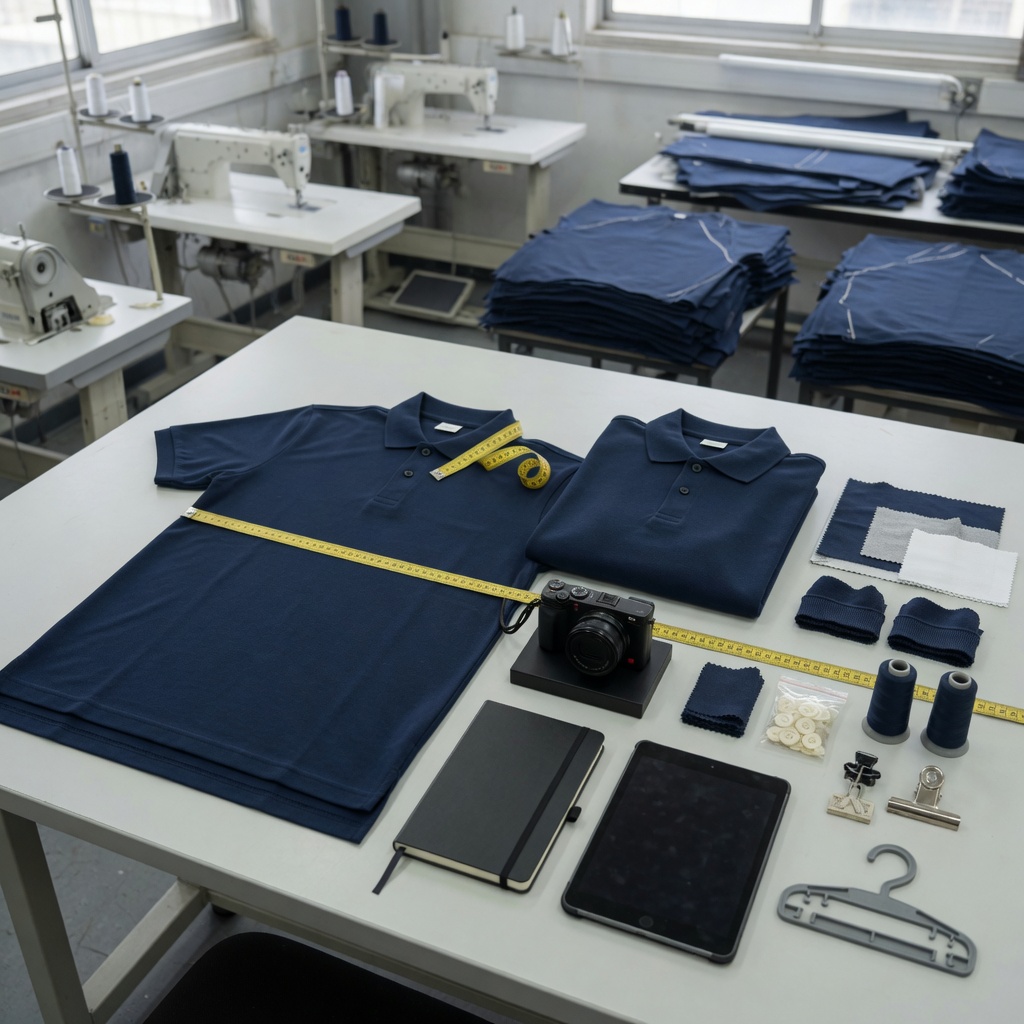
Polo Shirt OEM Communication Workflow Review for Europe
Vincent Xi Editorial Author https://www.vantaworkwear.com/authors/vincent-xi/
European B2B buyers should treat a polo shirt OEM communication workflow review as an award gate, not as a courtesy email chain. The test is whether production evidence still moves while pique body fabric, collar rib, placket, buttons, size set, fibre/care tickets and carton marks are changing. Lock four RFQ items before comparing unit price: a named production contact and backup with overlap in the buyer’s named European time zone; a written weekly critical-path update SOP; hybrid photo-plus-email rules for micro-decisions; and confirmation nodes for annotated sample feedback plus destination-market tickets.
Specify, compare, verify, then approve or hold. A fluent sales inbox is not the production SOP.
Polo shirt development is typically described as spanning 6–12 weeks (unit: weeks; scope: design, fabric sourcing, sampling, approvals and manufacturing as a typical development span; as-of: as stated in the cited critical-path article; publication date not independently confirmed here). That same discussion treats missing milestone reporting and unclear specs as root causes of delay. This page is for European procurement of polo shirt manufacturing only.
Communication workflow review gates: award, hold or re-bid
The buyer task is not to collect a brochure. It is to test who owns the file, how fast evidence moves, and which checkpoints can stop bulk.
When vetting a polo shirt manufacturer, ask for the full production process from tech pack submission to shipping, the communication protocols used during production, and who the main point of contact will be. Clear, consistent communication is presented as what separates a usable sample from an expensive bulk delay: factories can sample well and still fail in production communication. (polo manufacturer vetting questions)
Award only if the OEM returns named production owners, a sample weekly report, a hybrid restatement rule, and market-coded ticket proofs for the actual EU Member State(s), EEA country and/or UK destination named on the order.
Hold the purchase order if the contact is sales-only, updates are exception-only, or labels are offered as a generic “Europe export” pack.
Re-bid the communication lot if spec-changing decisions live only in chat, there is no backup owner for the destination country’s public holidays, or bulk cutting is not gated on written pre-production (PP) approval.
A usable review forces written answers on file ownership (merchandiser, technician, QC), holiday and late-question cover in the buyer’s named zone, stop-the-line versus log-and-continue events, how annotated sample comments become a revised centimetre measurement chart, and how destination labelling and chemical communication are confirmed for the actual country of sale. The SOP that matters is the one that still works when a heather yarn dye lot moves half a shade and the sewing line is already booked (operational example, not a measured incident from the cited pages).
Dedicated contacts, confirmation nodes, and who can approve a polo change
Specify production ownership, not only sampling ownership. Brands are described as getting stuck with manufacturers who made good samples and then communicated poorly in bulk, causing expensive delays. (point of contact during production)
Put this in the RFQ and the order acknowledgement:
- One named production merchandiser plus one named backup, with email, a retained instant channel, English-language reports, and clock-time overlap with the buyer’s named zone. Do not treat CET/CEST as the zone for every European destination: many EU/EEA buyers use CET/CEST, the UK uses GMT/BST, and Ireland and Portugal do not use CET/CEST. Name the zone on the RFQ.
- A RACI for fit, colour, fabric substitution, trims, embroidery/print, fibre/care tickets and carton marks.
- Confirmation nodes that require a written status of approved / approved-with-comments / rejected: tech-pack receipt, lab dip or yarn-dye shade, size-set, PP sample, top-of-production (TOP) sample, fibre/care/origin ticket proof, packing list and carton-mark proof.
- A rule that only named buyer emails can release bulk fabric cutting or accept a deviation.
- Report timestamps in a named pair of zones (factory local and the buyer’s named zone), so a Monday 09:00 file in that buyer zone (unit: clock time; scope: example report time to specify in the RFQ; as-of: commercial assumption to verify in the quote) is comparable across offers.
If the factory proposes a chat group as the “real” channel, still require that any spec-changing decision is restated on email or a shared tracker within a quoted number of factory working hours. Treat that hour count as a commercial assumption to verify in the supplier quote (an example to test: restatement within 8 factory working hours; unit: factory working hours; scope: spec-changing chat restatement; as-of: example SLA to confirm in the offer, not an audited factory result). Chat photos are evidence. They are not the contract unless the purchase terms say they are.
Critical-path cadence for polo shirt manufacturing: weekly reports and exceptions
The critical-path discussion that states the typical 6–12 week polo path also argues that factory and brand must agree a weekly progress-update SOP for all critical-path checkpoints, and that lack of regular milestone reporting is a root cause of missed deadlines. The largest risks called out are miscommunication and unclear specs, with routine risk reviews recommended at every checkpoint for timeline, spec consistency and raw-material readiness. (weekly critical-path SOP)
For a European buyer, cadence is also a time-zone product. A Monday morning report in the buyer’s named zone that covers Friday cutting and weekend overtime is more useful than a Friday evening factory-time dump that lands after that buyer’s close. Specify the zone; do not assume one European close of business.
Require a weekly critical-path report covering fabric in-house date, knitting/dyeing status, cutting start, sewing start, inline QC fail types, finishing, packing, booking, open spec questions, and quantities in pieces. Add polo-specific status lines: collar rib versus body shade, placket slope and button match, collar-stand height, side-vent and hem, embroidery or print placement if used. Schedule a live call during sampling and during the first production week; if twice-weekly calls are wanted, label that cadence as an assumption to confirm in the quote, not as an audited factory SLA.
Same-day exception alerts belong on shade band out of tolerance, shrinkage fail, needle damage, trim shortage, or a proposed fabric/trim substitute. Every report should carry structured risk-review fields: timeline (days of float remaining), spec consistency (open comments versus closed), raw-material readiness (yes/no plus replacement lead time in days). “We will update you if there is a problem” is not a workflow. It is how an inbound team discovers a ticket error at carton seal.
Hybrid tools, annotated sample feedback and micro-decisions
Fast factory communication is described as essential because custom manufacturing involves hundreds of micro-decisions about fit, fabric, colour and trim that a tech pack cannot fully anticipate. Professional apparel factories are described as using WeChat or WhatsApp for instant photo and video sharing during production, plus email for formal documentation and cloud-based trackers. A 24-hour email delay (unit: hours; scope: production stoppage on a custom clothing micro-decision; as-of: as stated by that factory-communication article; year not independently confirmed here) is described as able to stop production, with a reported cost of USD 500 to USD 5,000 per incident (unit: United States dollars; scope: delay cost as stated for custom clothing orders; as-of: as stated by that factory-communication article; year not independently confirmed here). (hybrid tools and delay cost)
Restate any delay cost in the quote currency against piece quantity. Treat FX as an example calculation to verify in the supplier quote—for example, at an illustrative 1.00 USD = 0.92 EUR (unit: euros per United States dollar; scope: example conversion only, not a dated official rate; as-of: assumption to verify on the quote date), USD 500–5,000 is about EUR 460–4,600 per incident (example conversion only; verify rate, currency and factory economics in the offer). European procurement should treat that cost band as source-reported USD for custom clothing orders, not as a Vanta Workwear price and not as an EU-wide, EEA-wide or UK average.
A practical hybrid split for polo shirts:
- Instant channel (WhatsApp, WeChat, or the equivalent your company can archive): wet-process shade, collar rib versus body, placket slope, button colour, embroidery or print placement, needle run, puckering, collar-stand height.
- Email / PDF / tracker: measurement charts in centimetres, graded specs, bill of materials, lab reports, deviation requests, commercial dates, approval records.
- Annotated sample feedback: photos with measurement callouts plus a returned physical sample or a couriered size-set when the change affects fit. Example POMs to require (verify against your own block): collar width, placket length, sleeve opening, body length from highest point of shoulder, chest 2.5 cm below armhole (unit: centimetres; scope: example POM list to confirm in the tech pack; as-of: buyer specification, not a measurement from the cited pages).
Ask how chat media is retained, who can add participants, how files are named (style / colour / size / date as an assumption to verify), and whether line videos will include identifiable operators. That is a buyer records and personal-data question for the buyer’s company in its EU Member State, EEA country or the UK, not a factory marketing claim and not a finding that any chat tool is adequate. Prefer a channel your company can archive for the life of the order plus your retention period (state required retention in months as an assumption to verify).
European manufacturing communication: EU, EEA and UK checkpoints in the SOP
Polo shirt manufacturing for Europe is not one paperwork pack. The communication workflow must name the destination market on every label proof and chemical file. Do not imply that an EU-oriented document automatically places goods in the United Kingdom, that an EEA shipment uses the same language set as a single-Member-State drop, or that one European rule set covers every country of sale.
Build these distinctions into confirmation nodes:
- EU: Require the factory to confirm fibre-composition and care information against the EU textile fibre rules that apply to the goods as sold, and to route chemical questions (restricted substances and SVHC communication) against EU REACH as it applies to the article. Label proofs should match the official language(s) needed in the Member State of sale. Distinguish a legal labelling requirement from the factory’s own hangtag design. This article does not claim any factory holds a current test report or certificate.
- EEA: Do not assume silent identical treatment. Name Norway, Iceland or Liechtenstein explicitly on the tech pack if they are destinations, and ask which EU-aligned files still need local language or importer details.
- UK: UK placement is a separate communication thread. Ask for written confirmation that fibre/care tickets, importer identity and chemical documentation are built for Great Britain and/or Northern Ireland as actually required for that order—not copied from an EU pack without review. Do not treat EU REACH files as automatically sufficient for UK shelves.
- Country-specific add-ons: Extra packaging marks, carton language and importer-of-record / EORI fields belong on the packing-proof node. If one bulk dye lot serves more than one European country, the SOP must say whether tickets are mixed in the carton or packed by market.
Name who communicates inspection booking, who receives fail photos, and who holds labels pending packing approval. Place those owners on the same milestone calendar as sewing start. Incoterms and VAT treatment are contract items for the importer of record; they are not specified by the cited manufacturer blogs. Confirm them in the offer separately for an EU Member State delivery and a UK delivery. A communication SOP that never names those owners leaves European inbound without a file owner.
Buyer decision table: compare OEM communication SOPs before you order
Score factories on the same polo shirt manufacturing file. Every row is a specify, compare, verify or approve action.
| Workflow element | Specify in the RFQ | What to compare | How to verify | Approve / order control |
|---|---|---|---|---|
| Named owner | Production merchandiser + backup; English; overlap in the buyer’s named European zone | Sales-only contact vs named production owner vs unsigned rotating alias | Kickoff call; org chart; timed reply to a sample spec question | No PO release without named owners on the order acknowledgement |
| Critical-path SOP | Weekly written report: fabric, cut, sew, QC defects, packing, booking, open specs; timestamps in the buyer’s named zone | Exception-only vs weekly vs extra calls in week one of sewing | Redacted sample reports with dates on each checkpoint | Tie fabric-commit or a prepayment milestone to the first on-time report |
| Hybrid tools | Photo/video for micro-decisions + email/PDF for approvals; archive rule; restatement in factory working hours | Chat-only vs hybrid vs email-only | Trial annotated collar photo; confirm email restatement | Spec changes invalid unless confirmed on the contract channel |
| Sample feedback | Annotated photos + centimetre POM sheet + physical PP/TOP sample to a named EU/EEA/UK address | Photo-only vs physical sample vs avatar-only | Dummy comment round that returns a marked-up spec sheet | Bulk fabric cut gated on written PP approval |
| Risk review | Timeline float (days); open spec items (count); raw material ready (yes/no + lead time in days) | Verbal assurance vs structured fields every checkpoint | Inspect one mock weekly report before deposit | Hold the cutting ticket if any of the three fields is red |
| Europe destination pack | Market list (EU Member State(s), EEA country, UK) on label and chemical nodes | Single “Europe” pack vs market-coded tickets | Label proof in actual languages; separate EU vs UK chemical confirmation | Packing cannot start without signed ticket proof |
| Inspection communication | Who books inspection; photo pack on fail; notice period in days (assumption to verify) | Buyer-booked vs factory-booked vs unnamed | Sample fail-photo email with date, PO and defect type | Ex-factory not authorised if the inspection node is blank |
| Micro-decision SLA | Same-calendar-day photo response during sewing; email confirmation in quoted factory working hours | 24-hour email-only vs same-day hybrid | Time-stamp a pre-production test question | Line-stop cost and payer must be in the contract if the SLA is missed |
| Deviation authority | Only named buyer emails can accept substitute yarn, button or interlining | Factory self-approves “equal” trims vs buyer sign-off | Redacted historical deviation form | Unauthorized substitute = rejectable lot |
Same-calendar-day photo response, extra calls in week one of sewing, and inspection notice periods are commercial assumptions to confirm in the supplier quote, not measured results from a factory audit.
RFQ checklist for European polo shirt manufacturing
Every item is something a European buyer can specify, compare across offers, verify, and use as an approval gate.
- Named production merchandiser, backup, and English-language window that overlaps the buyer’s named zone (state clock times; do not assume CET/CEST for the UK, Ireland or Portugal).
- Written process map from tech pack to shipping, including who speaks at each polo checkpoint (fabric, collar/rib, placket, embroidery/print, sewing, finishing, packing).
- Weekly critical-path report template as a PDF sample, with dates, timestamps in the buyer’s named zone, quantities in pieces, and open risks.
- Hybrid tool list: instant photo/video channel plus email/PDF tracker; retention period in months (state your required months as an assumption to verify).
- Confirmation-node list with approve / comment / reject language for lab dip, size-set, PP sample, TOP sample and ticket proofs.
- Annotated sample method: required photo angles for collar, placket, hem, side vent and size-label placement, plus a POM sheet in centimetres.
- Same-day exception definition: shade, shrinkage, needle damage, trim shortage, proposed substitute.
- Destination-market field on every label proof: list EU Member State(s), EEA country and/or UK as applicable; no generic “Europe” only.
- Chemical and fibre communication split: EU REACH / article SVHC questions versus UK chemical documentation, each with a named factory owner.
- Language of care and fibre tickets per country of sale; mixed-market packing rule if one bulk serves more than one European country.
- Courier address in the EU, EEA or UK for physical samples, plus who pays duties (Incoterm and account).
- Response SLA for photo questions during sewing, restated as factory working hours, plus who pays if a documented delay idles the line.
- Routine risk-review fields: timeline (days of float), spec consistency (open comment count), raw-material readiness (yes/no).
- Authority matrix: which factory role may propose a fabric/trim change; which buyer email may accept it.
- Inspection communication owner, fail-photo routing, and notice period in days (treat days as an assumption to verify in the quote).
- Archive pack at ex-factory: final spec, approvals, QC summary in defect pieces and defect rate as a percentage of inspected pieces, and signed label proofs.
How this review was compiled, source context and limitations
Source contexts. This communication workflow review uses three public manufacturer/industry articles: a polo critical-path note that states a typical 6–12 week development span and a weekly progress-update SOP; a custom-clothing communication note that states hundreds of micro-decisions, WeChat/WhatsApp plus email practice, and a USD 500–5,000 cost range for a 24-hour email delay; and a polo shirt manufacturer vetting note that tells buyers to ask for the full process, production communication protocols and the main point of contact. (critical path) (factory communication) (vetting questions)
Methodology. Numbered claims are taken as stated by those pages and attributed inline. Editorial RFQ items, time-zone examples, POM examples, FX conversion and SLA hour counts are buyer specification assumptions, not factory measurements. No factory was audited for this article, no laboratory was commissioned, and no customer outcome is reported. European regulatory checkpoints are framed as buyer specification questions (EU versus EEA versus UK) so the SOP names the real destination. They are not a legal opinion and not a claim that Vanta Workwear or any mill named in the source blogs holds a current certificate.
Limitations and what to verify. The source pages are commercial blogs, not Official Journal texts, not UK statutory guidance, and not dated cost models with a stated as-of year in the excerpts used here. The 6–12 week span is a typical polo shirt development range as those authors describe it, not a contracted lead time. The delay cost is USD, scoped to custom clothing production stoppage, and must be re-quoted in the buyer’s currency against piece quantity and factory efficiency. Tool names (WeChat, WhatsApp, email, cloud trackers) are examples from those articles, not an endorsement and not a personal-data adequacy finding. Country-specific European labelling and packaging add-ons change; verify the current official requirement for each Member State, EEA country or UK destination on the order. Confirm every SLA, sample courier term and document owner in the supplier’s written offer before fabric is committed.
Discuss Your Requirements
Review our manufacturing capabilities, then share your specifications for a supplier-fit review.