Polo Shirt Sustainability Sourcing Criteria for United States Procurement
Vincent Xi, Editorial Author (author profile)
Role: Editorial Author. This briefing is a specification and RFQ aid for United States B2B buyers. Vincent Xi is named as Editorial Author only. This page does not describe unpublished tests, factory visits, wear trials, client programs, awards, certifications held by this publisher, or first-hand production experience. No mill audit or laboratory test was performed for this editorial.
For United States B2B programs, polo shirt sourcing should rest on sustainability sourcing criteria you can attach to the purchase order: named fiber and chain-of-custody, dyehouse and restricted-substance-list (RSL) evidence, social-audit coverage of the actual knitting and sewing sites, durability tests that affect replacement rate, and United States fiber-content and origin labeling that will survive FTC and CBP review. Do not award on a hangtag slogan. A certificate is evidence only when it names the mill, product category, and production lot that will ship.
Lock the RFQ in this order: polo construction and fiber claim; lot-matched certificates and tests; United States label copy, origin, and entry data; landed cost plus a dated production-and-transit calendar; bulk start only after documents and sealed samples match. Keep measurable trade-offs on the quote.
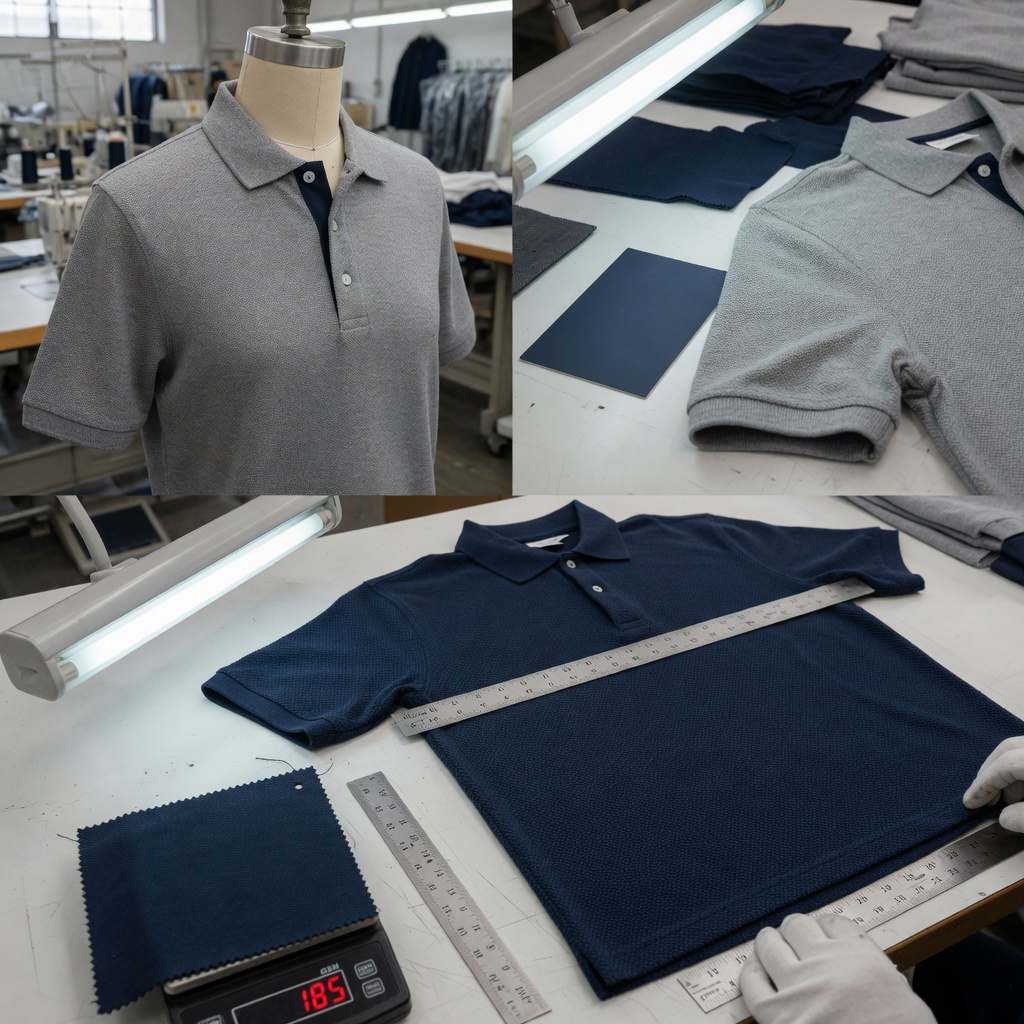
Manufacturer guidance on eco-friendly polo production lists organic cotton, recycled polyester, bamboo, hemp, and TENCEL as candidate fibers, discussed with GOTS and OEKO-TEX documentation (Eco-Friendly POLO Shirt Manufacturing Guide). A yarn-and-garment sourcing page describes GOTS-certified organic cotton polo shirts at 180–280 GSM (unit: grams per square meter; scope: organic-cotton polo constructions as published on that page; as-of: as stated on the cited live page at the time of this editorial synthesis, not independently weighed) and finished-garment MOQs starting at 300 pieces (unit: finished garments; scope: starting MOQ cited for that organic-cotton polo construction on the same page; as-of: as published there, not a capacity guarantee) (Organic Cotton Yarn for Polo Shirts). Reconfirm both figures on the live quote. Request recycled polyester with GRS or equivalent chain-of-custody. The cited fabric guide treats solution dyeing as a process-efficiency option for recycled PET; a GRS certificate does not answer a buyer-written policy on biodegradability or microfiber shedding—add those as separate RFQ lines if required (Sourcing Eco-Friendly Fabric: A B2B Guide). Mid-weight piqué in that published GSM band is described on the organic-cotton polo page for pilling resistance and collar retention versus a lighter jersey, at the cost of more yarn per garment. Example specification to verify in the supplier quote (not a measured result and not a Vanta Workwear specification): 220 GSM piqué inside the cited 180–280 GSM band, with a mill bill of materials showing grams of yarn per garment and expected cutting waste.
United States labeling, landed cost, and delivery controls
United States buyers remain responsible for Textile Fiber Products Identification Act labeling (fiber percentages by generic fiber name, RN or WPL identification, country of origin), care instructions under the Care Labeling Rule, and accurate entry classification. Unsubstantiated “eco,” “organic,” or “recycled” hangtags can create FTC Green Guides exposure. Distinguish a standard’s rule from a mill’s marketing line: GOTS or GRS defines when a feedstock claim may be used; the sewn-in United States label still has to match 16 CFR 303 fiber names and percentages. Demand a label mock-up that matches the mill certificate, a commercial invoice description that supports HTS classification for the knitted polo construction, and packing data that supports origin. Do not treat an HTS heading suggested by a mill as classification advice; confirm with a licensed customs broker for the actual fiber, gender/construction, and ornamentation.
Model landed cost as FOB mill, freight, insurance, duty (rate depends on exact fiber and construction), and brokerage—unless the quote is truly DDP. Do not assume a sustainability claim creates a duty preference. Specify delivery as production calendar days plus transit under named Incoterms to a United States port or door, with a written buffer for lab-dip, size-set, and document approval. Example planning assumption to replace with the mill’s written capacity (not taken from the cited manufacturer pages): 14 calendar days of approval buffer for lab-dip and size-set before bulk fabric is cut. A polo that cannot clear entry, or that fails a care or fiber-content claim, is not a successful sustainable purchase.
Fabric feedstock and certification criteria for polo shirts
Use only named fiber systems the mill can document for the polo article that will ship. Recycled-polyester feedstock should carry GRS or equivalent chain-of-custody covering yarn or fabric. B2B fabric-evaluation guidance additionally points to recycled PET origin, process efficiency, GRS, OEKO-TEX, and bluesign®, plus lab reports for pilling and colorfastness (Sourcing Eco-Friendly Fabric: A B2B Guide). A standard defines rules; a current certificate for the named site and article is the proof. Ask for certificate numbers, validity dates, product-category scope, and whether dyeing and finishing are included. For blends, require percentages and which component carries which claim.
Specify regenerated cellulosics marketed as bamboo by process (viscose versus lyocell-type) and effluent controls. United States sewn-in labels must use the generic fiber name required by the Textile Fiber Products Identification Act, not plant-origin advertising alone. If a mill proposes the TENCEL name on a hangtag or invoice, require current brand-authorization and fiber-composition documents that match the United States label copy. Example certificate-scope check to confirm on the live PDF (not a claim that any mill currently holds it): OEKO-TEX STANDARD 100 product class II for skin-contact garments, with the article description matching the polo that will ship.
Piqué (or another named knit) and a target GSM must sit inside the mill’s quoted construction, not only inside the published 180–280 GSM band. Replace the 220 GSM example with the mill’s marker data before approving bulk.
Process efficiency: water, energy, chemicals, and color
Name the coloration method (exhaust, continuous, or solution/dope dyeing for synthetics), whether wastewater treatment is documented, and whether a mill RSL or ZDHC-aligned MRSL applies. Solution dyeing of recycled polyester is cited as a process-efficiency lever because pigment is added in the polymer, reducing later water and chemical load in the dyehouse (Sourcing Eco-Friendly Fabric: A B2B Guide). Cotton polo dyeing claims should identify dye class and mill effluent summaries, not a lifestyle photograph. Require bulk-lot lab reports for colorfastness to washing, perspiration, and light, and for pilling, using methods the United States QA file already names. Example methods to put on the RFQ and then replace with the buyer’s written QA manual (not results from this editorial and not from the cited manufacturer pages): AATCC TM61 for washing, AATCC TM15 for perspiration, AATCC TM16.3 or equivalent for light, ISO 12945 or equivalent for pilling, and AATCC TM135 or TM150 for dimensional change after the wash route that will appear on the care label. Example grade floor to verify against that QA manual (assumption only): washing colorfastness grade 4 on AATCC TM61, 2A.
Durability belongs in the sustainability case: a collar that rolls or a face that pills after limited laundering shortens service life and offsets upstream fiber choices. Chemical management should include a current OEKO-TEX STANDARD 100 (or equivalent) certificate plus, if the buyer maintains a corporate RSL, a signed mapping and a random-test protocol on bulk. “Azo-free” by itself is not an RSL. Knitting, dyeing/finishing, and cut-and-sew may be different legal entities; require a process map and attach certificates to each named site.
Labor conditions, ethical audits, and forced-labor due diligence
Ethical labor practices, including SA8000, are listed among the documents manufacturers should be prepared to supply for eco-friendly polo programs (Eco-Friendly POLO Shirt Manufacturing Guide). United States RFQs may also name SMETA, BSCI, or a buyer-equivalent third-party social audit when the report is recent, covers the actual knitting and sewing sites, and is not only a self-assessment. That acceptance list is a buyer-side control to write into the RFQ, not a prevalence statistic and not a finding from the cited pages. Example control to set in the RFQ (assumption to align with the buyer’s written policy, not a statutory period and not a figure from the cited manufacturer pages): maximum audit age of 12 months, with audit type, date, non-conformance summary, and corrective-action status attached.
Forced-labor due diligence for United States import, including UFLPA-related CBP detention risk, is a separate legal overlay. Request country of origin and, for cotton, regional mapping sufficient for the buyer’s risk process even when the environmental story is GOTS or GRS. Specify packaging as recycled or certified paper, reduced polybag gauge, or bulk pack; green packaging is mentioned in manufacturer eco-polo guidance and should appear as a quoted line item with recycled-content evidence rather than as an uncosted promise.
Traceability, claims substantiation, and lot control
Require GOTS and/or GRS transaction certificates that list the order or the mill production lot. Platform QR codes help only if they resolve to the same PDFs. Keep marketing copy off the garment and off customer-facing pages until counsel has reviewed the certificates against FTC Green Guides. OEKO-TEX does not by itself prove organic or recycled feedstock. A GOTS or GRS scope certificate is not a substitute for a transaction certificate on the bulk lot. Keep a single document pack: mill certificates, dyehouse certificates, social audit, test reports, and packing specifications, all matching the commercial invoice and the sealed sample.
Sustainability sourcing criteria decision table for polo shirt procurement
| Criterion | Why it matters for United States polo shirt procurement | What to specify or request | How to verify | Typical trade-off |
|---|---|---|---|---|
| Feedstock (GOTS organic cotton vs GRS rPET vs lyocell) | Fiber claim, chemical profile, and any buyer Scope 3 template | Named standard, % by weight, origin region if required | Transaction certificate matching the lot | Organic cotton: higher cost, possible shade limits; rPET: buyer may still require separate microfiber language |
| Fabric construction | Wear life, collar roll, pilling, laundry performance | Piqué (or named alternative), GSM inside the 180–280 range cited for organic polos, stitch density | GSM check on bulk, pilling test, washed appearance | Higher GSM uses more fiber and can raise unit cost |
| Chemical / RSL | Consumer safety, brand RSL, wastewater | OEKO-TEX STANDARD 100 product class, mill RSL, test protocol | Valid certificate plus random AATCC/ISO tests on bulk | Extra testing time and cost |
| Dyeing method | Water and energy in coloration | Exhaust vs solution dye; mill effluent summary | Process declaration plus third-party mill report if claimed | Solution dye limited to synthetics and some color ranges |
| Social compliance | Import risk and working conditions | SA8000, SMETA, or BSCI as named in the RFQ; date within buyer window | Full report covering actual sites and CAP close-out | Audit cost often in price; site must be the actual factory |
| Chain of custody | Prevents mixing with conventional fiber | GOTS or GRS TC for the order | Certificate number and product description match the PO | Admin lead time; not every mill can issue TCs |
| US labeling and origin | FTC and CBP compliance | Fiber %, RN/WPL, COO, care; invoice description | Label mock-up plus production sample | Delay if specified late |
| Durability / replacement rate | True impact reduction | Colorfastness, shrinkage, pilling, seam strength | Lab reports on bulk, not only proto | Tighter specs can raise seconds |
| MOQ and lead time | Fits United States roll-out and inventory | Confirm against the 300-piece starting point cited for some organic finished polos, or mill’s actual number | Written quote | Certified programs sometimes higher MOQ |
| Packaging | Inbound waste and cube | Recycled content, reduced poly, carton specs | Spec sheet and pack-out photo | Slight cost or extra MOQ for special pack |
| Landed cost and delivery | Budget and in-use date | Incoterms, United States destination, freight, duty path, production plus transit calendar | Line-item quote and written capacity | DDP vs FOB shifts risk; sustainability claims do not set duty |
Verify the published 180–280 GSM band (grams per square meter; organic-cotton polo constructions on the cited yarn/polo page; as-of that live page at editorial synthesis) and the 300-piece finished-garment starting MOQ (finished garments; starting MOQ on the same page; as-of that live page) against the actual mill, color, and season.
Practical RFQ checklist for polo shirt sustainability sourcing criteria
Attach these as numbered RFQ line items and as a pre-production gate. Each item should produce a document, a measurement, or a yes/no with evidence.
Spec lock
- State exact fiber composition by percentage and the claim (GOTS organic cotton, GRS recycled polyester, lyocell including any branded TENCEL only if documented, or named blend) and require matching mill certificates.
- Specify knit type (piqué unless another structure is justified), target GSM (example to verify in the quote, not a measured result: 200–220 GSM inside the cited 180–280 band), and finished measurements per size.
- Specify colorfastness (washing, perspiration, light) and pilling methods and the minimum grades United States QA will accept; name the AATCC or ISO methods in the RFQ.
- Require shrinkage and twist after a stated wash method that matches the care label (home or industrial).
Lot-matched evidence
- Require GOTS and/or GRS transaction certificates covering the production lot, with validity dates and product description.
- Require OEKO-TEX STANDARD 100 (or equivalent) certificate for the finished article or fabric, including product class.
- If bluesign® or mill STeP is claimed, attach the current scope certificate for the dyeing and finishing site.
- Name the social-audit standard (SA8000, SMETA 4-pillar, BSCI, or buyer equivalent) and maximum report age; require CAP status for knitting and sewing sites.
- Request a chemical RSL declaration aligned to the buyer’s list or to OEKO-TEX/ZDHC, plus a random-test plan on bulk.
United States labeling, origin, and claims
- Provide United States label copy: generic fiber names and percentages, RN/WPL or equivalent, country of origin, care; require mock-up before bulk.
- Require country-of-origin and, if cotton, regional mapping sufficient for the buyer’s UFLPA due-diligence process.
- State that no green hangtag or website claim will be used unless counsel approves it against the supplied certificates and FTC Green Guides.
Landed cost, delivery, MOQ, and packaging
- State Incoterms, United States destination, and requested production plus transit calendar; ask for written capacity confirmation.
- Request a landed-cost breakdown (FOB, freight estimate; duty remains buyer-side unless DDP) and an itemized certified-fiber surcharge if any.
- Quote packaging: recycled polybag or paper, carton recycled content, units per carton, and cube.
- Ask whether certified fiber changes lab-dip, size-set, or bulk start dates.
- Confirm MOQ against the 300-piece starting figure cited for some organic-cotton finished polos, or the mill’s actual number for the colorway and size run.
Bulk gate
- Require that bulk production cannot start until documents and sealed samples are approved in writing.
Evidence, methodology, and limitations
Source context 1: A manufacturer blog on eco-friendly polo shirt manufacturing lists candidate fibers, GOTS, OEKO-TEX, SA8000, dyeing, labor, packaging, documentation, and MOQ discussion (Eco-Friendly POLO Shirt Manufacturing Guide). Source context 2: An organic-cotton yarn and polo page supplies the 180–280 GSM range, piqué quality notes, GOTS framing for ESG and Scope 3, and a 300-piece finished-garment MOQ starting point (Organic Cotton Yarn for Polo Shirts). Source context 3: A B2B eco-fabric sourcing guide emphasizes recycled PET feedstock, solution dyeing, wastewater, durability, GRS, OEKO-TEX, bluesign®, and lab reports for pilling and colorfastness (Sourcing Eco-Friendly Fabric: A B2B Guide).
Methodology: This article is an editorial synthesis of those three public pages plus publicly stated United States importer controls for textile labeling, entry, and forced-labor due diligence. GSM and MOQ figures are reproduced as published; they were not independently measured, and no mill interview or laboratory test was conducted for this briefing. Limitations: Certificate validity, actual GSM of a quoted fabric, true MOQ, audit dates, duty rates, and transit times change and must come from the live quote and current PDFs. The 180–280 GSM band and 300-piece MOQ are source figures, not a Vanta Workwear specification. Example targets such as 220 GSM, a 200–220 GSM RFQ band, a 14-calendar-day approval buffer, a 12-month audit-age window, STANDARD 100 product class II, and a grade-4 washing-colorfastness floor are assumptions for the buyer to replace with mill BOM, marker data, current certificates, and the buyer’s written policy. United States legal compliance (FTC labeling, CBP classification, UFLPA due diligence, any applicable state chemical rules) remains the importer’s responsibility. Do not treat this page as proof that any factory is currently certified.
Discuss Your Requirements
Review our manufacturing capabilities, then share your specifications for a supplier-fit review.