Safety Apparel OEM Product Development Capability for United Arab Emirates Procurement
By Vincent Xi, Editorial Author. Profile: https://www.vantaworkwear.com/authors/vincent-xi/
United Arab Emirates procurement teams assessing safety apparel OEM product development capability must qualify five core milestones before funding physical sampling: design file ownership, technical package freeze, material property verification, gated prototype approvals, and production release criteria. Treating an OEM product development engagement as a formal engineering checkpoint rather than an informal styling exercise prevents production delays and mismatched performance specifications. Industry accounts of custom workwear manufacturing show a sequential framework: collaborative design, technical package generation, high-performance fabric selection, sample order prototyping, seam and waterproof quality checks, bulk manufacturing, and customized packaging (How Safety Clothing Manufacturers Offer Custom Solutions). In industrial design practice, staged development structures follow defined milestones such as vision, definition with prototyping, specification, verification against standards, optimization, realisation, and implementation (Safety Equipment Development & Design). Neither reference documents Vanta Workwear factory metrics or guaranteed United Arab Emirates delivery terms; instead, buyers should use these structural benchmarks to audit a bidder's technical competency.
This article focuses strictly on safety apparel manufacturing and technical product-development workflows. It does not measure keyword search metrics or replace project-specific testing, customs advisories, or commercial supplier quotes.
Product Development Capability United Arab Emirates Buyers Should Lock Before Sampling
For procurement teams based in the United Arab Emirates, an OEM's product development capability must be measured by how systematically the factory translates a technical brief into an auditable garment specification. When sourcing high-visibility, flame-resistant, or general industrial safety apparel, buyers should mandate clear stage-gate documentation before issuing sample purchase orders.
Publicly documented custom workwear workflows detail 7 activity groups: collaborative design utilizing 3D modeling software, technical package development specifying materials and construction, performance fabric selection, prototype creation through sample orders, internal quality control checks (specifically seam integrity and waterproof testing), mass production, and tailored packaging for reflective and branded safety wear (custom solutions page). Scope note: this tally represents the exact activity categories published on the cited manufacturer page. As-of context: based on source review for this publication; publication date is unspecified in the source text. This count represents an activity structure, not a cycle time or Vanta operational metric.
A documented ballistic garment OEM project illustrates an analogous technical development workflow: design specifications with computer-aided design (CAD) patterning, prototype development paired with ergonomic fit trials, in-house ballistic screening, automated production runs with ISO quality controls, and formal third-party certification testing (Inside A Ballistic Vest OEM Project). That case study enumerates 5 sequential project blocks (design/CAD, prototyping/fit, in-house pre-testing, ISO mass production, and accredited lab testing). Scope and as-of context: extracted from the cited case study documentation for gate-structure comparison only. Ballistic-specific testing protocols must not be applied to standard industrial safety garments unless ballistic threat protection is contractually specified.
Specific United Arab Emirates customs paperwork, regional climate testing (such as extended UV stability or high-heat laundering degradation), import labeling rules, and landed shipping durations are not quantified in these technical reference sources. Procurement teams must request verified figures and documentation schedules within the formal quotation.
How Public OEM Development Sequences Are Structured
Documented industrial apparel OEM projects rely on systematic technical phases rather than isolated prototype iterations.
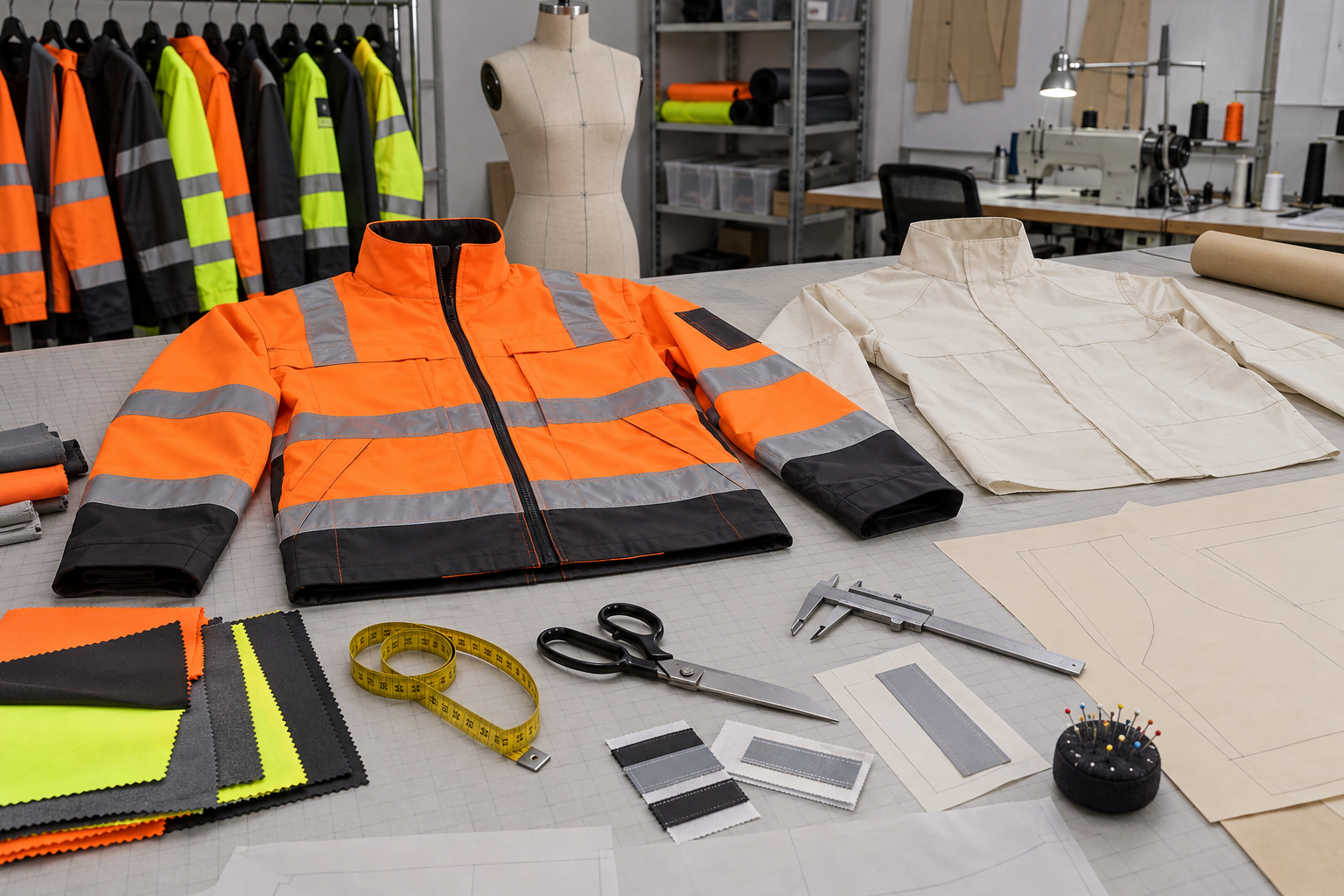
Design Definition and Technical Packaging. Documented custom projects pair initial design ideation with 3D garment visualization and CAD drafting to establish a formal technical package. The technical pack establishes silhouette dimensions, seam constructions, stitch densities, component placement (such as retroreflective bands), and size-grading charts. If grading tolerances are not formally approved in the tech pack, approving a sample in size Large does not validate the production pattern for smaller or larger sizes.
Raw Material Selection and Freezing. Industry frameworks position performance fabric selection prior to prototype assembly. Buyers must define essential properties—such as tear strength, retroreflective photometric performance, flame resistance, or water column resistance—and require the supplier to freeze the exact mill reference. Substituting raw materials during production without a formal re-sampling gate introduces substantial risk of non-compliance.
Prototyping and Ergonomic Fit. Technical OEM workflows treat sample production as a measurable validation gate. Prototyping must include dimensional verification against the tech pack and structured ergonomic evaluation. Fit approval should be governed by measurable physical tolerances on standard forms or defined trial rubrics rather than aesthetic impressions.
Verification Testing. Design-house development accounts position verification against standards immediately after engineering specification. Specialized OEM sources separate preliminary in-house screening from accredited third-party lab testing. An internal screening test verifies baseline construction but does not constitute accredited regulatory compliance. Design firm documentation indicates support across 6 safety compliance frameworks: UL, NFPA, CE, ISO, NIOSH, and EN (MMID Group). Scope and as-of context: manual count of distinct frameworks enumerated in cited text as of source review. This list reflects that organization's reported engineering scope; it is not a Vanta Workwear compliance claim or a guarantee that any single garment meets all listed frameworks.
Production Release and Packaging. Final bulk release requires verified pre-production sign-off followed by quality-controlled assembly and secondary packaging. Packaging specifications must be established during development to protect reflective materials and ensure importer labeling conforms to shipping requirements.
Measurable Trade-offs in Design, Sampling, and Production Release
Development workflows involve structural trade-offs between timeline velocity, upfront development expense, and quality control. The cited sources do not publish commercial pricing, minimum order quantities (MOQs), or lead times. The figures below are example calculations and assumptions to verify in the supplier quote; they do not represent market guarantees or Vanta factory schedules.
Example Planning Assumption A: Sample Turnaround Iterations (to verify in quote). Assume 3 prototype development cycles are required. Assume the supplier quotes 8 working days per cycle for CAD pattern adjustments and 7 working days for cut-and-sew garment assembly. Illustrative development duration before bulk production approval: 3 × (8 + 7) = 45 working days. Scope: one garment style, one sample size set, excluding third-party lab queues. Date context: baseline planning model formulated for this review, not empirical factory performance data. If mill fabric delivery times apply, add those lead times directly.
Example Planning Assumption B: Internal Screening Versus Laboratory Lead Time (to verify in quote). Assume an internal seam strength or hydrostatic head screen takes 2 working days, whereas third-party accredited laboratory testing requires 15 working days following sample receipt. If accredited certification is required prior to fabric cutting, the testing lead time adds 15 working days (or 17 working days if conducted sequentially after internal screening). Scope: one testing suite for a single style. Assumptions reflect operational planning estimates to be verified with the selected testing body.
Example Planning Assumption C: Late Bill of Materials (BOM) Revision (to verify in quote). Assume an industrial safety jacket BOM contains 12 distinct components. If a shell fabric change occurs late in development, affecting 4 of the 12 BOM lines, it requires 1 additional prototype iteration. Based on Assumption A, this triggers an illustrative delay of 15 working days plus fabric transit time. Figures are analytical models for quote comparison.
Expanding prototype iterations improves dimensional accuracy and field durability but extends the timeline per Assumption A. Freezing technical packages prematurely accelerates the path to cutting but magnifies financial exposure if materials fail performance criteria per Assumption C. Internal screening provides rapid initial feedback but cannot replace accredited third-party test reports when contractual compliance is mandatory. Digital 3D modeling clarifies visual specifications but cannot evaluate fabric hand-feel, thermal comfort, or seam behavior. Finally, deferring carton marking and import labeling specifications risks customs delays upon arrival in the United Arab Emirates.
Buyer Decision Table for Safety Apparel Manufacturing Gates
Buyers should evaluate OEM bidders against identical development gates using structured verification criteria.
| Development Gate | What the Buyer Specifies | What to Compare on Supplier Quotes | Mandatory Acceptance Evidence | Source Cue |
|---|---|---|---|---|
| Brief & Pattern Ownership | Garment classification, hazards, size matrix, and pattern ownership terms | CAD or 3D development format; terms of pattern asset transfer | Written contract clause confirming transfer of digital CAD patterns | 3D design and technical specification workflows (BW Workwear, ArmorGuard) |
| Technical Package Freeze | Fabric specs, trim dimensions, seam construction, grading charts | Whether complete tech pack is locked before initial sample cutting | Revision-controlled technical package signed by buyer and maker | Technical package creation covering materials and construction (BW Workwear) |
| Raw Material Traceability | Performance metrics (e.g., retroreflection, tensile strength, FR rating) | Policy on raw material substitutions and mill certifications | Mill test certificates and frozen BOM matched to approved sample | Performance fabric selection prior to prototype cutting (BW Workwear) |
| Prototype & Fit Review | Required sample sizes, test criteria, and iteration allowances | Quoted lead time and fee structure per prototype cycle | Dimensional inspection sheet showing measurements against tech pack | Prototyping rounds and ergonomic fit trials (BW Workwear, ArmorGuard) |
| Internal Factory Screening | Non-destructive checks (e.g., seam slippage, water ingress) | Equipment availability, screening method, and reporting format | In-house test report listing test method, parameters, and results | Seam and waterproof testing (BW Workwear); pre-testing (ArmorGuard) |
| Independent Verification | Specific standard designation and accredited lab requirements | Named laboratory, testing scope, and turnaround lead time | Valid accredited test certificate issued for the identical style | Standards verification (MMID Group); accredited lab certification (ArmorGuard) |
| Bulk Production Sign-off | Formal authorization protocol required to trigger bulk fabric cutting | Production release criteria and inline quality control gates | Countersigned production release sheet tied to sealed golden sample | ISO quality-controlled manufacturing execution (ArmorGuard) |
| Packing & Importer Compliance | Polybag specs, carton labeling, and UAE customs document pack | Inclusions in unit cost versus add-on packing and documentation fees | Approved carton markings, packaging spec, and certified packing list | Tailored packaging procedures (BW Workwear) |
Standards Named by Source Pages Versus What a Quote Must Prove
Standards citations must be evaluated rigorously during quotation review. The design consultancy page lists UL, NFPA, CE, ISO, NIOSH, and EN as standards frameworks its engineering supports, while the ballistic project narrative references NIJ compliance and ISO quality control. A standard's regulatory criteria are established solely by the relevant standards organization; a manufacturer's operational capability is demonstrated exclusively by current, style-specific test records and documented quality control procedures.
Third-party website mentions do not imply that Vanta Workwear maintains these certifications. B2B buyers must reject test reports that evaluate a different fabric weight, originate from unaccredited testing bodies, or have lapsed. For non-ballistic safety apparel, ballistic standards such as NIJ are irrelevant and should not appear in technical documentation. If an RFQ mandates EN ISO 20471 (high visibility) or ISO 11612 (heat and flame protection), the buyer must specify the standard and require an accredited laboratory certificate for the specific fabric and garment assembly.
References to "ISO quality control" in project accounts describe quality management procedures; they do not substantiate that a factory holds a current ISO 9001 certification. When procurement guidelines mandate certified quality management, buyers must require the certificate registration number, issuing registrar, audit scope, and expiration date.
RFQ Checklist
- Ask the supplier to list every product-development gate for this safety apparel style, from CAD file generation to final bulk release, confirming which gates are included in the baseline quotation.
- Require the manufacturer to issue a revision-controlled technical package documenting fabric specifications, seam construction, size grading, and component placement before cutting first-round prototypes.
- Specify the exact prototype sample size range, allowable dimensional tolerances, and written fit-acceptance criteria required for sample approval.
- Ask the supplier to separate in-house screening methods from third-party accredited laboratory testing, identifying test protocols, testing facilities, and report lead times.
- Require the manufacturer to submit accredited test certificates matching the exact garment construction and bill of materials for all claimed standard compliance.
- Specify complete carton markings, individual polybag labeling, and mandatory import documentation required by United Arab Emirates customs authorities.
- Require the supplier to provide a detailed milestone schedule incorporating raw material procurement, sampling rounds, testing queues, and bulk production lead times.
- Require the supplier to confirm intellectual property and ownership terms for CAD patterns, grading rules, and specialized tooling if production does not proceed after sampling.
- Specify that bulk production cutting begins only after countersigning a sealed pre-production golden sample and locking the final bill of materials.
Methodology, Source Contexts, and What to Verify
Methodology. Workflow phases and standards references were extracted and synthesized from three published industry resources. The metrics of 7 activity groups, 5 project stages, and 6 standards frameworks represent direct counts from the cited source texts. Planning metrics (45 working days, 15 to 17 working days, and 12 BOM line items) represent mathematical example models for procurement planning rather than empirical factory observations. No search engine optimization volume, cost-per-click, keyword ranking, or search traffic metrics were utilized. No factory audits, wear trials, or client outcomes are claimed.
Source Context 1. A custom workwear manufacturer outlines OEM/ODM development as a process covering 3D design collaboration, technical packages, fabric selection, prototype sampling, seam and waterproof testing, bulk production, and tailored packaging. URL: https://www.bwworkwear.com/how-safety-clothing-manufacturers-offer-custom-solutions/
Source Context 2. MMID Group details an engineering development model (LUCID) and lists technical design capability supporting UL, NFPA, CE, ISO, NIOSH, and EN standards for safety-critical products. URL: https://mmid-group.com/safety-security-product-design/
Source Context 3. ArmorGuard describes an OEM manufacturing cycle for protective vest development, covering CAD specification, prototype fit evaluations, in-house ballistic pre-testing, automated ISO production, and accredited NIJ testing. URL: https://armorguard.com/inside-a-ballistic-vest-oem-project-from-design-to-nij-testing/
Limitations and What to Verify. These public sources do not provide commercial pricing, minimum order quantities, prototype sample fees, standard turnaround schedules, or specific United Arab Emirates customs regulations. They do not constitute an audit of Vanta Workwear facilities or grant certification authority. Buyers must independently verify active testing standards, laboratory accreditations, landed duty structures, and supplier quotations before issuing purchase orders.
Author Note. Vincent Xi is the Editorial Author for this publication. Author profile: https://www.vantaworkwear.com/authors/vincent-xi/. Job title: Editorial Author. No first-person factory visits, proprietary laboratory tests, or customer deployment metrics are claimed. Editorial analysis is grounded solely on published technical literature and publicly available industry documentation.
Discuss Your Requirements
Review our manufacturing capabilities, then share your specifications for a supplier-fit review.