Sustainability Sourcing Criteria for Scrubs Procurement in Australia
By Vincent Xi, Editorial Author
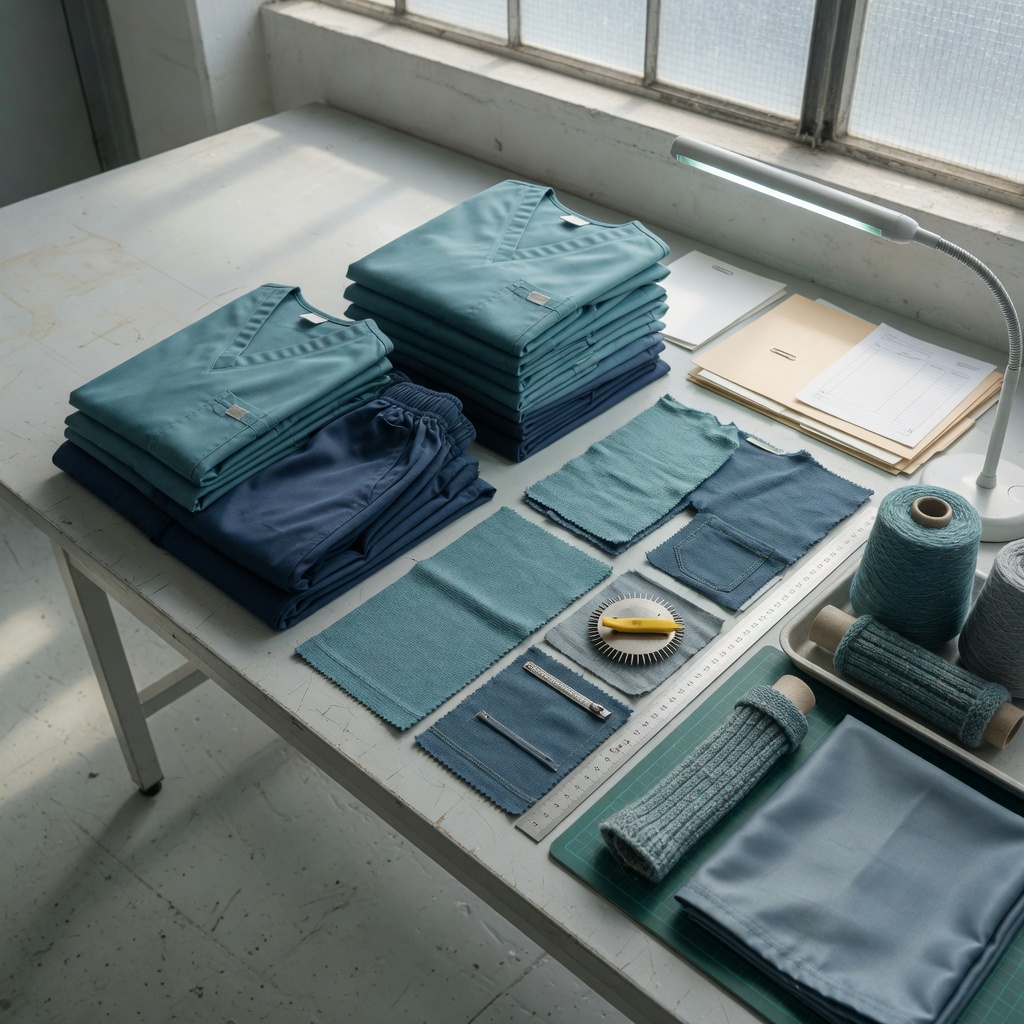
Australian procurement teams should award reusable scrubs against written sustainability sourcing criteria, not against unit price plus an unscoped eco label. Convert those criteria into bid fields: fibre mass fraction, mill legal name, certificate scope, restricted-substance evidence, subcontractor labour monitoring, a named durability test method, and a defined end-of-life route. Publish the weights in the procurement RFQ and fail bids that cannot match documents to the sites that will actually cut and sew.
Independent healthcare procurement guidance on reusable textiles, including medical scrubs, frames environmental and social requirements as part of the best price-quality ratio rather than as extras after unit price is locked. Sustainable procurement criteria for reusable textiles
A documented European hospital workwear tender scored fabric traceability, number of subcontractors and labour-condition monitoring, then awarded a mechanically recycled polyester and lyocell blend for a large staff replacement programme. Tailored for Change: Procuring Sustainable Workwear at Ghent University Hospital
That case is one hospital programme as reported in the EU Green Public Procurement good-practice library. It is not a contract outcome in Australia and it is not a product test for any named supplier. It still gives buyers a usable pattern: name the evidence, name the mill, name the test method, and reject unscoped eco labels.
Vincent Xi is the named Editorial Author for this briefing (author profile). This page does not claim factory visits, wear trials, certifications, awards, or client outcomes. The criteria below are derived from published reusable-textile procurement criteria, a documented hospital tender, and manufacturer-facing B2B vetting questions that buyers can copy into an RFQ.
How to apply sustainability sourcing criteria for scrubs procurement in Australia
Keep the product family as scrubs (reusable clinical tops and pants; include a matching jacket only when it is part of the same uniform set). Keep the task as procurement: specify, compare, verify, approve, then order.
Award only after sample, test and packaging evidence match the bid. Hold if certificates name a parent company rather than the production site, or if take-back is described as planned with no receiving facility type. Fail eco slogans, expired documents, unnamed mills, and social audits for a factory that is not the sewing line.
Sequence for buyers in Australia:
- Define the wear environment the bidder must design to (ward, theatre support, outpatient, aged care, and the industrial-laundry cycle the buyer records).
- Convert sustainability into measurable bid fields (fibre mass fraction, mill identity, certificate scope, chemical test method, repair/return route).
- Weight those fields in the evaluation model before prices are opened.
- Verify documents against the actual production sites named in the bid, not against a brand's parent company.
- Place a first order only after sample, test and packaging evidence match the award criteria.
European public-procurement criteria for reusable healthcare textiles consolidate minimum social, environmental and chemical expectations drawn from the EU Public Procurement Directive, REACH and the Medical Device Regulation. Sustainable procurement criteria for reusable textiles Those instruments are European legal baselines. They are not statutes in Australia. Use them as a structured checklist of issues (chemistry, labour, reusable-textile performance), then map each issue to the buyer's own legal, infection-control and import requirements.
A manufacturer-facing B2B briefing on sustainable medical uniforms describes buyer demand in certificate language: GOTS, OEKO-TEX Standard 100, GRS, BSCI/WRAP and ISO 14001, plus a five-question vetting matrix covering named scope certificates, mill disclosure, third-party fabric tests, MOQ flexibility and recyclable packaging (unit: five questions; scope: that manufacturer-facing checklist; as-of: the cited page; not proof that any factory holds current documents). Sustainable Medical Uniforms Manufacturer Treat that list as a request template, not as a vendor recommendation.
Fibre, recycled content and mill disclosure
Fibre comes first because it drives feedstock, dyeing behaviour, laundry life and end-of-life options.
- Mass fraction and process. If recycled polyester is offered, state mechanically recycled versus chemically recycled, the claimed percentage by mass, and whether the claim covers yarn, fabric or finished garment. Ask whether the recycled-content claim is a physically segregated yarn or a certified mass-balance allocation, and require the mill on the certificate to match the yarn in the bid fabric. The Ghent University Hospital award used a 65% mechanically recycled polyester / 35% lyocell blend (unit: percent fibre mass; scope: the awarded workwear fabric in that tender, as reported in the EU good-practice case; as-of: that case write-up; re-check the live source page for any later correction). Tailored for Change: Procuring Sustainable Workwear at Ghent University Hospital
- Named mills. "Recycled polyester from our approved mill network" is not disclosure. Require mill legal name, country of processing, and the certificate that matches that site and product group. Country of processing is a traceability field, not a sales-market target.
- Cellulosic claims. Lyocell and other man-made cellulosics need forest-source or dissolving-pulp evidence plus solvent-recovery claims that can be tied to a mill audit, not a hangtag.
- Organic versus recycled versus virgin synthetic. Organic, recycled and cellulosic routes are the usual alternatives to virgin synthetics in sustainable-uniform briefing language. Sustainable Medical Uniforms Manufacturer Do not treat those route names as equivalent. If a bidder claims organic cotton, recycled polyester or a viscose-route cellulosic, require the matching mill-named certificate and ask how colour, tensile results and the recycled or organic claim hold if a yarn lot is substituted.
Do not invent a freight-emissions number in the RFQ if the buyer cannot verify the calculation. Do require a bill of materials that still holds after a colour, GSM or trim change.
Chemistry, restricted substances and dyeing claims
Healthcare laundry, skin contact and residual finishing agents sit on the same garment, so chemistry belongs in the RFQ as a scored field.
- Restricted-substance evidence at fabric and, where relevant, trims (buttons, zips, prints, heat transfers). OEKO-TEX Standard 100 is commonly requested as a product-level chemical screen in B2B medical-uniform briefings. Sustainable Medical Uniforms Manufacturer It is not a life-cycle certification and it is not a labour audit. Ask for the certificate number, product class, expiry, and whether it covers the actual colourways, prints and trims in the bid.
- Dye and finish process claims. "Low-impact dye" is not a test. Request the dye class, whether the mill can provide wastewater and chemical-inventory documentation, and whether any antimicrobial, soil-release or moisture-management finish is applied. If a finish is applied, require the chemical identity or at least the trade name plus SDS and a statement of residual limits after industrial laundry.
- European chemical baseline as a mapping aid. The reusable-textile criteria document treats REACH-related chemical expectations as a minimum environmental and chemical standard for medical textiles including scrubs in its European scope. Sustainable procurement criteria for reusable textiles Buyers in Australia should not copy-paste REACH as if it were local law. They should still ask which substances of concern are excluded, how that exclusion is tested, and who pays for retesting if a dye lot changes.
- Medical-device boundary. The same European document references Medical Device Regulation requirements among minimum standards for medical textiles. Treat everyday reusable ward scrubs as apparel unless the buyer's specification makes a lot a regulated medical device. If a buyer is specifying barrier or sterile-associated garments, separate that lot in the RFQ so chemical and conformity evidence is not mixed with everyday uniforms.
Measurable trade-off to score, not a proven outcome: tighter chemical limits and named dyehouses can reduce mill choice and extend lead time; loose chemical language invites unverified chemistry that may fail later in laundry or occupational-health review. Require the bidder to state that trade-off in the bid rather than leaving it implicit.
Social compliance, subcontractors and labour monitoring
A lower environmental footprint produced through undeclared subcontract sewing is not a complete sustainability criterion.
The Ghent University Hospital negotiation scored bidders on fabric traceability, number of subcontractors and labour-condition monitoring, and required the awarded solution to meet ILO conventions as reported in the case. Staff scope for the replacement programme was more than 4,000 people (unit: people, programme headcount; scope: that hospital's workwear replacement, as reported in the EU good-practice case; as-of: that case write-up; not a national figure for Australia). Tailored for Change: Procuring Sustainable Workwear at Ghent University Hospital
Copy the evidence logic, not the geography:
- Cap or disclose subcontracting tiers for cutting, sewing, embroidery and packing.
- Require a current social-audit family that matches the sewing site (BSCI or WRAP are named in manufacturer-facing buyer lists; SA8000 or equivalent buyer-nominated schemes can be substituted if the buyer already uses them). Sustainable Medical Uniforms Manufacturer
- Ask how labour conditions are monitored between audit dates: grievance route, unannounced visits, and whether homeworking or unauthorized satellite lines are prohibited.
- Tie mill disclosure to social disclosure. A GRS or GOTS scope certificate that names a spinning mill does not prove the garment factory's working hours.
ISO 14001, where offered, is an environmental-management-system certificate for a named organization and site. It is not a product eco-label and not a social certificate. Request the certificate's scope statement and expiry, then read it. Do not treat a sewing-factory ISO 14001 as fibre proof.
Circularity, durability and end-of-life for healthcare scrubs
Criteria that stop at recycled content fail in healthcare because scrubs are a reusable textile subject to industrial laundry and abrasion at pockets, seams and knees.
- Service life in laundry cycles, not "durable quality." Ask for the test method (for example dimensional stability, colour fastness to washing, pilling, tensile or seam strength) and the industrial-laundry assumptions (temperature, chemistry, dryer). If the supplier cannot name a method, do not treat durability as evidenced.
- Repair and replacement rules. Ask which components the supplier's laundry or incoming-inspection data show fail first, whether the bid includes spare parts or repair credits, and the defined reject rate on incoming inspection. Do not award on untested claims about pocket bags, drawcords or side vents.
- Take-back or recyclability. Recyclable packaging appears on the manufacturer-facing vetting checklist cited above; that page is a document request template, not proof of any factory's current pack. Sustainable Medical Uniforms Manufacturer Garment recyclability is a separate bid field. A polyester-lyocell blend can raise recycled content and change hand-feel compared with a mono-material polyester; ask the bidder to state the take-back pathway and whether fibre-to-fibre recovery is actually available for that blend. A take-back offer should name the receiving facility type (downcycling, shredding, or fibre recovery) and who pays return freight from the buyer's delivery points in Australia.
- User comfort as a scored item. The Ghent negotiation weighted sustainability, CSR, circularity and user comfort above price in a five-phase competitive negotiation (unit: five process phases; scope: that hospital's workwear replacement tender, as reported; as-of: the EU good-practice case). Tailored for Change: Procuring Sustainable Workwear at Ghent University Hospital Put wearer trials on a sample set with a recorded scoring sheet. Do not treat comfort copy as a substitute for those scores.
Measurable trade-offs buyers should score
Write the exchanges into the evaluation model so the cheapest unproven bid does not win by default.
| Trade-off | What can improve | What to verify as a risk | How to measure in the bid |
|---|---|---|---|
| Higher mechanically recycled polyester content | Lower virgin feedstock share | Shade variation; tensile or pilling change; mass-balance versus physical recycled yarn | Mass % by garment part; mill certificate and accounting method; named physical tests |
| Polyester-lyocell blend versus 100% polyester | Comfort and cellulosic moisture handling, if wearer trials confirm it | End-of-life fibre separation | Blend %; wearer-trial scores; take-back pathway statement |
| Named mill + limited subcontractors | Traceability and labour monitoring | Capacity, MOQ, longer lead time | Mill list; subcontractor map; audit date and expiry |
| Tight chemical / dyehouse evidence | Residual chemistry control | Colour range and cost | Certificate scope; lot retest rule |
| Recyclable packaging and take-back | Downstream waste route | Return-freight cost from delivery points in Australia | Packaging spec; Incoterms; who pays return freight |
| Weighting sustainability above unit price | Comparable ESG scoring | Need for a competent evaluation panel | Declared weights published in the RFQ |
Price still belongs in the model. The European reusable-textile criteria recommend a best price-quality ratio that incorporates environmental and social award criteria. Sustainable procurement criteria for reusable textiles The Ghent case is one example of weights that put sustainability, CSR, circularity and comfort above price. Tailored for Change: Procuring Sustainable Workwear at Ghent University Hospital Buyers in Australia can choose different weights; they should not leave weights unpublished.
MOQ flexibility sits in the manufacturer-facing vetting matrix on the cited page. Sustainable Medical Uniforms Manufacturer Ask for the break points: sample MOQ, pilot MOQ, and full-rollout MOQ per colour and size run, and whether mixed sizes in one colour share a dye lot.
Buyer decision table: evidence versus fail condition
Use this table to compare bids for scrubs procurement in Australia. Every row is a specify / verify / approve action.
| Criterion | What to specify | Evidence to request | Fail or hold condition |
|---|---|---|---|
| Fibre claim | Mass %; virgin / recycled / organic / cellulosic; garment part covered; segregated versus mass-balance accounting | Scope certificate (e.g. GRS, GOTS) naming mill and product; bill of materials | Certificate expired, parent-company only, % that does not match the offered fabric, or accounting method that is not disclosed |
| Mill disclosure | Legal name and process step (spin, knit/weave, dye, cut-sew) | Mill list matching certificates; process flow | Unnamed "partner mills" or mills that change after award without re-approval |
| Chemical safety | Product class, colourways, finishes excluded or declared | OEKO-TEX Standard 100 or equivalent test report; SDS for functional finishes | Certificate that excludes prints/trims actually used |
| Dyeing / water-chemistry claims | Named dyehouse; what is measured | Mill environmental documents; whether wastewater is on-site treated | Narrative "eco dye" with no site or method |
| Social compliance | Sewing site plus subcontractors | Current audit (BSCI/WRAP or buyer-nominated); ILO-aligned policy as bid text | Audit on a different factory than the sewing line |
| Subcontracting | Maximum tiers; embroidery and packing included | Written subcontractor map; change-control clause | Hidden satellite sewing discovered at inspection |
| Durability | Laundry-cycle assumption and test methods | Lab reports on the bid fabric, not a "similar" quality | No method named; results from a different GSM |
| Circularity | Packaging; take-back; mono vs blend implications | Packaging spec; take-back operator and destination type | Take-back that is "planned" with no facility |
| Comfort / fit | Size set, fabric hand, recorded wearer scores | Sample set in production fabric and a scoring sheet | Samples that are a different fabric to bulk |
| Commercial fit | MOQ, lead time to the named delivery point in Australia, split shipments | Written MOQ ladder and production calendar | MOQ that forces over-buy of slow sizes |
| Management system (optional) | Named site only | ISO 14001 certificate and scope text | Using ISO 14001 as if it were a product eco-label |
Practical RFQ checklist for scrubs procurement
Copy these items into the RFQ. Each line should produce a document, a sample, or a contractual clause.
- State that the bid is for reusable scrubs (list SKUs: top, pant, optional jacket only if it is part of the same set) and that evaluation is a procurement exercise using published weights, not a design contest.
- Require fibre composition by mass for each SKU, with recycled or organic claims tied to a named mill, a named certificate scope, and a stated accounting method (physical segregation or mass balance).
- Require mill disclosure for spinning, fabric formation, dyeing/finishing and cut-and-sew, including country and legal entity.
- Require third-party fabric tests on the actual bid quality: composition, colour fastness to washing, dimensional stability, pilling and seam strength, with the laboratory and test methods named.
- Require chemical evidence covering fabric, sewing thread, prints and trims; list any antimicrobial or performance finish as a separate line item with SDS.
- Require a current social-compliance audit for the sewing site and a written subcontracting map that includes embroidery and packing.
- Cap unauthorized subcontracting and require written approval plus re-audit before any site change.
- State industrial-laundry assumptions used by the buyer (or ask the supplier to declare theirs) so durability claims can be compared.
- Require a sample set in production fabric, not sales-closet leftovers, in the size run that will be ordered first, with a recorded wearer-score sheet if comfort is weighted.
- Require MOQ by colour and the rule for mixed sizes; state whether a pilot quantity is allowed before full rollout in Australia.
- Require packaging specification (recycled content, polybag presence, carton composition) and who removes incoming plastic at the warehouse.
- Require an end-of-life statement: landfill, incineration, mechanical downcycling, or fibre recovery, and whether return freight from delivery points in Australia is included.
- Require certificate PDFs with legal entity, site, product group, standard name, and expiry date; screenshots are not acceptable.
- Require a change-control clause: any mill, dye recipe, GSM or trim change triggers re-submission of tests and certificates before production.
- Declare evaluation weights (price, sustainability, social monitoring, circularity, comfort, delivery) in the RFQ, following the price-quality logic used in reusable-textile procurement criteria. Sustainable procurement criteria for reusable textiles
- Require Incoterms, lead time to the named delivery point in Australia, split-shipment rules, and a production calendar that lists mill shutdowns and forbids silent mill substitution.
- Require incoming-inspection AQL or equivalent (buyer-nominated; do not invent a numeric AQL in the bid unless the buyer already uses one), shade-band approval across cartons, and the rule for dye-lot continuity on replenishment.
- Require names of the people authorised to sign certificate and audit representations, so responsibility is not left on a sales mailbox.
Method, sources, limitations and what to verify
How this briefing was derived. Criteria and examples are taken from three public pages: Health Care Without Harm Europe's sustainable procurement criteria for reusable textiles (healthcare procurer guidance consolidating European legal minima and award-criteria logic); the EU Green Forum good-practice case on Ghent University Hospital's workwear tender (staff count, evaluation emphasis, five-phase negotiation, and the 65/35 mechanically recycled polyester / lyocell award); and a manufacturer-facing page that lists commonly requested certificates and a five-question vetting matrix (named scope certificates, mill disclosure, third-party fabric tests, MOQ flexibility, recyclable packaging). Numbers are used only as published in those materials, with unit, scope and as-of context stated beside each figure. They are not search-demand, traffic or ranking metrics.
Source contexts. (1) Procurer-side reusable-textile criteria for healthcare, including scrubs, written for a European legal setting. (2) One hospital-scale workwear replacement (more than 4,000 staff, unit: people, programme headcount; five-phase competitive negotiation, unit: five process phases; sustainability, CSR, circularity and user comfort weighted above price; awarded 65% mechanically recycled polyester and 35% lyocell, unit: percent fibre mass; ILO conventions and labour-condition monitoring as scored items; scope: that hospital tender as reported; as-of: the EU good-practice case write-up). (3) Supplier-side B2B language about certificate packs and a five-question vetting matrix (unit: five questions; scope: that manufacturer-facing checklist; as-of: the cited page), used here only as a checklist of documents buyers already ask for.
Limitations — verify before award. European directives, REACH and the Medical Device Regulation are not law in Australia. Certificate names (GOTS, OEKO-TEX Standard 100, GRS, BSCI, WRAP, ISO 14001) do not equal current, in-scope, site-matched proof. The Ghent composition, five-phase process and staff figures are as reported in the case write-up; they are not a specification that laundries or infection-control policies in Australia must copy. Water, energy and chemical reductions are often claimed at mill level; this briefing does not treat unpublished mill KPIs as facts. Freight-emissions factors, consumer-labelling detail in Australia, and TGA or state-health apparel rules are not evidenced in the source set and must be checked by the buyer's own compliance team. Expiry dates, scope statements and whether garments are apparel or any form of regulated medical textile are buyer-verification tasks. If a supplier cannot produce named-scope documents for the mills that will actually ship, do not award on narrative sustainability.
Teams in Australia that keep the RFQ this tight will still receive a range of prices. Written sustainability sourcing criteria make that range intelligible for scrubs procurement: same fibre claim, same mill evidence, same chemical and labour pack, then a scored decision.
Discuss Your Requirements
Review our manufacturing capabilities, then share your specifications for a supplier-fit review.