Work Coat OEM Compliance Requirements for Europe
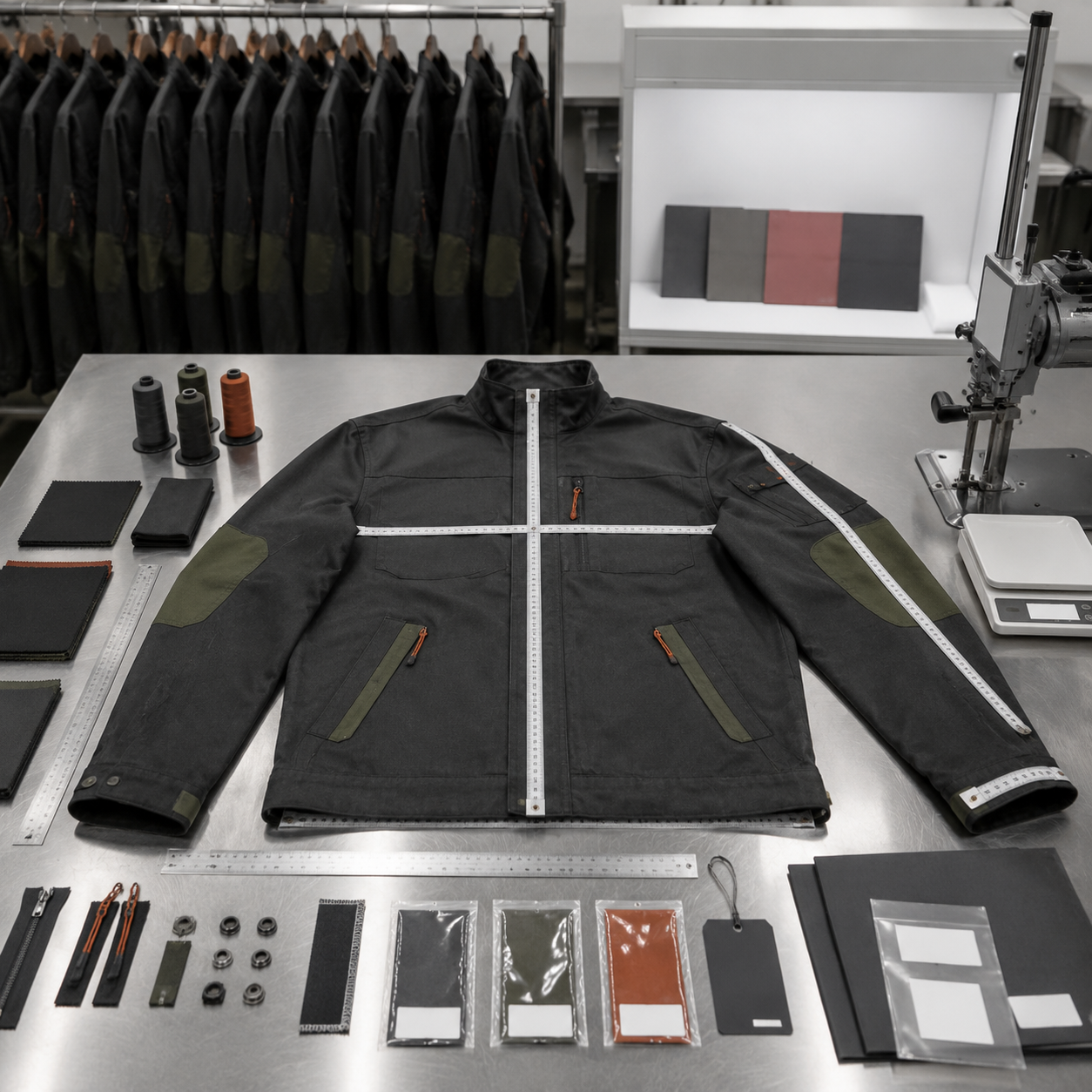
By Vincent Xi, Editorial Author
For a Europe-bound OEM order, define the work coat OEM compliance requirements before a supplier prices the work jacket. A usable RFQ connects intended use and permitted claims to a named destination, controlled garment specification, bill of materials, evidence schedule, cost owner, and release authority. This gives procurement a consistent manufacturing scope for comparing quotes and prevents a broad assurance from standing in for an approval decision.
Do not accept Europe compliant as a complete supplier response. Create separate destination records for each named EU country, EEA destination outside the EU, UK territory, and country-specific overlay identified during destination review. This separation is a buyer-created procurement control; it does not assert that the same rules or different rules apply in every destination. Record manufacturing origin separately for supplier qualification and traceability rather than using it as a substitute for destination review.
Throughout this article, must, required, hold, and release describe proposed buyer controls unless a statement is expressly attributed to a cited source. They are not presented as statutory duties or requirements of a named standard.
Author basis: The Vanta Workwear author profile supports the visible author name, Editorial Author role, and profile URL. No product testing, factory inspection, certification review, customer outcome, or manufacturing-experience claim is attributed to the author.
Europe Compliance Requirements Belong in the Manufacturing RFQ
Build the RFQ around the decisions that determine whether suppliers are pricing the same work jacket and evidence scope.
| RFQ control | Buyer entry | Required supplier return | Hold point |
|---|---|---|---|
| Intended use and claim boundary | Work environment, foreseeable use, permitted claims, prohibited claims, and unresolved classification questions | Written acceptance, exclusions, assumptions, and proposed claim wording | A quote, sample, label, or document introduces an unapproved protective or performance claim |
| Destination route | Named EU country, EEA destination outside the EU, UK territory, or country-specific European destination | Destination-specific scope, document responsibility, artwork inputs, cost, and timing | The response relies only on a generic Europe declaration or carries over another destination's approval without review |
| Controlled garment baseline | Style code, specification revision, measurement method, bill-of-material revision, construction, labels, packaging, and permitted alternatives | Costed confirmation and a complete deviation schedule | The quoted work jacket differs from the comparison baseline without a declared deviation |
| Evidence schedule | Required material, component, finished-garment, declaration, inspection, and traceability records | Evidence register identifying document scope, issuer, holder, date, product match, production connection, and status | Evidence cannot be matched to the quoted style, claim, material, destination, or production scope |
| Commercial allocation | Garment, samples, tooling, testing, retesting, inspection, packaging, logistics, rework, replacement, and delay responsibility | Included, excluded, conditional, or provisional status for each charge and assumption | Competing suppliers have priced materially different manufacturing or evidence scopes |
| Release authority | Sample approvals, bulk-material approval, inline controls, final inspection, change control, and shipment authority | Deliverables, responsible parties, dates, escalation route, and separate charges | Production or shipment can proceed without the specified approval record |
The buyer's designated destination reviewer should make the applicability decision for each route. Ask suppliers to mark every RFQ line accepted, deviation, excluded, or pending clarification; silence should not count as acceptance.
Set Claim Status Before Work Jacket Manufacturing
Start with the proposed claim, not the garment name. The supplied sources do not determine the legal classification of a particular work coat, so unresolved classification should remain an explicit RFQ hold point.
| Buyer-recorded status | Specification control | Evidence control | Quote instruction |
|---|---|---|---|
| No protective-performance claim proposed | Define ordinary intended use, materials, construction, fit, branding, and durability criteria without protective wording | Request evidence tied to the approved specification and destination record | Remove or flag protective wording introduced in quotes, sample records, labels, or packaging |
| Defined protective-performance claim proposed | State the exact claim and identify controlled features that cannot change without review | Record the official requirement source to verify, relevant standard where applicable, test scope, evidence owner, and component or finished-garment coverage | Price testing, documentation, design constraints, and destination work as included or excluded lines |
| Classification unresolved | Hold claim wording, associated labels, standard references, and release decisions | Name the reviewer, decision owner, source needed, deadline, and affected RFQ entries | State the assumption and its possible cost, evidence, and lead-time effects without treating it as approved |
The VizGlo factory-sourcing article identifies EN ISO 20471, a standard designation rather than a measured data point, and recommends batch-specific reports for reflective materials and fluorescent fabrics. The designation and recommendation are attributed only to that source. As of the RFQ review date recorded by the buyer, the designated reviewer should independently verify the current edition, applicability, garment classification, test scope, and destination acceptance. The cited commercial article does not establish those points, prove certification, or show that component evidence covers a finished work jacket.
Keep verified requirements from a current standard separate from the supplier's own batch-reporting practice. For each report, record whether it covers shell fabric, reflective material, another component, or the finished garment. Any proposed substitution between component and finished-garment evidence should receive written review against the approved claim and bill of materials.
Separate EU, EEA, UK, and Country-Specific Compliance Requirements
Use the destination matrix as a purchasing and release control. Its purpose is to prevent unverified transfer of evidence, declarations, labels, or artwork between routes, not to claim that every route necessarily has different requirements.
| European destination route | RFQ record | Verification before approval | Release treatment |
|---|---|---|---|
| EU | Named EU destination country, intended use, proposed claim, source register, and responsible commercial parties | Current EU-level sources and any applicable national, tender, or contractual conditions identified by the destination reviewer | Close the requirements assigned to the named EU destination before shipment approval |
| EEA outside the EU | Named EEA destination outside the EU and a separately controlled requirement record | Current authoritative sources for the named destination and a recorded review before reusing EU evidence or artwork | Approve the destination record independently unless transferability has been documented |
| UK | Named UK territory, intended use, proposed claim, source register, and responsible commercial parties | Current UK and territory-specific sources for the actual garment, claim, and sales route | Keep UK evidence, declarations, labels, artwork, and release status separate where the review requires it |
| Country-specific overlay | Exact destination, requirement type, source, version or date to verify, affected style, and status as legal, standard-based, tender-specific, contractual, or buyer policy | Applicability, evidence, language or artwork input, responsible party, and approval owner | Close each applicable overlay without inferring approval from another destination |
The supplied sources are not an official jurisdictional register. They do not support prescriptive claims about destination-specific marking, labeling, chemical, packaging, operator, or record-retention duties.
Build Evidence Around the Quoted Work Jacket
The DRESSOURCE workwear sourcing guide says a product brief should identify garment type, intended user, environment, fabric composition and mass, quantity, size range, branding, packaging, destination, and target date. It also treats social compliance, environmental claims, fiber certification, product safety, and destination standards as separate sourcing topics. Use that structure to organize evidence; do not treat it as a legal rule for a particular work jacket.
| Evidence field | Controlled entry | Hold when |
|---|---|---|
| Requirement basis | Buyer reference, requirement type, issuing body or owner, source title, URL or controlled document, version to verify, review date, and approver | The source, status, or current applicability cannot be established |
| Destination and claim | Named destination, intended use, exact approved claim, and classification status | The evidence is offered for another destination or an unresolved claim |
| Product match | Style code, colorway, size coverage, specification revision, bill-of-material revision, construction revision, and permitted alternatives | The document cannot be tied to the quoted and approved garment baseline |
| Document identity | Issuer, holder, issue date, reference, result, stated validity where applicable, and complete page set | Only a logo, title, cropped page, equipment list, or unverifiable extract is supplied |
| Material and sample trace | Producer, supplier reference, composition, mass where specified, finish, color, lot or batch identity, sample description, and component or garment status | The tested or documented item cannot be matched to the controlled material or finished work jacket |
| Manufacturing connection | Material lot, subcontractor, production batch, finished-garment record, carton reference, and shipment reference where required | Evidence exists but cannot be connected to the goods offered for release |
| Commercial ownership | Party responsible for initial evidence, failures, retests, changes, destination additions, and delay | Responsibility or cost is hidden in a general unit price |
| Change and disposition | Change trigger plus status such as included, excluded, conditional, pending, approved, rejected, superseded, or not applicable with named approval | A controlled change is implemented before evidence, cost, timing, and approval effects are reviewed |
A standard's verified requirements and a supplier's internal practices belong in separate fields. Factory audits, internal inspections, and supplier declarations may support qualification or contract controls, but they should not be described as requirements of a standard unless the current standard says so. Do not describe certification as current without a complete document, holder identity, scope, validity check, and match to the relevant product or process.
Use Manufacturing Gates as Commercial Hold Points
DRESSOURCE describes development, fit, size-set, and pre-production samples as possible sourcing stages. It also distinguishes pre-production meetings, inline inspection, final inspection, and laboratory testing. Select only the stages needed for the actual RFQ, then assign each stage a deliverable, approver, and failure response.
| Manufacturing gate | Controlled deliverable | Release question | Hold trigger |
|---|---|---|---|
| RFQ release | Intended-use record, destination matrix, specification, measurement method, bill of materials, evidence schedule, and response template | Can suppliers price the same work jacket and compliance scope? | Destination, claim, classification, or baseline information is materially incomplete |
| Supplier response | Line-by-line acceptance, deviations, evidence register, separate charges, timing assumptions, and subcontractor disclosure | Is the bid based on the controlled RFQ rather than a supplier default? | A deviation, exclusion, evidence cost, or responsibility remains concealed |
| Pre-production approval | Complete sample, measurement record, construction review, component identities, label proof, packaging proof, and open-deviation list as applicable | Does the proposed garment match the approved baseline? | The approval version is unclear or a controlled feature differs without disposition |
| Bulk-material release | Identified shell, lining, reinforcement, thread, closures, finishes, and other controlled components linked to purchasing and evidence records | May cutting or assembly begin with these materials? | Material identity, lot scope, report match, or change approval is incomplete |
| Inline review | Agreed workmanship, measurements, component use, traceability, and change-control results | May production continue without correction or segregation? | An unapproved material, process, subcontractor, or construction change is found |
| Pre-shipment release | Final inspection disposition, required reports, quantity reconciliation, destination documents, closed deviations, and named approval | Is the shipment within the approved product, evidence, and destination scope? | An assigned requirement, deviation, document, or approval remains open |
Reference every approved sample by style, revision, date, and status. A change request should identify affected evidence, inventory, price, timing, retesting, and reapproval before a controlled material, construction, process, subcontractor, claim, destination, label, or artwork file changes.
Normalize the Supplier Quote
The Toprise workwear article identifies fabric, construction, trims, compliance, order complexity, and logistics as workwear price drivers. DRESSOURCE recommends aligning construction, materials, compliance scope, and commercial terms when comparing quotations. These source statements support quote-normalization questions; they do not establish market prices, order thresholds, or supplier capability.
Example-calculation status: Every numeral below, including the hypothetical date, is a buyer-created assumption for a Europe-bound supplier quote dated 15 March 2025. Each assumption and calculation must be replaced or verified in the supplier's dated quote. None is a legal threshold, standard requirement, statistical sampling plan, market data point, Vanta Workwear practice, or statement of OEM capability.
| Buyer-created assumption to verify | Example calculation | Quote control |
|---|---|---|
| 1,200 finished work jackets per order, split across 2 colorways for the style and 6 alpha sizes per colorway | 2 colorways x 6 sizes = 12 color-size combinations per order; 1,200 jackets / 12 combinations = an arithmetic average of 100 finished jackets per combination | Return the exact color-size allocation, setup assumptions, packing method, and quantity-dependent charges |
| Finished-shell target of 260 grams per square metre, with a buyer-created tolerance of +/- 5 percent for that finished shell | The example range is 247 to 273 grams per square metre, calculated as 260 x 0.95 and 260 x 1.05 | Define the material tested, conditioning, test method, test location, rounding rule, and disposition; shell mass does not establish a protective claim |
| Buyer-created review workload of 5 finished work jackets per color-size combination across the 12 combinations in the hypothetical order | 5 finished jackets x 12 combinations = 60 finished jackets reviewed for that order | State the selection method and price the same workload; this is not a statistical sampling standard or acceptance-quality rule |
Require separate quote lines for garments, samples, tooling, testing, retesting, inspection, packaging, logistics, destination-document work, rework, replacement, and agreed delay exposure. Mark each line included, optional, excluded, conditional, or provisional. Do not treat unit prices as comparable until the work jacket, evidence, and manufacturing scopes align.
Practical Europe Work Jacket Manufacturing RFQ Checklist
Attach a completed copy of this checklist to each supplier quotation. Record an owner, status, evidence reference, deviation, cost effect, timing effect, and approval decision for every applicable line. Use a separate destination record wherever EU, EEA-outside-EU, UK, or country-specific review is required.
Buyer completes before issuing the RFQ
- [ ] Enter the RFQ reference, work jacket style code, specification revision, bill-of-material revision, measurement method, artwork status, packaging scope, and target production window.
- [ ] Name every European sales destination and classify each record as an EU country, EEA destination outside the EU, UK territory, or other country-specific European destination.
- [ ] State the intended user, work environment, foreseeable use, permitted product claims, prohibited claims, and any unresolved classification question.
- [ ] Record the source, owner, review date, and approval authority for each proposed compliance requirement; keep statutory, standard-based, tender, contractual, and buyer-policy entries distinct.
- [ ] Define shell, lining, reinforcement, trims, closures, thread, construction, dimensions, colorways, size range, branding, labels, and packaging using controlled revisions.
- [ ] State the required order allocation and identify which quantities, materials, tolerances, review workloads, or dates are assumptions that the supplier must verify.
- [ ] List required samples, material submissions, reports, declarations, inspections, traceability records, destination documents, and pre-shipment deliverables.
- [ ] Assign buyer approval authority for claims, standards, evidence, samples, bulk materials, deviations, changes, final inspection, and shipment release.
Supplier completes with the quotation
- [ ] Mark every RFQ line
accepted,deviation,excluded, orpending clarification, with no blank response treated as acceptance. - [ ] Confirm the quoted style, materials, construction, color-size allocation, labels, packaging, destination scope, manufacturing location, and disclosed subcontractors.
- [ ] Provide a complete deviation schedule that identifies the affected specification field, reason, proposed alternative, price effect, timing effect, evidence effect, and approval needed.
- [ ] Return an evidence register showing document identity, issuer, holder, scope, date, product match, material or garment coverage, production connection, destination, and current status.
- [ ] Separate verified requirements of any applicable standard from internal factory controls, customer-specific practices, and supplier recommendations.
- [ ] Supply a current complete document before describing certification as valid, and identify its holder, scope, stated validity, and match to the quoted product or process.
- [ ] Itemize garments, samples, tooling, testing, retesting, inspection, packaging, logistics, destination-document work, rework, replacement, and agreed delay exposure.
- [ ] Identify which charges are included, optional, excluded, conditional, or provisional and state the assumption that activates each conditional or provisional charge.
- [ ] Propose sample, bulk-material, inline, final-inspection, and shipment-release gates with deliverables, responsible parties, dates, and failure responses.
- [ ] Accept change control for materials, construction, processes, subcontractors, claims, destinations, labels, artwork, evidence, price, and timing.
Buyer verifies before award and release
- [ ] Confirm that each bid prices the same controlled garment, destination, evidence, inspection, documentation, and release scope before comparing unit prices.
- [ ] Resolve every classification question or retain it as a named hold point with an owner, source needed, deadline, and recorded commercial effect.
- [ ] Verify current destination requirements through official sources or competent destination-market advice rather than relying on a generic Europe assurance.
- [ ] Verify the current controlled text, applicability, scope, and edition of any named standard before accepting a standard-based claim or test plan.
- [ ] Match reports and other evidence to the approved claim, style, bill of materials, component or finished-garment scope, production batch, and named destination.
- [ ] Close or formally reject every deviation, exclusion, provisional charge, evidence gap, and unresolved responsibility before supplier award.
- [ ] Record approvals for the selected pre-production sample, bulk materials, controlled changes, final inspection, destination documents, and shipment release.
- [ ] Prevent production or shipment release while an assigned compliance requirement, evidence item, deviation, document, or approval remains open.
Sources, Methodology, and Limitations
| Source context | Supported use in this article | Not supported by that source in this package |
|---|---|---|
| Vanta Workwear author profile | Author name, Editorial Author role, and profile URL | Product testing, factory visits, credentials, certifications, customer outcomes, or manufacturing experience |
| VizGlo factory-sourcing article | The high-visibility standard designation reported by the page and its recommendation for batch-specific reflective-material and fluorescent-fabric reports | Legal applicability, current edition, garment class, certification, destination acceptance, or finished-garment conformity |
| DRESSOURCE workwear sourcing guide | Product-brief fields, separation of sourcing evidence topics, possible sample stages, inspections, testing, and quotation-alignment prompts | Statutory duties, destination-specific rules, test acceptance criteria, or current supplier capability |
| Toprise workwear article | Workwear cost-driver categories used to structure quote questions | Market prices, order thresholds, compliance conclusions, product performance, or OEM capability |
Methodology: Source-attributed statements were limited to the uses shown in the register and linked near the relevant text. The RFQ matrices and practical checklist were derived by converting those sourcing prompts into buyer-controlled specification, evidence, commercial, and release fields. Legal applicability and certification were not inferred from commercial source pages. The hypothetical arithmetic is shown so each supplier can verify or replace every assumption in its dated quote.
Limitations and verification: The cited pages are not an official legal register. They do not establish the classification of a particular work coat, current EU, EEA, UK, or country-specific duties, the applicable edition or complete requirements of a standard, laboratory scope, certificate validity, or an OEM's current capability. Before approving a quote, claim, production release, or shipment, verify destination requirements through current official sources or competent destination-market advice; verify any named standard from its current controlled text; and match complete evidence to the approved claim, style, bill of materials, production scope, and destination. Keep unresolved matters as documented commercial and release conditions.
Discuss Your Requirements
Review our manufacturing capabilities, then share your specifications for a supplier-fit review.