Work Coat OEM Material Options for European RFQs
By Vincent Xi, Editorial Author
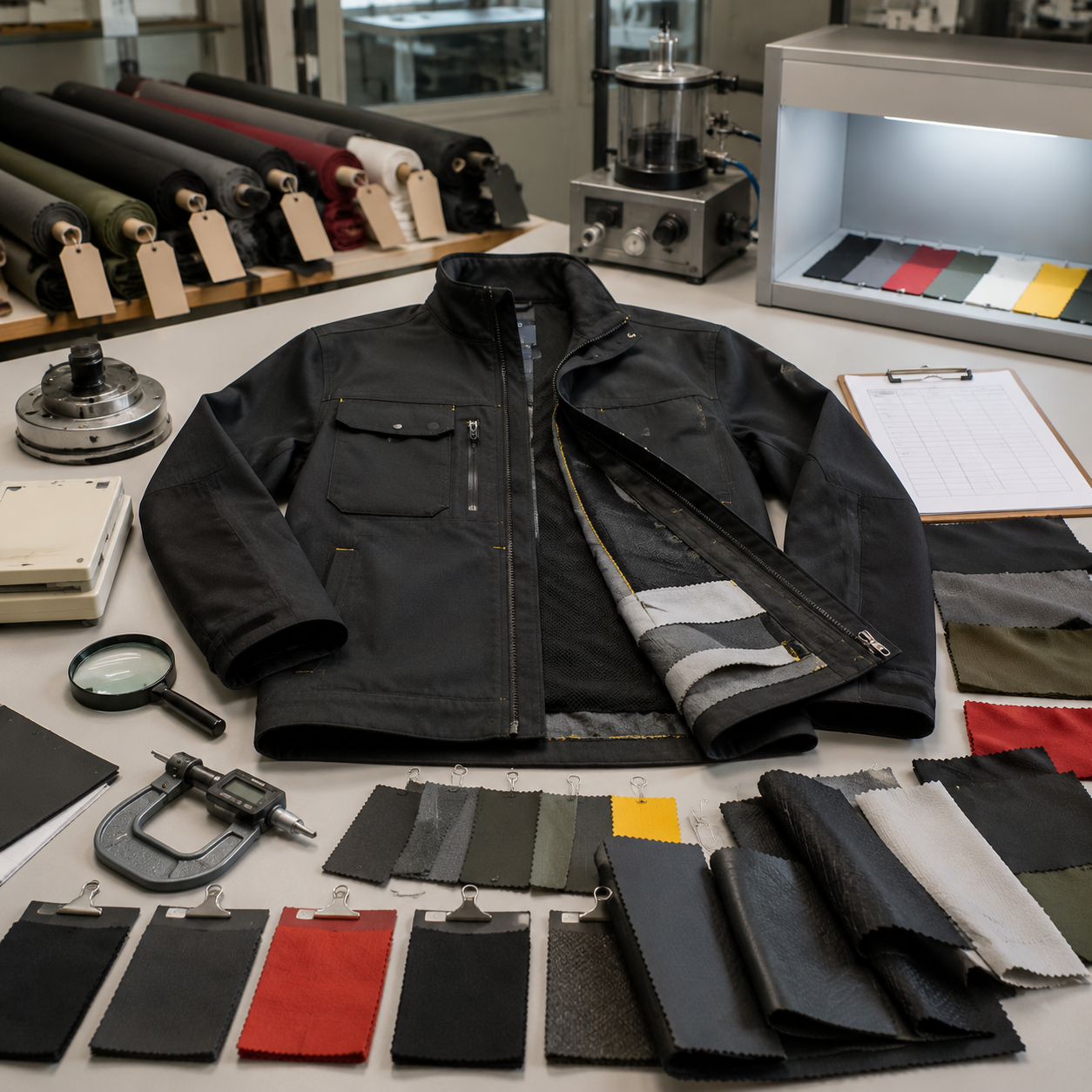
Work coat OEM material options for European RFQs include polyester-cotton twill, cotton-rich canvas, polyester plain weave or ripstop, nylon woven, bonded softshell, and coated polyester shell. These work jacket material options are quote-ready only when each complete construction is matched to the work task, care route, intended claims, evidence scope, and named destination country. For B2B buyers in Europe, a work jacket manufacturing programme should define the garment locations and require every bidder to price the same measurable construction. Each alternative should have a separate material code, quotation line, swatch, evidence scope, and bulk change-control proposal.
Terms such as poly-cotton, canvas, ripstop, nylon, softshell, and coated shell identify broad material families, not quote-ready specifications. A comparable quotation also needs fibre composition, construction, finished mass, usable width, finish or layer structure, colour route, material location, evidence scope, and proposed production controls.
This article addresses the material decision in work jacket manufacturing. It does not rank fabrics or treat a material name as proof of suitability, performance, or compliance.
Author basis: Vincent Xi's first-party profile identifies him as Vanta Workwear's Editorial Author. The profile provides no basis for a first-person claim about product use, factory visits, laboratory testing, or customer outcomes, so no such experience claim is made.
Work Coat OEM Material Options for Europe
This shortlist is a buyer-created RFQ structure, not a Vanta Workwear product specification or a universal suitability conclusion. Retain only the candidates relevant to the documented task, exposure assessment, care route, and intended claims.
| Candidate material option | Complete identity required in the quotation | Evidence question | Hold the bid when |
|---|---|---|---|
| Polyester-cotton twill | Fibre composition by mass, weave, yarn description, finished mass, usable width, finish, colour route, care route, and garment location | Which buyer-selected methods, specimens, directions, conditions, and pass rules will apply? | The quotation states only poly-cotton, or the quote, data sheet, report, and swatch use different material codes |
| Cotton-rich twill or canvas | Composition, construction, finished mass, usable width, finish, colour route, care route, and garment location | Does the evidence cover the quoted construction and intended care sequence? | Fibre content is presented as proof of a protective, durability, or garment-level property |
| Polyester plain weave or ripstop | Fibre and yarn description, construction, finished mass, usable width, finish, colour route, and shell or reinforcement location | Are any required tear, tensile, abrasion, or other characteristics defined by a named method and buyer pass rule? | A visible grid or generic ripstop label replaces the requested measurements |
| Nylon woven | Fibre description, weave, yarn form, finished mass, usable width, finish or coating, colour route, and garment location | Do competing results use aligned methods, specimen directions, conditioning, care sequences, and units? | Method or specimen differences are not disclosed |
| Bonded softshell | Face material, functional middle component, backing, bonding route, total finished mass, stretch direction, colour route, care route, and garment location | Which evidence applies to the component, finished composite, seam assembly, or completed work jacket? | The quotation states only softshell or omits part of the layer architecture |
| Coated polyester shell | Base fabric, coating description, application route, total finished mass, usable width, colour route, adhesion requirement, seam compatibility, and care route | Does the evidence cover the finished coated material and any relevant seam or garment construction? | A base-fabric result is used to support a coated-material or finished-garment claim without matching scope |
No material name establishes suitability by itself. Base the purchase decision on the complete quoted construction, approved physical reference, agreed evidence, destination review, bulk-control plan, and change terms.
Issue a Measurable Material Options Schedule
The LYDENIM custom sourcing page provides secondary briefing context for composition, fabric mass, width, handfeel, application, and quantity before sampling. Because it concerns a different fabric category, it is not used here as evidence of work jacket performance or suitability.
| RFQ field | Buyer enters | Supplier returns | Release condition |
|---|---|---|---|
| Programme boundary | Named European destination countries, work task, environment, care route, intended claims, colour allocation, size allocation, and delivery stage | Assumptions, exclusions, questions, and material-minimum effects | Every material decision refers to the same programme scope |
| Material bill | Shell, reinforcement, lining, pocketing, filling, interlining, binding, and every other location present in the design | A unique code and complete description for each quoted material | No garment location is covered by an unidentified material or substitute |
| Material identity | Required fibre declaration and reporting basis | Declared fibre composition by mass and proposed supporting evidence | Quote, data sheet, swatch, sample, and evidence identify the same material code |
| Construction | Weave or knit, yarn form, face and back, stretch direction, surface character, and layer structure where relevant | Construction details, declared tolerances, and production route | The description distinguishes each alternative without relying on a trade term |
| Finished mass and usable width | Required units, conditioning, sampling basis, tolerance format, and treatment of unusable selvedge | Nominal values, tolerances, verification methods, and roll-record process | Consumption and price use the quoted finished material and usable width |
| Finish and layers | Required finish, coating, membrane, backing, bonding, treatment, and garment location | Complete architecture, application route, care implications, and identified change risks | Every functional or structural layer is disclosed and accepted |
| Colour control | Physical reference, viewing condition, approval method, and dye-lot rule | Sample route, bulk shade-control proposal, lot identifiers, and escalation process | The bulk comparison and segregation rules are recorded before production |
| Acceptance evidence | Characteristic, specimen, method, unit, conditioning, direction, care sequence, sampling basis, and pass rule | Existing evidence identified as development, representative, or lot-specific, plus the proposed bulk plan | Evidence scope matches the intended decision and unresolved work is scheduled |
| Sample identity and traceability | Required swatch, garment sample, pre-production material, retained reference, roll, lot, report, and shipment links | Material code, source, colour, finish, date, differences, identifier format, and record owner | Samples, evidence, bulk material, and shipped goods can be reconciled |
| Change control | Changes requiring notice, resampling, retesting, and buyer approval | Notification route and controls over material sources and subcontracted processes | No composition, construction, finish, layer, colour route, or source substitution proceeds without review |
| Quote basis | Allocation, consumption format, currency, delivery term, quote validity, and permitted separate allowances | Unit price, material charges, minimums, lead times, consumption basis, allowances, and exceptions | Competing bids use the same technical and commercial scope |
Mark a price as non-comparable when it uses a different construction, usable-width basis, finish, evidence scope, allocation, or loss basis. Treat missing fields as clarification points, not as supplier acceptance.
Illustrative Material Assumptions to Verify
Every value below is a buyer-created example assumption as of the RFQ issue date. These values are not market averages, Vanta Workwear specifications, supplier commitments, or production results. Confirm or replace each value in the supplier quotation, approved marker, sample record, and evidence plan.
| Example RFQ field | Illustrative value and unit | Scope, date context, and source status | Supplier verification |
|---|---|---|---|
| Shell composition | 65% polyester by fibre mass and 35% cotton by fibre mass | Finished shell fabric only; as of the RFQ issue date; buyer-created example assumption to verify in the supplier quote | Confirm the declaration and the composition evidence proposed for approval |
| Finished shell mass | 245 grams per square metre nominal | Conditioned finished shell before cutting; as of the RFQ issue date; buyer-created example assumption to verify in the supplier quote | State the tolerance, conditioning, sampling basis, and verification method |
| Usable shell width | 150 centimetres of usable finished width | Finished shell excluding unusable selvedge; as of the RFQ issue date; buyer-created example assumption to verify in the supplier quote | Confirm through the proposed roll-width recording process |
| Programme allocation | 4,800 finished work jackets | Buyer-approved colour and size allocation for the example European programme; as of the RFQ issue date; buyer-created example assumption to verify in the supplier quote | Quote against the issued allocation and disclose material-minimum effects |
| Net shell consumption | 1.85 linear metres per finished work jacket | Approved-pattern basis using the assumed usable width for net shell only; as of the RFQ issue date; buyer-created example assumption to verify in the supplier quote | Confirm or replace with a marker for the approved pattern, allocation, and usable width |
Using only those buyer-created assumptions as of the RFQ issue date, the example calculation is 4,800 finished work jackets x 1.85 linear metres per finished work jacket = 8,880 linear metres of net shell fabric for the stated European programme scope. This is an example assumption to verify in the supplier quote, not observed production data. Require fabric loss, shade segregation, test material, and contingency to appear separately from net marker consumption.
Evidence Boundaries for Bonded and Coated Options
The ExploreTex softshell sourcing page provides secondary context for treating softshell as a layered architecture involving a face, functional middle component, and backing. It does not establish that every softshell has the same construction or performance.
For a bonded or coated material, require the evidence register to identify:
- Whether the result applies to a raw component, finished fabric, finished composite, seam assembly, or completed work jacket.
- The material code, colour, finish, lot, specimen description, report date, issuer, and relationship to the proposed bulk goods.
- The named method, specimen orientation, conditioning, care sequence, result unit, and buyer-defined pass rule.
- The face, coating or functional layer, backing, bonding route, and total finished mass where applicable.
- The seam construction and treatment relevant to any intended garment-level claim.
- Whether the report is development-only, representative of the proposed route, or specific to a production lot.
- What must be repeated after a change to composition, construction, coating, bonding, colour route, finish, backing, or material source.
Compare water-resistance, water-vapour, adhesion, care-retention, or other results only when the methods, specimens, conditions, units, and pass rules align. Keep a result within its stated evidence boundary. A base-fabric report does not establish finished coated-material, seam, or garment performance unless those constructions are included in the report scope.
Europe Material Checks: EU, EEA, UK, and Country Scope
Europe is the sales destination for this RFQ framework, but the supplied citations are commercial sourcing pages rather than official legal sources. A qualified compliance owner should verify current requirements for every named destination and intended material claim as of order approval.
| Destination scope | Material-related RFQ action | Approval control |
|---|---|---|
| EU destination | Name the destination Member State, intended use, product category under review, material claims, required languages, and relevant economic-operator questions | Verify applicable EU-level requirements and the country-specific layer using current official or qualified sources |
| Individual EU Member State | Keep country-specific material labelling, chemical restriction, claim-language, instruction-language, and document questions visible in the destination matrix | Do not infer that a conclusion for one Member State resolves another country's local requirements |
| Non-EU EEA destination | Maintain a separate destination row and evidence decision | Verify local application, language, administrative, operator, and document requirements rather than extending an EU conclusion by assumption |
| UK destination | Run a separate material-claim, product-category, marking, operator, and technical-document review | Do not treat an EU-oriented document set as automatically complete for the UK |
| Other named European destination | Build a country-specific row limited to the intended product and material claims | Verify applicable national requirements without extending an EU, EEA, or UK conclusion |
If the intended work jacket carries a high-visibility claim, the VizGlo high-visibility sourcing checklist names EN ISO 20471 and discusses batch-specific reports for fluorescent and reflective inputs. EN ISO 20471 is a standard identifier; its numerals are not a measured quantity, unit, date, edition, or test result. In this article, the identifier is used only for the high-visibility sourcing context stated by that commercial page. The cited source does not establish current applicability, the applicable edition, legal status, a pass result, or certification. Verify those points as of order approval for each named destination and intended claim.
When a standard is relevant, separate its documented requirements from a supplier's own production practice. A stated practice is not certification. Do not release a certification claim without a current document identifying the issuer, holder, product or material scope, referenced edition, validity, and connection to the ordered construction.
Material Lot Controls in Work Jacket Manufacturing
The DRESSOURCE workwear sourcing guide provides secondary context for aligned quotation terms and staged sampling and production controls, including pre-production review, inline checks, final inspection, and laboratory testing. It does not prove the suitability, compliance, or factory capability of a particular work jacket material.
Apply that context to the material RFQ through the following buyer-created control plan:
| Control point | Required material record | Release decision |
|---|---|---|
| Technical review | Completed material schedule, technical data, bidder exceptions, and proposed evidence plan | Hold development until material fields and deviations are resolved |
| Development swatch | Material code, composition, construction, finished mass, usable width, colour, finish, source, and differences from intended bulk | Approve only as a development reference |
| Garment sample | Swatch link, material code, construction observations, required care trial, and unresolved material differences | Confirm compatibility with the work jacket design without treating the sample as bulk evidence |
| Pre-production material | Intended bulk route, colour, finish, lot identity, evidence, and comparison with the approved reference | Release only the recorded material for cutting |
| Incoming rolls | Roll and dye-lot identity, usable width, shade grouping, visible-defect record, and required lot evidence | Segregate or escalate material outside the agreed rule |
| Inline manufacturing | Material-code check, shade mixing, coating or bonding damage, seam response, and substitution check | Correct issues while affected work jackets remain identifiable |
| Final material file | Shipped-lot map, evidence links, approved changes, inspection outcome, and retained references | Release only when the records reconcile with the purchase order |
Accept a report only for the scope it identifies. If its material code, colour, finish, lot, specimen, or construction cannot be reconciled with the ordered goods, record the evidence as unresolved instead of extending the result by assumption.
RFQ Release and Material Award
Before comparing bids, confirm that the RFQ:
- Names every European destination country and the owner of current applicability checks.
- Defines the work task, environment, care route, movement needs, and intended material claims.
- Includes every shell, reinforcement, lining, pocketing, filling, interlining, binding, and treatment location present in the work jacket.
- Gives each material option a separate quotation line and unique code.
- States the required composition, construction, finished mass, usable width, finish, colour route, and layer architecture.
- Converts intended performance claims into a specimen, method, unit, condition, care sequence, and pass rule.
- Defines the physical colour reference, viewing condition, approval route, and dye-lot rule.
- Links quotations, technical data, swatches, samples, pre-production material, reports, lots, and shipments by material code.
- Requires explicit deviations, controlled substitutions, resampling and retesting triggers, cost responsibility, and release authority.
- Separates marker consumption, loss allowances, contingency, material minimums, development time, bulk lead time, evidence time, and quote validity.
Approve a material option only when the purchase specification, quotation, approved physical reference, evidence register, destination matrix, bulk-control plan, and change terms identify the same construction and scope.
| Bid status | Decision rule |
|---|---|
| Comparable | Required fields, evidence scope, allocation, and commercial basis align |
| Clarification required | A field, exception, document link, or approval dependency remains unresolved |
| Non-comparable | Material architecture, method, evidence scope, usable-width basis, allocation, or commercial basis differs |
| Hold | Destination applicability, claim evidence, material traceability, or change approval is incomplete |
Methodology and Limitations
The supplied pages were treated as secondary commercial sourcing contexts. Their supported briefing and control themes were converted into buyer-entered fields, supplier-return fields, evidence boundaries, and material release decisions. Recommendations in the tables are buyer-created RFQ controls rather than claims that the cited sources prescribe a universal specification.
| Supplied source | Supported context used here | Not used to establish |
|---|---|---|
| DRESSOURCE | Aligned quotation context and staged sampling and production controls | Suitability, performance, compliance, or factory capability for a particular material |
| LYDENIM | Pre-sampling briefing fields such as composition, mass, width, handfeel, application, and quantity | Work jacket performance or suitability |
| ExploreTex | Layer-architecture context for softshell RFQs | A universal softshell construction, result, or garment-level claim |
| VizGlo | Conditional high-visibility sourcing context, including the named standard identifier and batch-linked input evidence | Legal applicability, current edition, certification, pass status, or evidence for an ordered product |
The numerical scenario was derived solely from the buyer-created assumptions identified in its table. The net-shell result multiplies the assumed finished-jacket allocation by the assumed net shell consumption per finished work jacket. It is not observational, market, supplier, or production data.
Limitations and items to verify:
- The cited industry pages are commercial content, not legislation, official standards publications, certificates, or independent laboratory reports.
- Generic fibre names and material architectures do not establish finished-garment suitability.
- No Vanta Workwear material specification, test result, certification, factory capability, minimum order, lead time, price, or customer outcome is asserted.
- This article does not determine whether a proposed work jacket is ordinary workwear, personal protective equipment, or another regulated product category.
- Current law, standard editions, conformity routes, language requirements, operator duties, and document obligations require destination-specific verification for each named EU, non-EU EEA, UK, or other European country.
- Existing evidence must be reconciled with the quoted material code, colour, finish, specimen, construction, lot, method, and ordered goods.
- Every illustrative value requires confirmation or replacement in the supplier quotation, approved marker, representative bulk material, and agreed evidence plan.
Discuss Your Requirements
Review our manufacturing capabilities, then share your specifications for a supplier-fit review.