Work Pant OEM Packing Requirements for Australian B2B Orders
By Vincent Xi, Editorial Author
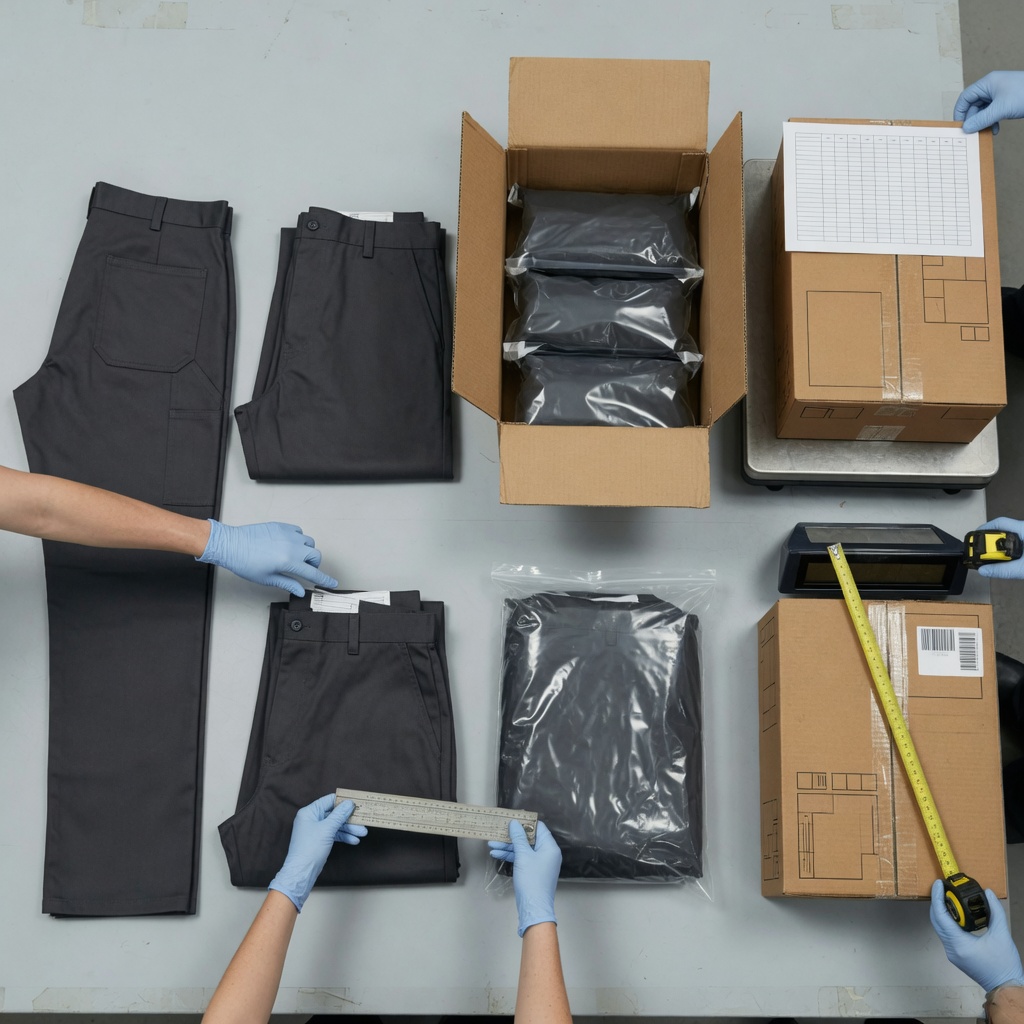
Australian B2B buyers should define work pant OEM packing requirements before bulk manufacturing is priced and approved. A usable RFQ does more than request standard export packing. It identifies the unit pack, fold, packed dimensions, product identification, carton proposal, size assortment, carton marks, packing-list fields, inspection evidence, deviation process, and release authority.
The cited evidence supports those packing categories without establishing universal specifications. The OEM mechanic work pants page publishes an individual-polybag practice and configurable identification and assortment options. The garment-process page describes folding, bagging, carton packing, and related checks. The bulk-workwear production page identifies mixed sizes and incorrect packaging as risks.
For an Australian purchase order, the buyer should attach the current ship-to, distribution-centre, scanning, labelling, freight-data, and compliance instructions that apply to the order. The supplied sources do not establish Australian statutory wording, barcode rules, carton limits, or legal compliance. Those requirements must come from current buyer-controlled evidence rather than a supplier's generic packing statement.
Australia RFQ packing requirements: quote-to-release decisions
| Packing decision | Buyer input for the RFQ | Measurable supplier response | Approval or release evidence |
|---|---|---|---|
| Unit pack | Required pack configuration, artwork status, and any buyer restrictions | Material description, gauge with unit, finished dimensions with units, closure, venting where applicable, pack quantity, and itemised price | Approved packed sample and dated production photographs |
| Fold | Fold diagram or approved reference, garment orientation, and tag visibility | Measured folded length, width, and height with units, measuring method, and proposed tolerance | Approved fold sample and measurement record |
| Product identity | Exact size string, buyer SKU, sticker, barcode, and hangtag rules | Populated artwork proof, encoded data, symbology, dimensions, placement, and buyer-defined scan result | Sewn label, external identification, encoded data, and PO line reconcile |
| Carton build | Required data fields and any documented performance criterion | Packed quantity, internal and external dimensions with units, net and gross mass with units, construction, closure, and separately priced options | Closed-carton measurement record and photographs |
| Size mode | Solid-size cartons or a buyer-issued assortment | Carton-level style, colour, and size breakdown, including treatment of leftover sizes | Open-carton contents match the carton mark and packing list |
| Carton marks | Approved field list, marked faces, and actual PO data | Populated mark proof and barcode data where required | Photographs of all required marked faces |
| Packing list | Buyer template with PO-line and carton-level fields | Draft populated from production packing data | Packing-list totals reconcile with cartons and the PO |
| Deviations | Written approval before substitutions or specification changes | Reason, price effect, timing effect, affected quantity, and corrective proposal | Named buyer approval retained with the order record |
| Shipment release | Buyer-defined hold points and release authority | Complete packing record and resolved discrepancy log | Freight booking proceeds only after the defined reconciliation is complete |
The supplier should distinguish committed specifications from estimates and exclusions. Open values such as factory standard bag, export carton, or normal assortment should not be treated as approved packing requirements because they do not define a measurable result.
Practical RFQ checklist for Australian packing requirements
Use this checklist as an RFQ attachment. Do not close the packing portion of the quote comparison until every applicable item has a supplier-returned value, supporting evidence, or a written buyer-approved exclusion.
- [ ] Attach the current Australian ship-to, distribution-centre, receiving, scanning, labelling, freight-data, and compliance instructions applicable to the order.
- [ ] State the required garments per unit pack and ask the supplier to identify every assumption or exclusion.
- [ ] Request the unit-pack material description, gauge with unit, finished dimensions with units, closure, venting where applicable, and itemised cost.
- [ ] Attach a fold diagram or approved reference and request measured folded length, width, and height with units and a stated measuring method.
- [ ] Provide the exact style, colour, size, SKU, sewn-label, external-sticker, barcode, and hangtag data for each PO line.
- [ ] Define any barcode symbology, placement, printed dimensions, encoded data, and buyer-controlled scan-acceptance method.
- [ ] State whether cartons must be solid-size or assorted and provide every assortment in pieces by size.
- [ ] Require proposed carton quantity, construction, closure, internal and external dimensions with units, and net and gross mass with units.
- [ ] Supply a carton-mark template and require a proof populated with actual PO data rather than placeholder content.
- [ ] Supply a packing-list template and require carton-level quantities, assortment details, sequence identifiers, and PO-line reconciliation.
- [ ] Request separate prices for unit packing, labels, hangtags, carton options, setup, labour, minimum quantities, and expected surplus where applicable.
- [ ] Require an approved packed sample and controlled artwork before production packing begins.
- [ ] Require production photographs, measurement records, requested scan results, and a discrepancy log before shipment release.
- [ ] Prohibit substitutions to the approved bag, fold, identification, carton, assortment, marks, or documents without written buyer approval.
- [ ] Identify the person or function authorised to approve deviations and release freight booking.
- [ ] Reconcile packed contents, carton marks, packing-list totals, the PO, and approved deviations before authorising shipment.
Unit packing requirements for work pants
The OEM mechanic work pants page supports using an individual polybag as a supplier-published starting point. It does not establish a universal bag material, gauge, dimension, closure, venting method, or environmental attribute.
The RFQ should require the supplier to return:
- Pack configuration and garments per pack.
- Bag material description and any buyer-requested supporting document.
- Gauge and gauge unit.
- Finished length and width with units.
- Opening, closure, adhesive position, and venting where applicable.
- Plain or printed presentation, with controlled artwork for any print.
- Packaging material, labour, setup, minimum-quantity, and expected-surplus charges where applicable.
- A written change request before altering the approved material, dimensions, closure, print, or pack configuration.
The proposed bag should be assessed as part of a physical packing sample. The cited page describes a supplier practice; it does not prove that the same pack is suitable for every work-pants construction or Australian receiving process.
Fold and packed dimensions
The garment-process source places folding before bagging and carton packing. Convert that process step into an approved packed result by attaching a fold diagram or reference sample and requiring the supplier to measure the proposed garment after folding.
The returned proposal should state folded length, width, and height with units; waistband and leg orientation; pocket and fastening condition; hangtag visibility; measuring method; and any proposed tolerance. Approval should refer to the physical sample or controlled image used as the production reference.
No cited source establishes a standard folded dimension for work pants. The quoted dimensions should therefore come from the actual garment construction, size, trims, fold method, and unit pack rather than an unsourced default.
Size stickers, barcodes, and hangtags
The OEM and garment-process sources support controlling size stickers, barcodes, size labels, and hangtags. For each ordered style, colour, and size, the buyer should provide or approve:
- The exact size string used on the sewn label, external sticker, carton mark, and packing list.
- The buyer SKU and the data encoded in any barcode.
- Barcode symbology, printed dimensions, placement, and the buyer's scan-acceptance rule.
- Hangtag artwork, attachment point, attachment method, and disposition for missing or damaged tags.
- A comparison rule covering the sewn size label, external identification, encoded data, and PO line.
A barcode artwork file alone does not show that a printed production label meets the buyer's receiving rule. Where scanning is required, request evidence from the proposed printed label using the buyer-defined system or acceptance method. The cited sources do not establish an Australia-specific barcode or statutory labelling requirement.
Carton and assortment packing requirements
No cited source provides a universal carton quantity, dimension, board specification, closure method, mass limit, or performance threshold for work pants. The supplier should propose the carton after measuring the approved fold and unit pack.
Require the quote and packed-carton record to state:
- Packed garments per carton and whether the carton is solid-size or assorted.
- Internal and external length, width, and height with units.
- Net and gross mass with units.
- Carton material and construction description.
- Closure and sealing method.
- Any buyer-required inner pack, liner, divider, or desiccant.
- Any documented carton-performance value, unit, test method, sample scope, and current supporting evidence required by the buyer.
- The packing-price and freight-data effect of each proposed option.
If the buyer invokes a standard, the RFQ should identify the relevant requirement and the evidence expected from the supplier. A company's own carton practice is not the same as a standard's requirement, and a supplier statement should not be presented as certification without a current document covering the quoted material, facility, and order scope.
The bulk-workwear production page supports confirming size ratio, while the OEM page presents assortment packing as configurable. The buyer should specify:
- Solid-size or assorted-carton mode.
- Assortment in pieces by size rather than percentages alone.
- Whether styles or colours may be mixed.
- How leftover sizes are packed and identified.
- Whether every assorted carton requires a size breakdown on the packing list.
- How solid-size and assorted cartons are distinguished on the carton mark.
- Whether an unapproved mixed-size carton blocks shipment release.
The correct assortment depends on the Australian buyer's actual receiving and allocation instructions. The cited sources do not demonstrate that any particular assortment is automatically suitable for an Australian warehouse.
Packing requirements for Australian carton marks and documents
The garment-process page supports checking carton markings and quantities. The bulk-workwear page supports confirming carton marks and a packing list before shipment. The buyer should attach controlled templates populated with the fields needed for the live order.
A carton-mark specification can include:
- Buyer PO and line reference.
- Buyer style and SKU.
- Colour name and code exactly as shown on the PO.
- Size or approved assortment breakdown.
- Packed quantity and quantity unit.
- Carton sequence identifier and total carton count.
- Net and gross mass with units where required.
- Carton dimensions with units where required.
- Australian ship-to name or distribution-centre code supplied by the buyer.
- Buyer-supplied barcode data and symbology where carton scanning is required.
- Handling marks supported by a documented buyer requirement.
Require a mark proof populated with actual PO data. A blank layout does not show whether the order values have been mapped correctly.
The packing-list template should identify the PO and PO line, style, colour, size, SKU, quantity unit, carton sequence, carton-level quantity, assortment breakdown where applicable, total carton count, total packed quantity, dimensions and mass where used, and any approved variance reference.
At release, compare packed contents with the carton mark, carton marks with the packing list, and packing-list totals with the PO. A mismatch should trigger correction, recount, or written buyer disposition before freight booking. This is a buyer-authored release control, not a statement of Australian law.
Packing inspection evidence and change control
| Packing risk or checkpoint | Evidence basis | Buyer-authored control | Release evidence |
|---|---|---|---|
| Mixed sizes | Identified as a risk by the bulk-workwear source | Approve solid-size or assortment rules in pieces by size | Open-carton contents match the mark and packing-list breakdown |
| Incorrect packaging | Identified as a risk by the bulk-workwear source | Approve the bag, fold, labels, carton, and change-control fields | Production pack matches the approved references |
| Label, barcode, or hangtag mismatch | Listed as packing-check categories by the garment-process source | Define exact data, placement, and buyer scan rule | Garment label, pack identification, encoded data, and PO line reconcile |
| Carton-mark or quantity mismatch | Listed as packing-check categories by the garment-process source | Approve actual-data marks and carton-level quantities | Contents, mark, packing list, and PO reconcile |
| Unapproved substitution | Buyer-defined control rather than a reported source outcome | Require written approval before changing packing | Named buyer approval is recorded against the order |
The production packing record should cover the ordered style, colour, size, sewn label, external identification, polybag, fold, hangtag, barcode, carton contents, carton mark, measured dimensions, measured mass, quantity, and approved deviations where applicable.
Useful release evidence includes photographs of the unfolded garment, approved fold, sealed unit pack, open-carton contents, closed carton, and required marked faces; measurement records for the folded pack and carton; buyer-defined barcode scan results; a packing list populated from production data; and a discrepancy log covering rework, recounts, substitutions, and buyer dispositions.
The cited evidence does not define a sampling plan, defect classification, or acceptance threshold. If sampling is required, the PO should state the inspection stage, sample scope, acceptance criteria, recording method, and packing defects that block release.
Concrete data for the supplier quote
- Sourced baseline:
1 piece per polybag. Unit: pieces per polybag. Scope: the published packing practice for the custom mechanic work-pants offer on the cited product page. As-of context: the source page is undated, with no publication or update date stated. Source: OEM mechanic work pants packing. This is a supplier-published starting point, not an industry requirement. - Example assumption to verify in the supplier quote:
24 pieces per carton. Unit: pieces per carton. Scope: a hypothetical Australian OEM RFQ for a work-pants SKU. This value is illustrative and must be verified against the approved fold, measured carton, gross mass, production packing record, and live supplier quote. - Example calculation to verify in the supplier quote:
1,200 order pieces / 24 pieces per carton = 50 cartons. Units: order pieces, pieces per carton, and cartons. Scope: the same hypothetical Australian RFQ. All values are illustrative assumptions and must be replaced with the quoted packing quantity and production packing-list data. - Example reconciliation to verify against live documents:
1,188 packed pieces compared with 1,200 ordered pieces produces a 12-piece shortfall. Unit: pieces. Scope: a hypothetical PO-to-packing-list check. All values are illustrative and must be replaced with the actual PO quantity, approved variance, and supplier packing-list total.
These examples show how to test a supplier's proposed packing data. They do not prescribe carton quantity, order quantity, or an acceptable variance for an Australian order.
Copy-ready OEM packing requirement
```text Market and ship-to: Australia; buyer to attach current destination, receiving, scan, labelling, freight-data, and compliance instructions.
Supplier packing proposal: state the unit-pack material, gauge and unit, finished dimensions and units, closure, fold dimensions and units, measuring method, product-identification data, carton quantity, carton construction, internal and external dimensions and units, net and gross mass and units, solid-size or assortment breakdown, carton-mark proof, packing-list fields, itemised packing charges, exclusions, and assumptions.
Approval evidence: provide the packed sample, controlled artwork, required scan result, production packing photographs, carton measurement record, populated packing list, and discrepancy log.
Change control: obtain written buyer approval before changing the approved bag, fold, identification, carton, assortment, marks, or documents.
Release: do not book freight until packed contents, carton marks, packing-list totals, the PO, and approved deviations reconcile under the buyer's release procedure. ```
Source method and limitations
| Source context | Packing statement retained | Use in the RFQ | Claim not supported |
|---|---|---|---|
| OEM mechanic work pants packing | Publishes a unit-pack practice and presents size stickers, SKU barcode stickers, carton marks, and assortment packing as configurable options | Establish a supplier-published baseline and identify fields requiring buyer confirmation | An industry-wide rule, independently verified capability, Australian compliance, or certification |
| How pants are made | Describes inspection followed by folding, bagging, carton packing, and shipment; packing checks include polybags, hangtags, barcodes, size labels, carton markings, and quantities | Define packing-stage checkpoints and evidence categories | A work-pants carton dimension, bag gauge, defect tolerance, Australian legal requirement, or shipment outcome |
| Bulk workwear production controls | Identifies mixed sizes and incorrect packaging as risks and advises confirming size ratio, individual packaging, carton marks, and a packing list before shipment | Support assortment, identification, document, and pre-shipment controls | Proof of a supplier audit, performance result, certification, or customer outcome |
Methodology. Packing-specific statements were extracted from the cited pages and separated from buyer-authored RFQ controls. Overlapping source categories were mapped to quote fields, approval evidence, change control, and shipment-release decisions. No dimensions, material specifications, legal requirements, test results, supplier capabilities, or performance outcomes were inferred where the sources did not provide them. The source pages are treated as published context, not independent verification of the businesses behind them.
Limitations and buyer verification. The sources do not provide a current bag material or gauge, folded dimensions, carton dimensions, carton-performance values, barcode specification, packing prices, defect tolerances, sampling rules, or Australia-specific packaging and labelling law. They do not establish that a supplier holds a certification, passed a buyer audit, completed a compliant shipment, or achieved a customer outcome.
Before approval, verify the proposed pack against the actual work-pants construction, physical packing sample, current PO, Australian ship-to instructions, warehouse scan rules, and freight-booking data. Replace every example value with supplier-quoted and production-measured data. Where a standard, legal requirement, or certification is relevant, obtain the current controlled document and confirm that its scope covers the quoted packaging, facility, and order.
Author note. Vincent Xi is identified as Editorial Author on the cited profile. This article makes no first-person claim about factory visits, production trials, laboratory tests, shipment inspections, client work, or customer outcomes.
Discuss Your Requirements
Review our manufacturing capabilities, then share your specifications for a supplier-fit review.