Work Pant OEM Quality Control Inspection for United States Buyers
By Vincent Xi, Editorial Author
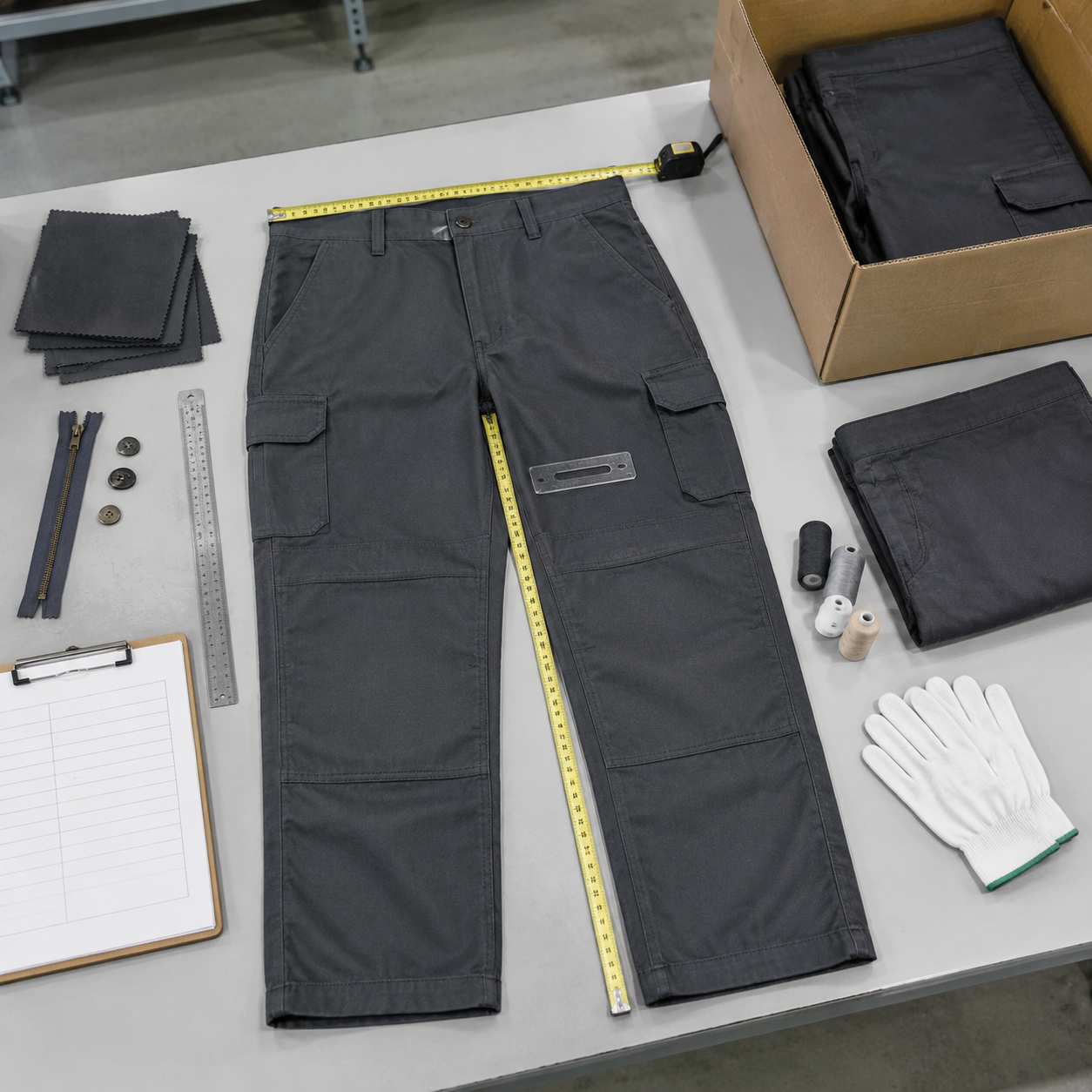
For a United States OEM purchase, a work pant quality control inspection should end with a documented shipment decision: release, correct and reinspect, or reject under the purchase contract. The inspection file must connect the sampled finished lot to the controlling specification revision, approved materials and samples, label and packing approvals, test scope, landed-cost assumptions, delivery milestones, and named release authority.
Supplier acknowledgment confirms agreement to a requirement; it does not prove that the requirement was met. Dispatch should remain on hold when an approval, inspection result, test report, deviation decision, or shipment document required by the RFQ is missing. The DRESSOURCE sourcing guide likewise treats the product brief, materials, sampling, production controls, inspection, testing, packaging, and commercial terms as connected sourcing inputs (DRESSOURCE).
> Author basis: The Vanta Workwear author profile identifies Vincent Xi as an Editorial Author. It does not document firsthand factory inspection, supplier-audit, product-testing, procurement, or order-outcome experience, and no such experience is claimed here.
United States Work Pants Quality Control Inspection Release Gate
The following is a buyer-defined control framework, not a description of any supplier's current practices or capabilities. Each gate should identify the controlling requirement, required evidence, decision owner, and shipment-blocking condition.
| Gate | RFQ or purchase-order control | Evidence for release | Hold condition |
|---|---|---|---|
| Product baseline | Purchase order, tech pack, bill of materials, measurement chart, artwork, packaging file, approved sample, and document-precedence rule | Supplier-acknowledged revision register and buyer approval record | Missing, conflicting, or unapproved revision |
| Materials and sample | Shell, trims, color reference, permitted substitutions, sample stage, and approval owner | Approved swatches, trims, sample identity, material records, and deviation decisions | Unapproved material, substitution, or sample |
| Production control | Incoming-material and inline inspection scope, timing, reporting, and corrective action | Findings, measurements, photographs, deviation records, and closure evidence | Recurring or unresolved deviation |
| Finished lot | Lot definition, sample-selection rule, workmanship checks, measurements, defect classes, packing scope, and release rule | Lot identity, selected-unit record, defect report, measurements, photographs, and packed-goods findings | Contracted rejection condition or incomplete evidence |
| Labels, packing, and claims | Approved artwork, placement, attachment, assortment, carton, marking, and claim-verification scope | Approved files and samples, inspection findings, and scope-matched supporting reports | Wrong revision, placement, packing, or unsupported claim |
| Commercial and delivery release | Cost inclusions, milestones, shipment documents, deviation terms, and release authority | Final cost confirmation, inspection status, corrective-action closure, packing list, and required shipping records | Unapproved charge, unresolved deviation, missed gate, or missing document |
Freeze the Work Pants Manufacturing Baseline Before Pricing
Quotation comparison begins with document control. The RFQ should state which file prevails when the purchase order, tech pack, bill of materials, artwork, measurement chart, or approved sample conflicts. That precedence rule is a buyer-defined contractual control, not a universal industry requirement.
The frozen work pant specification should cover:
- Style allocation by color, size, quantity, and United States delivery point.
- Shell construction, fiber composition, finished mass per unit area, finish, and approved color reference.
- Zippers, buttons, snaps, thread, hook-and-loop components, labels, and packaging materials where applicable.
- Points of measure, nominal dimensions, grading, tolerances, measurement method, and authoritative unit system.
- Seam construction, reinforcement locations, pocket geometry, hems, closures, and visible defect zones.
- Label artwork, placement, attachment, folding, assortment, bagging, carton, and marking instructions.
- Sample gates, test scope, inspection stages, defect definitions, corrective action, and shipment-release authority.
DRESSOURCE recommends measurable sampling comments and identifies fabric, construction, garment operations, trims, packaging, inspection, and testing as quotation inputs (source). For this RFQ, the supplier response should show compliance, deviation, cost effect, delivery effect, and proposed evidence against each controlled requirement. A supplier alternative should not replace the specification until the buyer approves the change in writing.
Dated Example Specification Assumptions
The following values are buyer-created assumptions for an illustrative RFQ issued on January 15, 2025. They are not sourced benchmarks, Vanta Workwear specifications, supplier capabilities, or test results. Each value must be confirmed or replaced in the supplier quotation and linked approval record.
| Controlled field | Example value and scope | Source status and verification |
|---|---|---|
| Order quantity | 2,000 sellable pairs of the work pant covered by the illustrative United States delivery scope | Buyer-created example assumption as of January 15, 2025; verify in the scope-matched supplier quotation and purchase order |
| Finished shell | 245 g/m2 finished mass per unit area, with 65% polyester by mass and 35% cotton by mass, for the shell fabric only | Buyer-created example assumption as of January 15, 2025; verify in the quotation, bill of materials, approved swatch, label artwork, and buyer-selected material evidence |
| Finished half-waist | +/- 0.8 cm from the nominal half-waist for each sampled finished garment, measured closed and flat under the buyer-defined method | Buyer-created example assumption as of January 15, 2025; verify in the graded chart, approved sample, and inspection measurements |
| Finished inseam | +/- 1.0 cm from the nominal inseam for each sampled finished garment, following the buyer-defined seam path | Buyer-created example assumption as of January 15, 2025; verify in the graded chart, approved sample, and inspection measurements |
The measurement file should define garment conditioning, closure, positioning, tape placement, rounding, and recording rules. If buyer and supplier records use different units, a buyer-approved conversion chart should identify the authoritative values before sample approval and inspection.
Contract the Work Pants Quality Control Inspection Evidence
A requirement that says only final inspection or names an acceptance level is incomplete. If acceptance sampling is selected, the contract should identify the buyer-selected standard and edition, lot definition, inspection level, sample-selection method, sample-size determination, defect classes, and applicable acceptance and rejection values. Defect classifications should be linked to the approved work pant specification and intended use.
No sampling or product-test standard is asserted as applicable here because the supplied sources do not establish what governs the buyer's actual product. If the buyer adopts a standard, the RFQ should name its title, edition, relevant method or clause, and required report scope. Contractual use of a standard is separate from certification; neither a supplier nor a product should be described as certified without a current, scope-matched document.
| Inspection stage | Buyer-defined scope | Required evidence | Decision |
|---|---|---|---|
| Pre-production review | Controlling revisions, approvals, materials, construction, labels, packing, test scope, inspection plan, and schedule | Signed review record, approved references, and open-item register | Permit or hold bulk start |
| Incoming-material verification | Shell, color, trims, thread, labels, and packaging against approved references | Material findings and approval or deviation record | Permit or hold cutting and assembly |
| Inline inspection | Early output, seams, reinforcement, pocket placement, dimensions, shade grouping, and recurring workmanship issues | Selected-unit record, measurements, photographs, and corrective-action status | Continue, correct, sort, or hold production |
| Finished-lot inspection | Completed lot, workmanship, measurements, functions, assortment, labels, packing, and carton condition | Lot identity, sample-selection record, defect list, measurements, photographs, and result | Release, correct and reinspect, or reject under the contract |
| Laboratory verification | Only the physical, dimensional, colorfastness, chemical, safety, or claim-related properties included in the approved specification | Report identifying the tested sample, method, result, report date, and scope | Approve, retest, remove the claim, or hold release |
The purchase order should assign the inspector, inspection and reinspection costs, lot-completion condition, required packing state, sample-selection responsibility, report recipients, and conditional-release authority. A sampled result supports the contracted lot decision; it does not show that every unit was inspected. Visual inspection also does not replace separately required laboratory evidence.
An adjacent denim OEM article recommends requesting clear certificate copies, checking identifiers through the relevant official database, and comparing stated capacity with production-line and monthly-output information (Newasia Garment). This is an attributed due-diligence prompt from an adjacent trouser-manufacturing context. It does not establish a prospective supplier's work pant capability, capacity, certification, or performance.
United States Labeling and Quality Control Inspection
The supplied sources do not establish mandatory United States label wording for the buyer's actual work pants. The RFQ should instead assign responsibility for a legally reviewed, buyer-approved label matrix and should not treat supplier-prepared artwork as legal approval.
The buyer's compliance owner should determine which fields apply to the actual product and transaction. The resulting matrix can control fiber wording, care instructions, country-of-origin wording, responsible business or brand identification, size, placement, attachment, packaging statements, and claim-specific wording.
| Control | Evidence required before release | Shipment-blocking issue |
|---|---|---|
| Artwork and content | Buyer-approved filename, revision, content, language, dimensions, material, and color reference | Wrong or unapproved content or revision |
| Placement and attachment | Approved placement reference, buyer-defined tolerance where applicable, attachment method, and physical sample | Incorrect location, orientation, or attachment |
| Shell-content relationship | Approved bill of materials, label wording, material declaration, and buyer-selected verification evidence | Conflict among material, label, and verification records |
| Care wording | Buyer compliance approval, supporting evaluation selected by the buyer, and approved sample | Unsupported or unapproved instruction |
| Origin and responsible-party fields | Buyer-approved legal matrix and matching bulk artwork | Missing or conflicting approved field |
| Performance claim | Applicable requirement and edition, test method, tested-sample identity, report scope, and buyer approval | Unsupported wording, failed result, or report outside the relevant scope |
| Packing and carton marking | Approved packing file, assortment, carton specification, marking artwork, and packed sample | Incorrect assortment, protection, carton, or marking |
A supplied high-visibility jacket sourcing article recommends batch-specific material reports and third-party inspection rights in that product context (VizGlo Safety). That attributed recommendation can inform an evidence clause when the work pant specification contains a relevant performance claim. It does not establish that a particular standard applies to ordinary work pants or that a supplier complies with one.
Factory audits, management-system certificates, material declarations, and product test reports are different evidence types. Before relying on a document, verify its holder, issuer, manufacturing site, product or material scope, validity, report date, tested-sample identity, and referenced requirement.
Normalize United States Landed Cost to the Inspection Scope
Quotations are comparable only when they use the same product revision, order allocation, commercial term and named place, packaging, testing, inspection, freight mode, United States delivery point, importer responsibility, and exclusions. DRESSOURCE states that an FOB quotation can clarify the manufacturing component for comparison and that a DDP quotation should identify included items and importer-of-record responsibility (source). This source does not establish a current price, duty rate, freight rate, or legal allocation for the buyer's transaction.
The following buyer-created example calculation applies only to the illustrative RFQ issued on January 15, 2025, covering 2,000 sellable pairs delivered to a buyer-named United States point before domestic warehousing. Every input must be verified in the supplier quote, inspection or laboratory proposal, freight quote, and qualified customs estimate for the actual transaction.
| Landed-cost component | Example amount and order scope | Source status and verification |
|---|---|---|
| FOB manufacturing amount | USD 18.40 per sellable pair for the 2,000-pair illustrative order | Buyer-created example assumption as of January 15, 2025; verify in the scope-matched supplier quotation |
| Allocated quality control inspection amount | USD 0.22 per sellable pair for the 2,000-pair illustrative order | Buyer-created example assumption as of January 15, 2025; verify against the inspection proposal and actual order allocation |
| Allocated testing amount | USD 0.18 per sellable pair for the 2,000-pair illustrative order | Buyer-created example assumption as of January 15, 2025; verify against the laboratory proposal and actual order allocation |
| Allocated freight, assumed duty, clearance, and brokerage | USD 3.70 per sellable pair for the 2,000-pair illustrative order | Buyer-created example assumption as of January 15, 2025; verify with the freight quote and qualified customs estimate |
| Arithmetic landed-cost subtotal | USD 22.50 per sellable pair for the 2,000-pair illustrative order | Buyer-created example calculation as of January 15, 2025; verify every input before commercial approval |
The quote schedule should separate product, samples, tooling, testing, inspection, reinspection, packaging, freight, assumed duty, clearance, brokerage, and other charges. It should also assign responsibility for rejected units, shortages, sorting, repair, remake, retest, replacement freight, storage, and delayed delivery.
Any United States duty or entry amount remains an assumption until the buyer verifies classification, material composition, origin, transaction value, entry date, commercial structure, and importer responsibility with qualified customs support. Record each commercial term with its named place and itemized inclusions rather than using the term as a complete landed-cost description.
Tie Delivery to Inspection and Written Release
A delivery commitment should identify the event that starts the manufacturing period and the approvals included in the schedule. The RFQ should require calendar dates or buyer-approved date logic for each milestone instead of relying on an undefined lead-time statement.
| Delivery control | Supplier response | Evidence or dependency | Escalation trigger |
|---|---|---|---|
| Specification freeze | Date when document, material, label, and sample approvals must be complete | Approved revision register and sample record | Open approval or unresolved deviation |
| Material readiness | Planned material-complete and cutting-ready dates | Material status and incoming-verification record | Missing or unapproved material |
| Inline readiness | Date and production condition for inline inspection | Production status and inspector-access confirmation | Output not at the contracted inspection condition |
| Finished-lot readiness | Date, completed quantity, and packing condition for final inspection | Lot and packing status | Incomplete, inaccessible, or incorrectly packed lot |
| Correction window | Time reserved for report review, corrective action, and reinspection | Report, corrective-action plan, and closure evidence | Shipment booking conflicts with unresolved findings |
| Transport milestones | Cargo-ready date, booking cutoff, planned departure, arrival estimate, and named United States delivery point | Booking and shipment-document status | Date change, missing release, or document conflict |
Final inspection should be scheduled early enough to preserve the contracted report-review, correction, and reinspection window before dispatch. The purchase order should name the role authorized to release shipment and define the required release package, including the approved revision register, inspection result, agreed test reports, corrective-action closure, packing list, carton details, and shipping documents.
Practical United States Work Pants Manufacturing RFQ Checklist
Use this checklist before supplier selection, purchase-order issue, and shipment release. Mark an item complete only after the named evidence has been received and reviewed; a supplier promise alone does not close the control.
- [ ] Freeze scope and revisions: List every purchase order, tech pack, bill of materials, measurement chart, artwork, packaging file, and approved-sample revision, then state which document prevails if they conflict.
- [ ] Confirm manufacturing scope: Identify the proposed manufacturing site, included operations, disclosed subcontracting, and the approval required before a site or subcontractor changes.
- [ ] Lock materials and trims: Require the supplier to confirm each shell, trim, thread, closure, color, and packaging specification and disclose every substitution before production.
- [ ] Approve measurements and construction: Confirm points of measure, tolerances, measurement methods, grading, seams, reinforcement, pockets, hems, closures, and the sample used as the inspection reference.
- [ ] Set sample gates: Name each required sample stage, approval owner, evidence package, and the condition that blocks progression to bulk manufacturing.
- [ ] Define quality control inspection terms: Record the lot definition, inspection stages, sample-selection rule, defect classes, measurement scope, packing state, reporting format, and release decision.
- [ ] Assign testing responsibilities: Identify any required property, method, sample identity, laboratory scope, timing, report owner, cost, and retest responsibility without implying certification.
- [ ] Approve United States labeling inputs: Require a buyer-reviewed label matrix, artwork revision, placement, attachment method, packaging statements, and supporting evidence for any product claim.
- [ ] Normalize landed cost: Separate manufacturing, samples, tooling, testing, inspection, reinspection, packaging, freight, assumed duty, clearance, brokerage, exclusions, and importer responsibility.
- [ ] Confirm delivery dependencies: State the schedule trigger, approval deadlines, material-ready date, inspection readiness, correction window, cargo-ready date, transport milestones, and United States delivery point.
- [ ] Log every deviation: Require each proposed alternative to show the affected specification, reason, evidence, unit-cost effect, schedule effect, and buyer approval status.
- [ ] Allocate corrective-action costs: Assign responsibility for sorting, repair, remake, shortages, retesting, reinspection, replacement freight, storage, and delay-related charges.
- [ ] Name the release authority: Identify the buyer role permitted to approve deviations, accept conditional release, and issue the final written shipment authorization.
- [ ] Assemble the release file: Obtain the approved revision register, inspection result, required test reports, deviation closures, packing list, carton details, final cost confirmation, and shipping records before dispatch.
A blank or unsupported response should remain an open commercial or quality-control issue. Any proposed alternative should state its effect on specification, evidence, cost, and delivery before the buyer decides whether to amend the controlling documents.
Methodology, Source Contexts, and Limitations
The editorial method separated attributed source statements from buyer-created RFQ controls. Relevant sourcing recommendations were translated into work pant decision gates, evidence requirements, and scope-verification questions. Numerical content is limited to explicitly dated hypothetical assumptions and an arithmetic example; it is not presented as sourced product, supplier, pricing, or market data.
| Source context | Supported use | Claim boundary |
|---|---|---|
| Vanta Workwear author profile | Supports Vincent Xi's name and Editorial Author role | Does not support firsthand manufacturing, inspection, testing, audit, procurement, or buyer-outcome claims |
| DRESSOURCE workwear sourcing guide | Supports attributed sourcing context for product briefs, measurable sample comments, production controls, inspection, testing, packaging, quotation inputs, and commercial comparison | Does not prove a supplier's capability, practice, pricing, compliance, certification, or United States legal position |
| Newasia Garment denim OEM article | Supplies adjacent trouser-manufacturing prompts for checking certificate identifiers and reviewing stated capacity evidence | Does not establish work pant capability, certification, capacity, or performance |
| VizGlo Safety high-visibility jacket article | Supplies conditional sourcing context for batch evidence and third-party inspection rights when a relevant performance claim is specified | Does not establish that a standard applies to the buyer's work pants or that a supplier complies with it |
The sourcing references are supplier-published materials, not independent proof of company practices. None of the supplied sources establishes a Vanta Workwear factory, manufacturing site, work pant material specification, price, minimum order quantity, capacity, lead time, inspection result, test result, certification, or customer outcome.
All example specifications and costs must be replaced or confirmed in the supplier quotation and approval record. United States labeling, customs, tariff, product-safety, and performance-claim requirements must be verified for the actual product, materials, intended use, transaction date, and importer structure with qualified legal, testing, and customs professionals. Sampled inspection supports only the contracted lot decision and does not replace upstream material controls, separately required laboratory work, or current scope-matched documents.
Discuss Your Requirements
Review our manufacturing capabilities, then share your specifications for a supplier-fit review.