Work Pant Wholesale Supplier Financial Stability Assessment for Europe
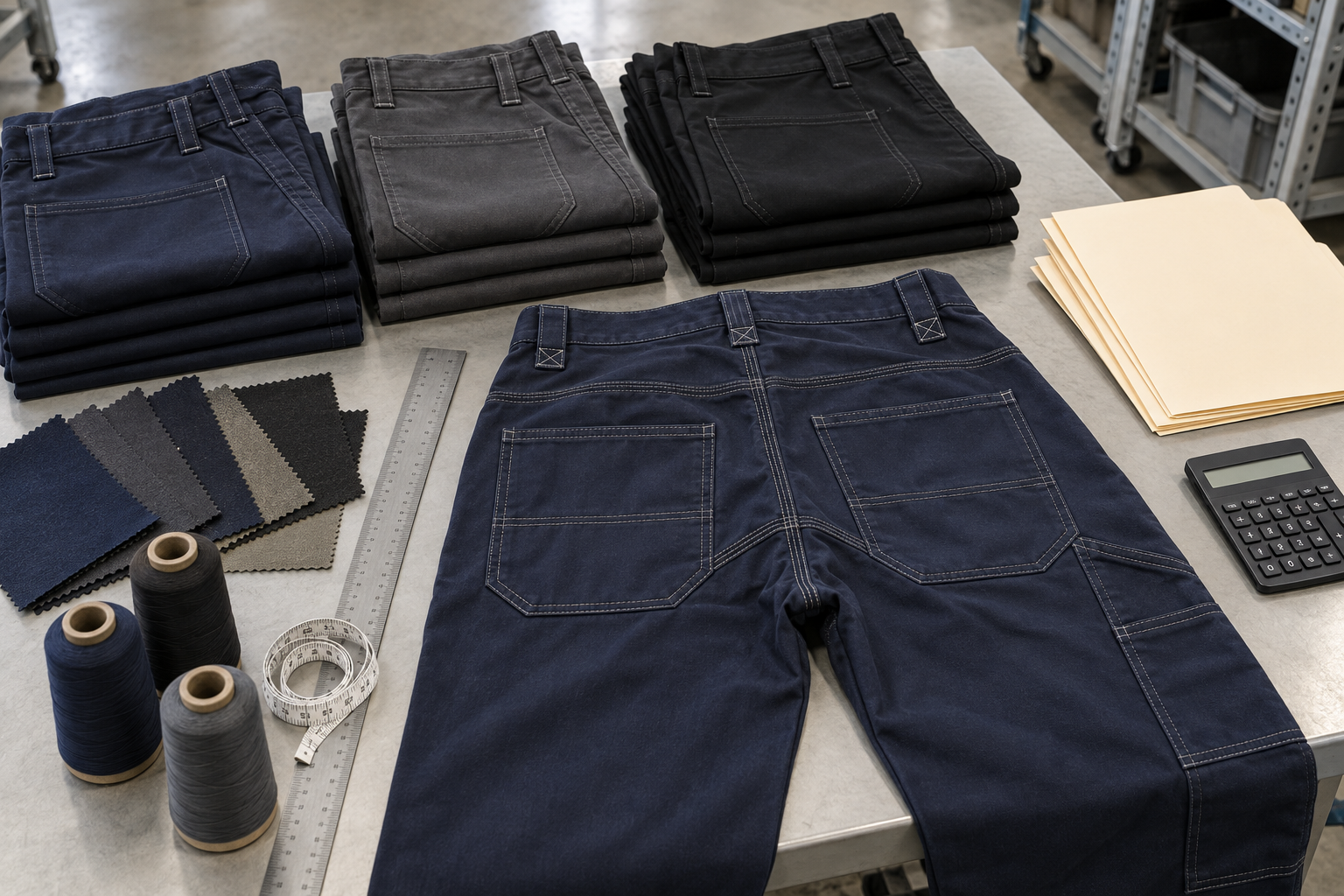
A European buyer should treat a work pant wholesale supplier financial stability assessment as a go or no-go gate before reserving factory lines, not as an afterthought once unit pricing is settled. For work pants in wholesale supply into Europe, the critical operational test is whether the manufacturing partner can finance piece goods, industrial trims, labour, and transit through the production window without relying on buyer deposit cash as emergency operating liquidity. A buyer must evaluate liquidity, leverage, operating margins, cash-flow quality, and customer concentration across the same corporate entity and reporting period before finalizing volume allocations. CreditPulse identifies these core disciplines as essential for supplier health reviews. Kodiak Hub links balance-sheet health, income statements, and cash-flow statements directly to commercial disruption vulnerability.
This assessment framework serves procurement professionals managing work-pants contracts distributed across European destinations. Accounting standards and statutory filing disclosures are not uniform across the region. Statutory requirements for an EU member state, regulatory arrangements in the EEA, and Companies House requirements in the UK each present distinct visibility thresholds; moreover, country-specific reporting exemptions mean one local filing standard cannot be assumed across all European jurisdictions. Procurement teams must isolate the exact legal entity that invoices the goods, identify its statutory filing jurisdiction, and establish which accounting standards govern its public or private accounts. Promotional group presentations must never substitute for the verified financial records of the actual operating sewing plant.
This article is published under the byline of Vincent Xi, Editorial Author, at https://www.vantaworkwear.com/authors/vincent-xi/. It does not report a factory visit, a wear test, a named customer result, or any certification.
Why financial stability assessment comes before capacity for work pants in Europe
Every production run of industrial work trousers locks up working capital in heavy cotton or poly-cotton fabrics, pocketing, metal closures, and dedicated sewing lines. An attractive FOB or DDP price per unit becomes an expensive liability if vendor cash flow is bottlenecked by overdue receivables, strained trade credit, or excessive dependence on one major client. The DealStream clothing-wholesaler due-diligence guide instructs evaluators to scrutinize historical revenue, gross margins, net profit, and EBITDA, followed by working capital metrics, accounts receivable ageing, payable turnover, debt structure, interest coverage, and operational cash flow. In wholesale work-pants supply, these ratios determine whether a production partner can purchase certified fabrics and pay factory wages on schedule.
According to Kodiak Hub, 81 percent of organisations were impacted by supplier issues recently (unit: percent of organisations; scope: surveyed organisations cited in Kodiak Hub's supplier financial risk publication, not a dedicated European procurement cohort; as-of context: recently reported in the cited reference without specifying an exact calendar year, sample size, or geographic region; source: Kodiak Hub). Sourcing managers should treat this metric as an indicator of systemic supply-chain disruption rather than a verified European bankruptcy rate. When a garment manufacturer faces severe cash shortages, piece-goods mill orders stall, leading directly to missed seasonal delivery dates in European logistics hubs.
Europe represents the primary destination market this analysis addresses. Manufacturing countries of origin represent production bases rather than target sales markets. Sourcing evaluations must score the contracting legal entity responsible for fulfilling European work-pants orders, regardless of sewing geography.
What statements and ratios to request
Procurement officers should require full financial statements covering at least two, and ideally three, sequential fiscal years: the balance sheet, income statement, and statement of cash flows. Because private apparel manufacturers rarely publish detailed audited accounts, CreditPulse highlights that commercial buyers should request these records directly under non-disclosure agreements or pull commercial credit dossiers from providers such as Dun & Bradstreet where reporting is maintained. The same source emphasises that periodic annual reviews provide weaker protection than active, continuous supplier monitoring.
All balance-sheet and performance ratios must be derived from the identical corporate entity across matching fiscal years.
Liquidity metrics. The current ratio measures total current assets against current liabilities. The quick ratio adjusts this baseline by subtracting inventory. In wholesale work-pants production, this adjustment is essential: specialized workwear work-in-progress and unsold finished trousers cannot be converted into cash rapidly if a liquidity crisis strikes. A favorable current ratio driven by bloated, aged trouser stock provides false security.
Leverage and debt coverage. Debt-to-equity calculates overall liabilities relative to shareholder equity. Interest coverage evaluates operating profit against scheduled interest charges—a metric pairing Kodiak Hub emphasizes for evaluating balance-sheet resilience. Multi-year trajectory is critical: escalating debt combined with declining interest coverage represents a significant continuity risk before booking production capacity.
Operating profitability. Net margin isolates net earnings against revenue, while return on assets measures net earnings relative to total corporate assets. DealStream stresses monitoring gross margins and EBITDA alongside net earnings to confirm that financing overhead or depreciation does not mask structurally unprofitable cut-and-make garment pricing.
Cash-flow discipline. Sourcing teams must cross-reference net profit with cash flow generated from operations within the same annual period. Consistent reported profits coupled with negative operating cash flows signal structural problems. Production scaling sustained entirely by customer prepayments, external borrowing, or delayed payments to cloth mills threatens delivery stability.
Customer exposure. CreditPulse includes revenue concentration as a foundational risk pillar. If a single client generates a dominant percentage of a factory's total revenue, the loss or slowdown of that client can instantly eliminate the cash required to procure cloth for other accounts. Buyers should require banded percentage figures if exact customer identities are shielded by commercial non-disclosure.
Example calculations to recompute from the supplier file
The following financial models serve as structured review templates. They do not represent an existing supplier, a Vanta Workwear commercial outcome, or an established credit pass mark. Sourcing analysts must recalculate each formula using the vendor's actual audited or certified statements. The label "currency units" denotes an unstated monetary unit without specific currency conversion. The designation "Year N" refers to the fiscal period marked on the submitted file, scoped strictly to a single contracting entity.
Example assumption A. Current assets stand at 2,400,000 currency units. Inventory is valued at 1,200,000 currency units. Current liabilities total 1,600,000 currency units. The current ratio is 2,400,000 divided by 1,600,000, yielding 1.50. The quick ratio is 1,200,000 divided by 1,600,000, yielding 0.75. In this model, the quick ratio falls below 1.00, demonstrating that short-term liquidity relies heavily on physical inventory liquidation. Procurement must clarify whether this stock consists of committed finished work pants, dead garments, or greige fabric.
Example assumption B. Total debt is 3,000,000 currency units, shareholder equity is 2,000,000 currency units, operating profit equals 450,000 currency units, and interest expense totals 150,000 currency units for the same entity in Year N. The debt-to-equity ratio is 3,000,000 divided by 2,000,000, or 1.50. Interest coverage is 450,000 divided by 150,000, equaling 3.00 times. A coverage margin of 3.00 times leaves minimal cushion if commercial lending rates rise or shipment milestones slip. Buyers must inspect the debt maturity schedule in addition to calculating the coverage multiple.
Example assumption C. Total revenue is 8,000,000 currency units, gross profit is 2,000,000 currency units, net profit is 320,000 currency units, operational cash flow is 40,000 currency units, and revenue from the largest customer equals 3,200,000 currency units. These figures yield an assumed gross margin of 25 percent, a net margin of 4 percent, and a single-customer concentration ratio of 40 percent. Because operating cash flow lags far behind net profit, earnings quality remains weak until working-capital movements are formally documented. These percentages represent mathematical outputs derived solely from the stated assumptions rather than apparel sector averages.
These simulated calculations should not be inserted directly into supply contracts; they demonstrate the verification steps required on active vendor documentation.
Measurable trade-offs when comparing wholesale supply partners
Price concessions against solvency risk. Sourcing from a lower-priced garment manufacturer with thin balance-sheet liquidity often introduces indirect costs if raw material suppliers demand advance cash payments or if production bottlenecks force emergency air freight to meet European launch dates. A financially stable manufacturer quoting a slightly higher make charge may present lower total-cost risk for European distribution. Buyers must compare total exposure—including deposit outlays, contingency air-freight allowances, and inventory delay costs—rather than base FOB pricing alone.
Payment structures against working capital safety. Reducing deposit percentages shields the buyer when a supplier displays an unconvincing quick ratio. However, restricted advance funding can strain the supplier's procurement budget, potentially triggering higher garment quotes. Procurement contracts should separate deposit limits, production progress milestones, and late-delivery penalties into distinct clauses to ensure credit adjustments do not compromise fabric specifications.
Production dedication against customer concentration. A specialized work-pants producer serving a narrow customer roster often delivers superior seam construction and fit consistency, yet carries heightened client-concentration risk. A larger, diversified garment enterprise provides financial stability across multiple categories but may treat small workwear orders as secondary priorities. A financial audit does not replace physical garment stress testing; it confirms whether the supplier will stay liquid if an unrelated major customer leaves during your order cycle.
Information transparency against documentation depth. Private sewing operations frequently withhold full balance sheets. Internal management accounts, verified banking references, trade insurer reports, or parent-company guarantees serve as limited proxies. Sourcing files must explicitly document any missing data. A corporate guarantee from an offshore holding entity that cannot be legally enforced against the local manufacturing subsidiary provides negligible security.
Audit frequency against management overhead. Because CreditPulse notes that annual checks offer limited protection compared to ongoing oversight, seasonal workwear buying requires a disciplined schedule: an in-depth financial audit before signing initial master service agreements, a streamlined review ahead of seasonal reorders, and an immediate mandatory reassessment if payment terms, management, or mill credit terms shift. This review schedule reflects an editorial procurement recommendation; it does not constitute a statutory requirement under EU directives, EEA agreements, or UK commercial law.
Financial documentation rules differ across jurisdictions even when ratio benchmarks align. Consolidated accounts, small-company reporting exemptions, and UK statutory submissions differ in disclosure depth and filing timeliness. A parent company's solvency ratios do not prove that an overseas cut-and-make factory has settled invoices with its twill and hardware suppliers. Procurement contracts must tie liability directly to the exact invoicing entity. Never assume an EU practice applies directly in the UK, or that an EEA framework operates uniformly across all individual EU member states.
Decision table for the financial stability assessment
Procurement managers should evaluate competing manufacturers against identical production parameters. The table below outlines concrete verification actions rather than subjective credit scoring.
| Assessment Area | Evaluation Focus | Strong Indicator | High-Risk Indicator | Procurement Action |
|---|---|---|---|---|
| Corporate Entity | Invoice name, production site, and accounts | Identical legal entity across purchase orders and accounts | Intermediary or parent holding company filed instead | Approve only the specific operating company under review |
| Liquidity Ratio | Current and quick ratios over 24 to 36 months | Consistent quick ratio above parity without inventory reliance | Current ratio inflated by stagnant trouser inventory | Mandate lower upfront deposits or onboard a secondary cutter |
| Working Capital | Accounts receivable and payable turnover | Customer collections match stated invoice windows | Payables stretched while mill lead times lengthen | Require accounts receivable ageing schedules with the formal RFQ |
| Debt Leverage | Total debt-to-equity and repayment terms | Declining debt or term liabilities with clear debt covenants | Short-term debt maturing during the production run | Request formal debt repayment schedules before booking lines |
| Interest Coverage | Operating income relative to debt servicing | Coverage multiple stable across consecutive cycles | Falling coverage multiple paired with rising short-term debt | Pause purchase order finalization until debt service is explained |
| Margin Stability | Gross margin, net margin, and EBITDA trends | Consistent gross margins on cut-and-make workwear | Non-operating gains masking falling operational margins | Re-evaluate volume commitments once core production margins are clear |
| Operating Cash Flow | Cash from operations compared to net income | Operating cash flow consistently mirrors or exceeds net profit | Declining cash flow alongside rising reported profit | Mandate cash-flow statement disclosures rather than summary sheets |
| Client Exposure | Percentage share of primary customer revenue | Balanced customer base without single-client reliance | One client accounts for a dominant revenue share | Qualify an audited backup facility for identical work trousers |
| Jurisdiction Scope | EU, EEA, UK, or overseas statutory filings | Statements clearly identify entity, jurisdiction, and dates | Undated group summary without clear corporate identity | Reject unverified corporate filings until origin is proven |
| Audit Review Cycle | Time elapsed since previous comprehensive review | Refreshed audit completed prior to seasonal booking | Review relying on historical records older than 18 months | Re-run verification assessments before committing follow-up orders |
Red flags that should pause or reshape the order
The following financial irregularities should prompt an immediate pause or restructuring of a wholesale order, though they require context rather than immediate disqualification:
- Expanding top-line revenue paired with persistent negative operating cash flow, without a documented rationale for working-capital expansion.
- A deteriorating receivables collection cycle occurring alongside supplier demands for increased cash deposits on work-pants orders.
- Commercial debt maturing directly within the scheduled cutting and assembly period without verified refinancing agreements.
- Progressively declining interest coverage multiples across the two most recent reporting years.
- Financial submissions reflecting an offshore parent, commercial agent, or non-operating affiliate that refuses to sign contractual performance guarantees.
- Complete refusal to provide banded customer concentration metrics. A benchmark where a single buyer represents 30 percent or more of overall volume provides an example threshold for commercial risk assessment, not an official regulatory ceiling (unit: percent of supplier revenue; scope: evaluated single entity; as-of: filing year; classification: example assumption).
- Refusal to submit multiple comparative financial years, running counter to trend-analysis guidance from CreditPulse and Kodiak Hub.
- Unexplained changes in accounting period end-dates or restated earnings files. Evaluators must never infer an unqualified audit opinion unless full documentation is supplied.
These risk signals represent commercial vetting criteria rather than standardized regulatory test standards. This document does not claim that any manufacturer, including Vanta Workwear, holds a verified third-party credit certification.
How the data was derived
This methodology synthesizes publicly available corporate finance and supply-chain risk publications; it is not derived from proprietary internal audits or non-public datasets. CreditPulse outlines the five foundational evaluation pillars: liquidity dynamics (current and quick ratios), leverage structures (debt-to-equity), multi-year profitability trajectories, operating cash-flow validity, and customer concentration limits. CreditPulse also highlights the limitations of annual reviews relative to ongoing vendor monitoring. Kodiak Hub provides the primary three-statement review framework and specific ratio categories—covering current ratio, quick ratio, net margin, return on assets, debt-to-equity, and interest coverage—as well as the 81 percent disruption benchmark, subject to the contextual limitations noted above. DealStream provides sector-specific guidance for apparel wholesalers, emphasizing top-line stability, gross margins, EBITDA, working-capital balance, receivables ageing, payable cycles, debt load, interest coverage, and operating cash flows.
The computational scenarios under Examples A, B, and C represent theoretical mathematical exercises designed to illustrate ratio mechanics. They rely on standardized currency units without third-party references. The recommended review schedule represents an editorial guideline tailored to wholesale apparel procurement: complete verification prior to initial volume commitments, a focused update prior to each seasonal buying window, and an immediate review if commercial ownership or payment terms shift. This review rhythm does not represent a standard from the cited literature. This guide incorporates no keyword search metrics, search volumes, or ranking projections.
What to verify and what this page does not prove
The referenced source frameworks outline financial assessment practices; they do not establish uniform pass-or-fail thresholds for work-pants manufacturers. The 81 percent disruption figure from Kodiak Hub must not be cited as a Europe-specific supply-chain failure rate, as its underlying sample group, geographic scope, and reporting dates are not specified in the source material. Private enterprise documentation is often abbreviated. Small-company statutory exemptions in specific EU member states permit the omission of detailed line items found in larger enterprise filings. Furthermore, EEA legal frameworks and EU member-state regulations are distinct, just as UK statutory corporate filings follow separate legal paths. Contractual procedures common in one European market cannot be presumed to operate across another.
Variations in accounting methodologies alter key ratios. Inventory valuation methods, accounts receivable factoring, capitalized operating leases, and owner loan balances materially impact calculated stability. Sourcing teams must verify whether assets were factored or owner obligations subordinated during the period in question. Favorable financial ratios at a parent-holding level do not ensure that an operational sewing entity possesses the liquidity to purchase twill fabrics. If purchase contracts are settled in euros while a manufacturer reports in an alternative currency, financial filings alone do not detail foreign-exchange hedging protections. Currency exposure must be clarified prior to issuing deposit payments.
This publication does not constitute a certified credit rating, credit insurance underwriting, or legal counsel, nor does it make claims regarding any individual supplier's solvency. Buyers must verify every figure against primary audited statements, confirming dates and corporate legal entities. Where an invoicing entity diverges from the entity documented in the balance sheet, the file cannot substantiate an order approval.
RFQ Checklist
- Ask the supplier to name the legal entity that will invoice European work-pants orders and to attach accounts for that same entity for at least two full years.
- Require the manufacturer to include a balance sheet, an income statement, and a cash-flow statement, plus receivable ageing and a debt maturity schedule, in the response.
- Specify that current ratio, quick ratio, debt-to-equity, interest coverage, gross margin, and net margin be recomputed from those statements, with period and currency labelled.
- Ask the supplier to state, in bands, the revenue share of the largest customer and whether losing that account would affect cloth bought for the season.
- Require the supplier to disclose related-party loans, receivable factoring, and any change of year-end in the periods provided.
- Specify a deposit cap, a balance-payment trigger tied to accepted shipment, and a qualified second source if quick-ratio or operating-cash evidence stays weak.
- Ask the supplier to state whether the accounts follow an EU member-state filing practice, an EEA context, a UK practice, or another country's rules, and not to treat one regime as valid for every European delivery.
- Require a dated refresh before each seasonal reorder and immediate notice if ownership, senior lenders, or payment terms change.
Approving the work pants order after the assessment
Approve wholesale work-pants contracts only when three basic verifications align: the contracting entity matches the legal entity documented in the financial accounts; the reporting period covers the active production cycle; and operating cash flows correlate with declared operating profits, or discrepancies are substantiated through formal filings. If a manufacturer demonstrates acceptable liquidity but shows excessive customer concentration, negotiate a restricted initial order volume while retaining an approved secondary factory for identical work trousers. If financial leverage is elevated but the manufacturer accepts a reduced upfront deposit backed by enforceable corporate guarantees, record that risk mitigation directly into the procurement agreement. If the vendor supplies only unverified, undated group overviews, pause the order.
Maintain technical garment construction, seam tolerances, size gradings, and packaging requirements on a dedicated technical specification sheet. Commercial solvency does not guarantee sewing precision, and a flawless pre-production sample does not prove a factory can finance repeat fabric orders. Within the European wholesale supply sector for work pants, complete both physical product validation and balance-sheet verification before signing binding supply contracts. Recalculate all financial metrics against original submitted statements, discarding theoretical examples A, B, and C once primary files are delivered. Retain all audited reports, evaluation dates, and auditor notes within the permanent vendor file.
Vincent Xi, Editorial Author, publishes this buying framework for European work-pants procurement. The supplier's own statements remain the only evidence of that supplier's financial position. A manufacturing address, a sample shipment, or a quoted unit price is not a substitute for the entity-level file.
Discuss Your Requirements
Review our manufacturing capabilities, then share your specifications for a supplier-fit review.