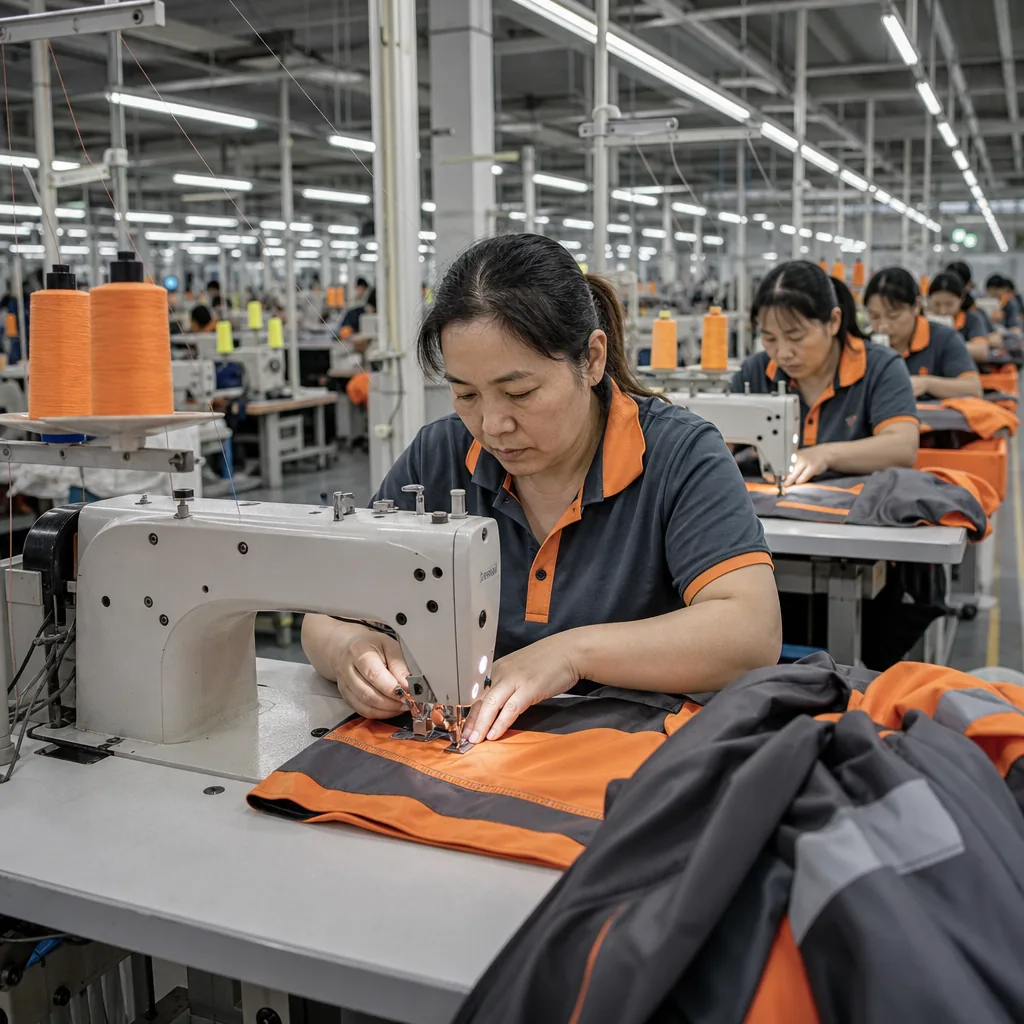
What a BSCI audit reviews in workwear factories
BSCI is commonly referenced through the amfori BSCI framework, a social compliance system used by many brands and retailers to assess supplier performance against labor and workplace expectations. In a workwear factory, the audit typically reviews employment records, working hours, wages, social insurance or statutory benefits where required by law, freedom of association, occupational health and safety, fire preparedness, dormitory conditions where applicable, and management systems for handling grievances and corrective actions.
For buyers, the key point is that a BSCI-style review is not about product quality alone. A factory may sew excellent jackets or uniforms, but still fail if records are incomplete, overtime is excessive, subcontracting is uncontrolled, or safety systems are weak. That is why social compliance should sit alongside your QA, fabric, and delivery checks from the start of sourcing.
Why buyers should care before sampling starts
The earlier you address compliance, the easier it is to avoid delays later. A supplier that cannot show basic labor and safety controls may also struggle with document discipline, traceability, and schedule reliability. In practice, buyers often use a social compliance audit as part of supplier onboarding, before bulk PO placement and sometimes before finalizing development for large programs.
- It helps confirm the factory is suitable for long-term OEM workwear programs.
- It reduces the chance of late-stage compliance objections from your procurement, legal, or ESG team.
- It gives you a baseline for corrective action if issues appear during production.
- It supports responsible sourcing claims only when the facts are documented and accurate.
Core evidence buyers should ask to review
A serious audit is evidence-based. You do not need every file, but you should expect a supplier to have structured records that demonstrate how the factory operates. In workwear sourcing, the strongest suppliers can usually provide clear documentation quickly and consistently.
| Audit area | What to review | Why it matters |
|---|---|---|
| Employment records | Contracts, age verification, personnel files | Confirms lawful hiring and worker identity control |
| Working hours | Attendance sheets, overtime approvals, rest-day records | Shows whether hours are managed within legal limits |
| Wages and benefits | Payroll, social insurance evidence where required | Checks payment accuracy and statutory compliance |
| Health and safety | PPE issue logs, machine guards, emergency drills, incident reports | Evaluates whether the workplace is controlled and prepared |
| Management systems | Internal audits, training records, corrective actions | Shows whether issues are tracked and resolved |
| Dormitory and canteen controls | If provided, housing rules and inspection logs | Important where the factory manages worker accommodation |
How BSCI differs from product compliance testing
It is easy to confuse social compliance with fabric or garment testing, but they answer different questions. Product compliance asks whether the garment performs as specified. Social compliance asks whether the factory makes it responsibly.
A practical way to separate the two
- Product compliance: fabric composition, color fastness, shrinkage, seam strength, PPE performance, and labeling accuracy.
- Social compliance: legal working age, wages, work hours, freedom of association, safety, and grievance handling.
- Operational compliance: document control, traceability, subcontracting control, and change management.
For custom workwear, buyers need all three layers. A technically strong garment is not enough if the sourcing model lacks worker protections or traceable production control.
Common findings in workwear programs
In real factory assessments, nonconformities often appear in administrative systems rather than on the sewing line itself. That is useful because many issues can be corrected with discipline and management attention. Typical findings include incomplete overtime approvals, inconsistent payroll calculations, unclear subcontracting records, missing machine maintenance logs, or insufficient emergency drill evidence.
- Document gaps: forms exist but are not signed, dated, or retained consistently.
- Timekeeping errors: attendance records do not match payroll or shop-floor reality.
- Safety weaknesses: blocked exits, missing training records, or overdue equipment inspections.
- Subcontracting risk: unapproved outside work that is not fully traceable.
- Worker communication gaps: grievance channels exist but are not clearly understood by staff.
How to evaluate remediation, not just the audit result
A pass/fail mindset is often too simplistic. Many buyers care more about whether a supplier can identify root causes and close findings on time. A factory that responds quickly with evidence, retraining, and revised controls may be a better long-term partner than one that looks perfect on paper but has weak follow-through.
- Ask for a corrective action plan with owners and deadlines.
- Check whether actions are preventive, not just cosmetic fixes.
- Verify whether the supplier has updated procedures, not only one-off approvals.
- Revisit the issue in the next order cycle or follow-up audit.
Questions buyers should ask an OEM supplier
Use direct, practical questions when screening factories for custom uniforms and industrial workwear programs. The answers should be specific, current, and supported by records.
- Have you completed an amfori BSCI or equivalent social audit within the last cycle?
- Who is responsible for labor compliance, safety, and corrective actions?
- Do you subcontract any steps such as embroidery, printing, or washing, and how is that controlled?
- How do you track overtime and rest days across peak production periods?
- Can you show a recent safety drill, training record, and incident log?
- How do you handle worker grievances and confidentiality?
Practical tips for sourcing teams
A good sourcing process makes compliance visible early. When you request quotes, ask for the factory’s compliance overview alongside capacity, lead time, and QC capability. During development, confirm whether any decoration or finishing steps may be outsourced. Before bulk production, align on which records you may need for customer audits or internal ESG review.
If you are building a multi-style uniform program, it can help to combine supplier onboarding checks with your workwear tech pack review and your own internal approval steps. That way, compliance is treated as part of program design rather than an afterthought.
What a strong factory partnership should look like
The best OEM partners treat social compliance as part of daily operations. They maintain organized records, train supervisors, correct issues promptly, and keep production realistic rather than overpromising. For buyers, that usually translates into fewer disruptions, clearer communication, and more confidence that bulk workwear orders can be delivered responsibly.
If you are comparing suppliers, look for consistency: the same factory that can explain its labor records clearly, show its safety controls, and support corrective actions is usually better prepared for long-term B2B workwear programs than a supplier that only answers quality questions.
Need a compliant workwear supplier shortlist?
If you are planning a custom uniform or industrial workwear program, we can help you review factory capabilities, compliance readiness, and production fit before you place bulk orders.
Request a quote →