Start with the job the garment must do
A capable custom workwear manufacturer should ask what the wearer does before discussing unit price. Office uniforms, warehouse polos, chef coats, high-visibility jackets, cargo trousers, and insulated outerwear fail in different ways when the specification is vague. Define the work environment, climate, laundering method, expected wear life, storage conditions, and whether the garment needs visibility, flame resistance, water resistance, abrasion resistance, stretch, or extra pocketing. This protects the budget because it prevents overbuilding where a simple fabric is enough and underbuilding where failure would be costly. A warehouse vest may need durable binding and compliant reflective tape placement more than a premium shell fabric, while a maintenance trouser may need reinforced knees, bar tacks, and a stable waistband. If you are comparing supplier models, our overview of OEM clothing manufacturing explains how production responsibility changes from design-only sourcing to full-package manufacturing.
Verify standards before accepting safety claims
Many workwear programs include safety language, but not every uniform is personal protective equipment. A responsible supplier will distinguish ordinary branded apparel from garments designed and tested to meet a standard. Common references include EN ISO 20471 for high-visibility clothing, ANSI/ISEA 107 for high-visibility safety apparel and accessories in the United States, ISO 13688 for general protective clothing requirements, EN 343 for protection against rain, and ISO 11612 for protective clothing against heat and flame. These standards are not interchangeable. A factory should not claim compliance unless the fabric, trims, reflective materials, design, labeling, and testing support that claim. For flame-resistant or arc-rated garments, buyers should work from the required hazard assessment and local regulations rather than asking for a generic “FR uniform.” Ask for current test reports where relevant and confirm whether testing covers only fabric components or the finished garment.
Evaluate fabric knowledge, not swatch cards
- Ask for composition, construction, weight, finish, shrinkage tolerance, colorfastness expectations, and recommended care method. A professional answer should be specific, not simply “durable polyester” or “good cotton.”
- For cotton-rich workwear, confirm dimensional stability and whether fabric pre-shrinking or garment washing is needed. For poly-cotton uniforms, check pilling resistance, shade consistency, and heat sensitivity during decoration.
- For stretch workwear, discuss recovery after repeated movement and laundering. A fabric can feel comfortable in sampling yet bag out at knees and elbows if the elastane content or weave is poorly matched to the job.
- For outerwear, separate water-repellent finishes from waterproof constructions. Durable water repellent treatment helps shed light rain; waterproof performance usually depends on coating, membrane, seam construction, and garment design.
- For high-visibility garments, do not accept vague claims. The visible background material, reflective material, garment class, placement, and care instructions must all align with the target standard and end market.
Check sampling discipline before bulk production
- Begin with a clear tech pack or reference sample that includes measurements, tolerances, fabric details, trims, logo placement, color references, packaging, and labeling requirements.
- Request a development sample when the design is new. This stage verifies construction, silhouette, pocket function, range of movement, and decoration feasibility before bulk materials are committed.
- Use a fit sample or size-set sample to confirm grading across the required size range. Workwear often needs broader sizing than fashion apparel, including room for movement, layering, and regional body-shape differences.
- Approve a pre-production sample made with bulk fabric, trims, and decoration whenever possible. This is the sample that should guide the production line and final inspection.
- Lock written approvals. Changes after approval can affect fabric yield, lead time, cost, and consistency. A disciplined sample record is one of the clearest signs of a reliable factory.
Inspect construction details that affect wear life
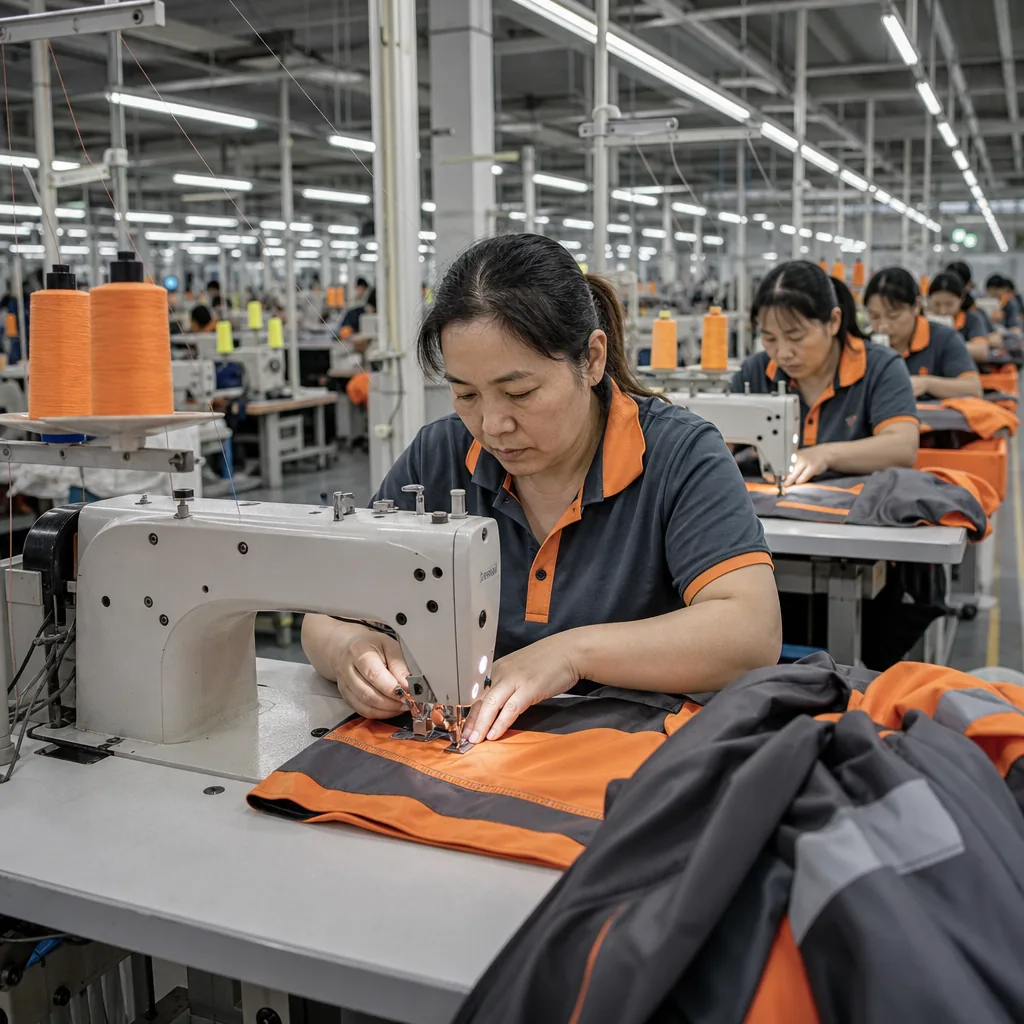
Workwear quality is often hidden in small decisions: seam type, stitch density, reinforcement, pocket shape, zipper grade, snap strength, waistband construction, interlining, bartack placement, and how stress points are finished. A shirt that looks acceptable on a hanger may fail after repeated industrial laundering if seam allowance is too narrow. Cargo pockets may sag if the fabric is heavy but the pocket mouth is not reinforced. Reflective tape may peel if the heat application is wrong or if the tape is not suited to the fabric and wash cycle. When reviewing samples, turn the garment inside out. Check loose threads, skipped stitches, puckering, twisted legs, uneven plackets, shade variation between panels, and whether left and right components match. For recurring programs, keep a sealed approval sample and a measurement chart for every style so incoming lots can be compared objectively.
Treat branding as an engineering step
Logo decoration is not only a visual choice. Embroidery, screen printing, heat transfer, woven patches, rubber patches, and sublimated elements each interact differently with fabric weight, stretch, coatings, waterproof layers, and laundering. A thick embroidered logo may look premium on a fleece jacket but feel uncomfortable on a lightweight polo. A heat transfer may look sharp on softshell but require testing for wash resistance and temperature sensitivity. Reflective or high-visibility garments need special care because decoration must not reduce the compliant visible area or create confusion with required reflective components. Specify logo size, placement, color reference, and acceptable variation. The safest approach is to approve decoration on the actual bulk fabric, not on a generic swatch. For more detail, see our guide to logo branding options.
Compare MOQ, lead time, and cost honestly
- MOQ is affected by fabric availability, dyeing requirements, trims, decoration method, size spread, and style complexity. A low MOQ is easier when the design uses stock fabric and common trims.
- Lead time should be separated into sampling, material preparation, bulk cutting, sewing, decoration, finishing, inspection, packing, and freight. This avoids unrealistic promises.
- Unit price should be compared against the same specification. A cheaper quote may use lighter fabric, fewer reinforcements, lower-grade zippers, simpler packaging, or less inspection time.
- Size ratios influence cost and risk. Very large or very small sizes consume different fabric quantities and may require pattern adjustments, especially for inclusive workwear programs.
- Repeat orders are usually more efficient when patterns, approved samples, fabric records, and decoration files are maintained properly. Ask how the factory controls version history.
Use QC checkpoints, not one final inspection
Final inspection is important, but it should not be the first time quality is checked. Strong workwear production uses incoming material inspection, fabric shade control, shrinkage checks where needed, cutting-room audits, inline sewing checks, decoration testing, measurement reviews, and final AQL-based inspection when appropriate. AQL, commonly associated with ISO 2859-1 sampling procedures, is a method for sampling inspection, not a guarantee that every piece is perfect. For critical safety garments, buyers may require stricter controls or additional testing. At minimum, define major defects, minor defects, measurement tolerances, packaging rules, carton markings, and acceptable repair procedures before production begins. Photos and inspection reports should be traceable to the purchase order, style, color, size range, and production date. This is especially important for distributors, rental uniform providers, and brands managing multiple end customers.
Choose a partner that communicates in production terms
The best supplier relationship feels practical and specific. Instead of saying yes to every request, a good factory explains trade-offs: which fabric is available, which trim needs longer sourcing time, why a seam should be changed, how a logo method affects wash durability, and what inspection point will catch a likely defect. For international buyers, export experience also matters. Confirm carton packing, barcode or SKU requirements if needed, shipping marks, documentation, and whether the supplier can support repeat orders with consistent records. If you are sourcing multiple categories, review whether the factory can coordinate shirts, trousers, jackets, aprons, vests, and accessories into one coherent program. A custom workwear manufacturer should ultimately reduce operational risk: clearer specifications, stable quality, predictable delivery, and garments that people are willing to wear every day.
Build a clearer workwear specification
Share your garment type, target market, fabric needs, logo method, quantity, and timeline. Vanta Workwear can review the specification and suggest practical OEM production options.
Request a quote →