What EN 343 covers
EN 343 is the European standard for protective clothing against rain. It applies to garments and clothing assemblies intended to protect the wearer from precipitation, fog, and ground humidity. In sourcing practice, it is most relevant for jackets, trousers, coveralls, and shell layers used in construction, transport, utilities, logistics yards, and field service.
For buyers, the value of EN 343 waterproof workwear is that it creates a common language between brand, factory, and test lab. Instead of asking for a garment that is merely waterproof, you can ask which edition was used, whether the evidence covers the complete garment, and how seams and closures were built. That matters when comparing coated fabrics with laminates or moving from a salesman sample to bulk production.
How classification works in buying practice
EN 343 evaluates rainwear in two main areas: resistance to water penetration and resistance to water vapour. Buyers often see these shown as separate classes on product documentation and markings. Higher classes indicate stronger performance within the standard, but the practical question is whether the tested item truly matches the quoted product.
| Criterion | What it measures | Why buyers should care |
|---|---|---|
| Resistance to water penetration | How well material and garment resist rain passing through | Directly affects dryness in prolonged wet conditions |
| Resistance to water vapour | How easily perspiration moisture can escape | Affects comfort, heat build-up, and user acceptance |
| Seam integrity | Whether stitched seams remain protected after sealing | Weak seam sealing can undermine a strong fabric |
| Garment construction | How flaps, cuffs, hood, and closures support protection | Design details shape real-world performance |
A frequent sourcing mistake is to focus on a membrane or coating claim alone. EN 343 performance depends on the finished product, not just one fabric statement. Needle holes, seam tape compatibility, zipper shielding, cuff design, and hood coverage all influence whether water stays out during use.
Edition changes and report checks
Older EN 343 references are still common in the market, so report review matters. Earlier editions were often cited with class formats familiar to many buyers. The currently referenced version in the EU market is EN 343:2019 for protective clothing against rain, with updated marking and information requirements. Some documentation may also mention optional finished-garment rain tower testing. Because formats can vary by edition, ask for the full report rather than relying on a catalog icon.
- Ask the supplier to identify the exact EN 343 edition used by the lab.
- Check whether evidence covers fabric only or the completed garment.
- Verify that sample description, materials, and closures match your BOM.
- If fabric, seam tape, or construction changes, review whether retesting is needed.
What EN 343 does not tell you
EN 343 addresses rain protection and moisture-related comfort, but it does not automatically cover other workplace hazards. A jacket can meet EN 343 and still be unsuitable if users also need high visibility, flame resistance, antistatic properties, arc protection, or chemical protection. Those requirements must be specified separately and combined in the garment design where needed.
It also does not replace wear trials. Two garments with similar classifications may feel very different because of fabric weight, pattern shape, ventilation features, and layering strategy. Procurement teams buying for roadside crews or industrial users should review related requirements in our certifications articles before approving a final specification.
- It does not guarantee abrasion life on rough job sites.
- It does not prove every colorway performs identically unless controlled or tested.
- It does not confirm decoration methods will preserve waterproof integrity.
- It does not determine warmth, because insulation is a separate design choice.
Materials and construction that affect compliance
Most EN 343 rainwear uses polyester or polyester-cotton face fabrics with PU or PVC coatings, or laminated constructions with waterproof breathable layers. Coated fabrics are often economical and durable, while laminates may offer lower weight and better moisture management. Neither option is automatically better; the right choice depends on weather exposure, wear duration, laundering expectations, and target cost.
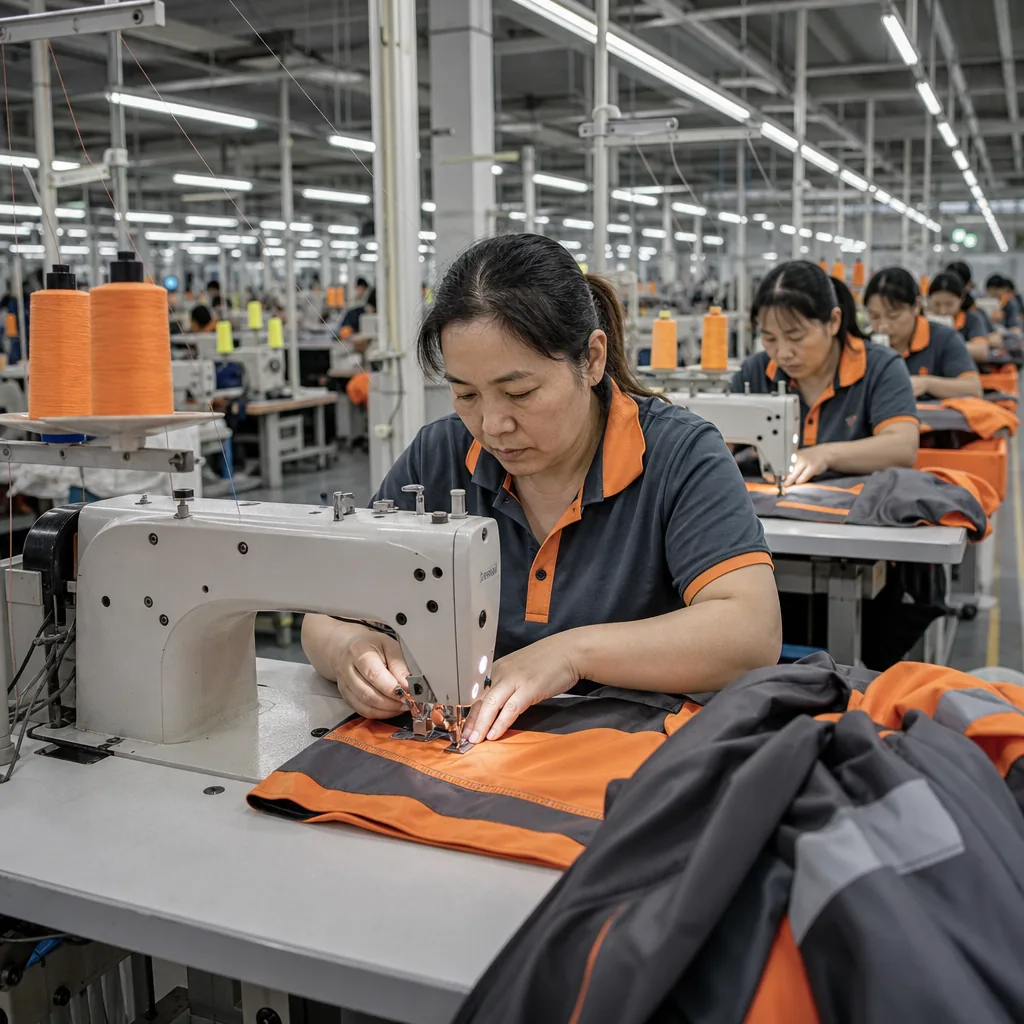
Construction discipline matters just as much as material choice. A factory needs seam tape that matches the coating or laminate, controlled temperature and pressure during application, and sewing settings that do not damage the barrier. Closures and pockets also need attention. A premium fabric can still fail in the field if tape lifts, zippers leak, or pocket openings channel water inward.
Practical build points to review
- Seal all critical exposed seams consistently.
- Confirm storm flaps, zipper garages, cuff tabs, and hood adjustment details.
- Review pocket entry design to reduce water ingress.
- Match the barrier system to expected laundering and wear cycles.
- Keep approved seam-sealed panels and swatches for QC comparison.
Decoration and branding without compromising protection
Branding choices can affect waterproof performance, so they should be reviewed early in development. Embroidery can puncture barrier zones if placed directly on exposed shell panels. Heat-applied graphics may be easier to control, but they still require compatibility checks for adhesion, flexibility, and durability after washing. Placement planning is often more important than the decoration method itself.
For custom programs, ask the factory to identify safe branding zones and test any critical application on the actual shell fabric. If you are planning decorated rainwear, review branding options alongside your technical package so the approved design does not conflict with seam sealing or waterproof panels.
How to review supplier test documents
When a supplier offers EN 343 rainwear, request the underlying lab report instead of accepting a one-line claim. A useful review should include the laboratory name, the standard reference, the sample description, and enough technical information to connect the result to your proposed bill of materials. If a mill, coating supplier, seam tape, or zipper system is later substituted, the original report may no longer represent production.
Buyers should also separate fabric evidence from garment evidence. Fabric tests can show potential, but finished-garment performance depends on seam sealing and construction quality. In OEM programs, it is good practice to lock the BOM at pre-production stage and compare bulk output to the approved reference. For a wider view of factory coordination, see our OEM workflow guide.
RFQ questions for OEM rainwear projects
A capable supplier should discuss waterproofing as a system, not only as a fabric feature. During quotation and development, ask how seam sealing is applied, what in-line checks are used, and how the factory controls tape lifting, skipped sections, or leakage at stress points. The strongest partner is often the one with tighter process control, even if the first quoted price is not the lowest.
- Is the garment for short exposure or all-day outdoor use?
- Will workers layer the shell over fleece or insulated garments?
- What climate is expected: cool-wet, tropical, windy, or mixed seasonal use?
- Which branding placements must avoid waterproof critical zones?
- Who is responsible for development and confirmation testing costs?
- What in-line and final QC checks are used for seam sealing and closures?
Need help specifying compliant rainwear?
We help procurement teams turn EN 343 requirements into practical OEM specs, from fabric selection and seam sealing to sampling, decoration, and bulk QC for branded workwear.
Request a quote →Final takeaway for procurement teams
EN 343 works best as a specification and verification tool, not a marketing slogan. It helps buyers define the rain protection they need, verify whether a supplier tested the right construction, and reduce risk when moving from sample approval to bulk production. A reliable process is straightforward: define the job, lock the BOM, review the full report, validate the sample, and control substitutions tightly. Done well, EN 343 becomes a practical framework for buying rainwear with more confidence.