What EN 343 actually covers
EN 343 is the European standard for protective clothing against rain. It is used for garments intended to protect against precipitation, fog, and ground moisture in wet conditions. In practice, that usually means rain jackets, overtrousers, bib trousers, and some protective coveralls used in industrial, logistics, construction, utilities, and transport settings.
The standard focuses on two main performance areas: resistance to water penetration and resistance to water vapour. The first relates to keeping external water out. The second relates to how readily perspiration vapour can escape, which affects thermal comfort during physical work. For B2B buyers, both matter. A jacket that blocks rain but traps sweat can still perform poorly on the job.
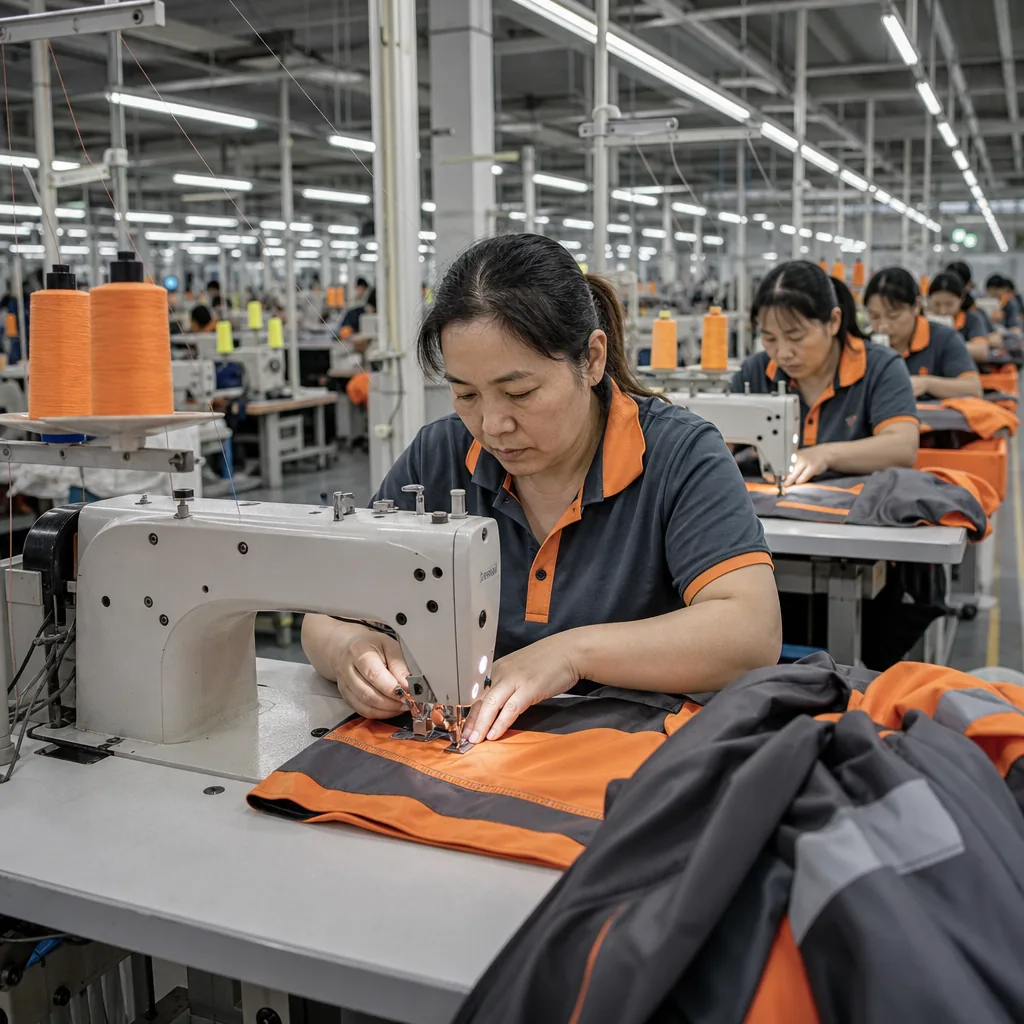
One point buyers often miss is that compliance depends on the tested product configuration. Fabric, seam construction, seam sealing, closures, and garment design all influence the result. If you develop a style with an OEM clothing manufacturer, the approved sample, bill of materials, and bulk production method need to remain aligned with the tested specification.
Which edition and marking buyers should expect
Buyers should ask which edition of the standard the garment is assessed to. The current reference commonly seen in the market is EN 343:2019, which replaced the older 2003 edition. Under EN 343:2019, the marking is typically shown as X,Y plus, where relevant, an optional rain tower symbol result for tested finished garments. In simple terms, X refers to water penetration resistance and Y refers to water vapour resistance.
This is also where terminology causes confusion. In EN 343:2019, water penetration resistance is classified from 1 to 4, with 4 being the highest. Water vapour resistance is also classified from 1 to 4, but here a higher class indicates lower water vapour resistance and therefore worse breathability. Buyers should not assume that a larger number is always better on both sides of the marking.
| Marking element | What it measures | Buyer interpretation |
|---|---|---|
| X | Resistance to water penetration | Higher class generally means better rain barrier performance |
| Y | Resistance to water vapour | Lower resistance is better for breathability; check the class carefully |
| Optional rain tower result | Finished garment leakage performance under rain simulation | Useful confirmation that seams and construction support the fabric claim |
Because of that distinction, two garments can both meet EN 343 and still suit very different use cases. A heavy-duty rain suit for prolonged exposure may prioritize maximum water barrier performance, while a lighter shell for active maintenance crews may need a stronger balance between weather protection and moisture management.
Why seams and finished construction matter
A common sourcing mistake is to focus only on the shell fabric or membrane. In rainwear, seams are often the most vulnerable points. Needle holes create potential water entry paths, and even a strong laminated fabric can underperform if seam tape, stitch density, or sealing conditions are poorly controlled.
- Confirm whether the approved style uses fully taped seams or only critical seam sealing.
- Check that bulk production uses the same seam tape specification, width, and application settings as the tested sample.
- Review exposed areas such as hood joins, shoulder seams, zipper fronts, pocket openings, cuffs, and hem constructions.
- Ask whether decoration, alterations, or size-pattern changes could affect waterproof integrity.
- Make sure care instructions are realistic, because laundering and reproofing practices can change long-term performance.
Factory controls matter here. During inline and final inspection, QC teams should check seam tape adhesion, lifting, puckering, skipped sealing, contamination, and early delamination. Buyers who want tighter production control often connect compliance review with AQL inspection planning.
Breathability is a functional issue, not a luxury
In workwear sourcing, breathability is sometimes treated as a premium add-on. That is the wrong frame for many applications. Workers who walk sites, load vehicles, climb access routes, or perform maintenance can generate substantial body heat even in cold and wet weather. If vapour cannot move out through the garment system, inner layers may become damp from perspiration.
That can reduce comfort, increase chill during low-activity periods, and lower user compliance with required PPE. For that reason, the best buying decision is rarely based on waterproofness alone. EN 343 should be read alongside garment ventilation, layering allowance, lining choice, and mobility features such as articulated sleeves, adjustable cuffs, storm flaps, and hood design.
Questions buyers should ask suppliers
- Which edition of EN 343 applies, and can you provide the supporting test report or certificate from a competent test laboratory or certification body?
- Does the claim relate only to the fabric, or to the finished garment including seams and closures?
- Were the exact bulk materials, linings, seam tape, zippers, and trims used in the tested sample?
- What washing or care conditions were used for testing, and how do those conditions compare with the intended use program?
- If logos are added, will embroidery, badge attachment, or heat-applied branding affect waterproof performance?
- Can pre-production samples be approved again if there are any material or pattern changes after testing?
Branding needs special care on waterproof shells. Needle-based decoration can puncture a barrier layer and create leakage points unless the area is resealed or designed around the decoration method. On some styles, heat transfer or patch application is more suitable than direct embroidery. See logo branding options when planning decoration on coated or laminated fabrics.
EN 343 is only one part of a PPE specification
EN 343 does not cover every hazard on a jobsite. It addresses protection against rain, but other risks may require additional standards depending on the task and risk assessment. For example, roadside or rail applications may also require high-visibility clothing, while some industrial environments may need flame-resistant, antistatic, or arc-rated garments. Buyers should build the specification around the actual hazard profile, not around a single mark.
This broader review also affects material selection. A lightweight shell may improve wearer acceptance, but higher abrasion or contamination risk may call for a tougher face fabric, reinforcement, or different garment architecture. Compliance, durability, and wear comfort should be reviewed together during development and wearer trials.
Common buying mistakes
- Assuming all waterproof garments are EN 343 compliant.
- Reading both class numbers as if higher is always better.
- Accepting a certificate without checking whether it covers the finished style being purchased.
- Changing fabric, seam tape, zipper type, or decoration method after approval without reassessing compliance risk.
- Ignoring breathability and focusing only on rain barrier performance.
- Skipping wearer trials for climates, shift lengths, and activity levels that differ from the lab scenario.
What to include in your RFQ and tech pack
If you are sourcing EN 343 waterproof workwear, your RFQ should define more than color and logo placement. Include the end use, climate, expected layering, target class if known, shell construction, seam sealing requirement, hood design, closure system, pocket layout, branding method, and care-label expectations. The clearer the package, the easier it is for the supplier to judge whether the style can realistically support the compliance target.
For custom programs, connect the compliance goal to the product design from the start. That may mean reviewing suitable products, aligning with a wholesale uniform program, and documenting any approved substitutions before bulk launch. EN 343 is valuable because it provides a recognized framework for rain protection, but the purchasing decision should still be based on whether the tested garment, the production garment, and the real end-use conditions truly match.
Need EN 343-ready OEM support?
We help buyers develop weather-protective workwear with the right fabric, seam construction, decoration method, and factory QC controls for bulk production.
Request a quote →